Geotechnical Engineering Roadmap (2026): Mastering Soil Mechanics & Subsurface Engineering
Learn how to engineer the ground beneath civil structures. Master soil phase relations, Terzaghi effective stress, consolidation settlement, deep foundation load transfer, and slope stability analysis.

What's in this guide
The Short Answer: Geotechnical Engineering in 2026
Every building, highway, tunnel, and dam rests upon soil or rock. Because natural ground is heterogeneous, non-linear, and filled with groundwater, geotechnical engineering is one of the most intellectually challenging and safety-critical disciplines in civil engineering.
In 2026, geotechnical engineers employ advanced in-situ testing (CPTu, seismic dilatometer), 2D/3D finite element geomechanics (PLAXIS), and probabilistic risk assessment to design resilient infrastructure on soft soils, seismic liquefaction zones, and steep slopes.
Water rules soil behavior. Pore water pressure reduces Terzaghi effective stress (σ' = σ - u); failure to manage groundwater seepage is the root cause of over 80% of foundation and slope failures.
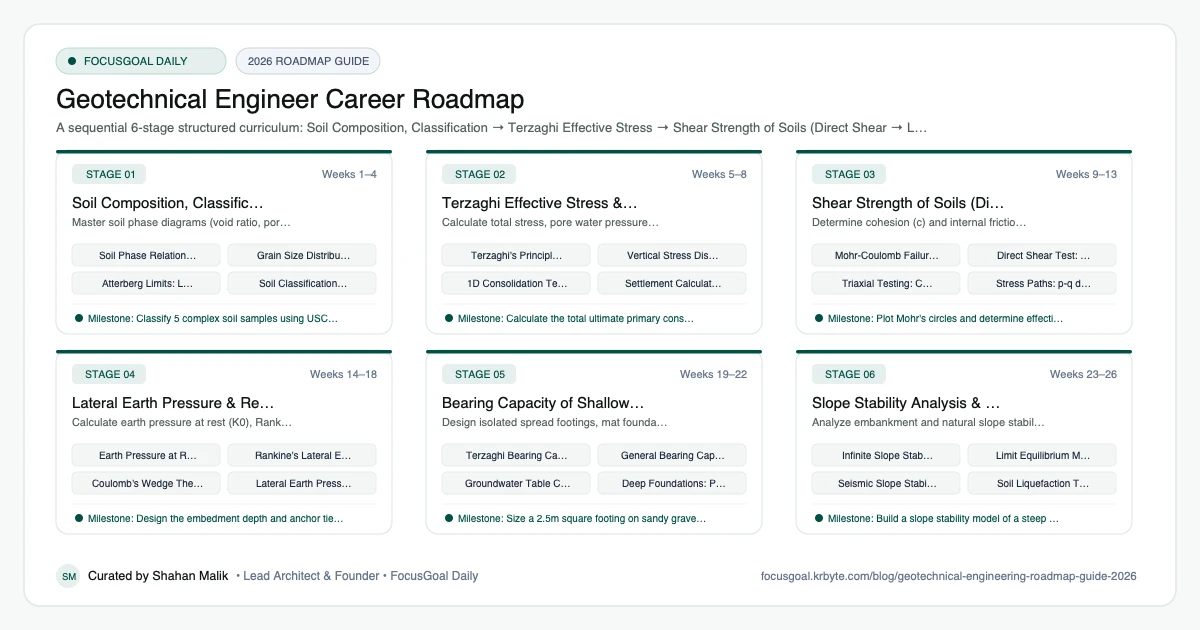
The 6 Production Stages
Follow these structured, sequential stages to systematically build production competence:
Soil Composition, Classification & Permeability
Master soil phase diagrams (void ratio, porosity, saturation), sieve grain size curves, Atterberg limits, and Darcy's seepage law.
Terzaghi Effective Stress & 1D Consolidation
Calculate total stress, pore water pressure, effective stress profiles, primary consolidation settlement, and time-rate of consolidation.
Shear Strength of Soils (Direct Shear & Triaxial Testing)
Determine cohesion (c) and internal friction angle (φ) using direct shear, unconfined compression, and triaxial testing.
Lateral Earth Pressure & Retaining Walls
Calculate earth pressure at rest (K0), Rankine active/passive states, Coulomb wedge theory, and retaining structure stability.
Bearing Capacity of Shallow & Deep Foundations
Design isolated spread footings, mat foundations, and driven/drilled deep piles using Meyerhof and Vesic equations.
Slope Stability Analysis & Numerical Modeling (GeoStudio/PLAXIS)
Analyze embankment and natural slope stability using limit equilibrium methods and 2D finite element geotechnical models.
Is Geotechnical Engineering a Good Career in 2026?
Geotechnical engineering supports almost every construction project because everything is built on or in the ground. Demand follows construction, infrastructure, energy projects, and hazard assessment such as slope stability and earthquake effects.
Caveats: the work often includes fieldwork in weather and remote locations, ground conditions are uncertain so judgment matters, and licensing is typically important. Check official labour statistics and local firms for demand. This article is general education, not design advice.
- Good fit if you like outdoor work combined with analysis.
- Ground uncertainty means experience counts heavily.
- Work ranges from site investigation to design and monitoring.
Software & Tools Geotechnical Engineers Use
Geotechnical work combines field and laboratory testing with analysis software. Understanding the tests behind the data matters as much as running the software.
Results depend on ground investigation quality, so learn to interpret borehole logs critically.
- Analysis: PLAXIS, GeoStudio, Slide, LPILE, and similar tools.
- Data and logging: gINT, Leapfrog, or comparable log software.
- Field tests: SPT, CPT, and plate load tests as general concepts.
- Lab tests: grain size, Atterberg limits, consolidation, triaxial.
- Mapping: GIS tools such as QGIS or ArcGIS.
Degrees, Licensing & How to Get Your First Geotechnical Engineering Job
Most geotechnical engineers start with a civil engineering bachelor's degree and often take a master's degree with soil mechanics focus. In the US, FE and PE exams apply, with PE often needed for signing designs. Other countries use chartered or registered routes. Requirements vary, so check your local licensing body.
Entry roles often begin with site investigation, logging, and lab testing. Internships with geotechnical consultancies or contractors, plus a project interpreting a real or sample borehole dataset, help show you can work with uncertain data.
- Seek internships involving fieldwork and lab testing.
- Take soil mechanics and foundations electives seriously.
- Practice interpreting borehole logs and test results.
- Check local registration requirements early.
Beginner Pitfalls vs Production Reality
Self-taught developers commonly waste months making avoidable structural mistakes. Here is how production engineers approach these challenges:
Master Geotechnical Engineering with FocusGoal Daily
Geotechnical engineering combines empirical lab test standards, multi-phase mechanics, and subsurface foundation equations. FocusGoal Daily turns this wide syllabus into disciplined daily milestones.
- Daily micro-tasks for effective stress math, bearing capacity factors, and consolidation equations.
- Track study streaks offline while out on geotechnical drill rigs and field sampling sites.
- Instant AI tutor explanations for Casagrande charts, Terzaghi pore pressures, and triaxial stress paths.
Track this roadmap,
one topic at a time.
Download FocusGoal, pick this roadmap and finish your first daily topic in minutes.
Frequently Asked Questions
What software is standard in geotechnical engineering firms?
The GeoStudio suite (SLOPE/W, SEEP/W, SIGMA/W) and Rocscience suite (Slide2, RS2) are industry standards for limit equilibrium slope stability and seepage. PLAXIS is the global benchmark for advanced finite element geomechanics.
How important is field experience for a geotechnical engineer?
Indispensable. Geotechnical engineers must log soil borings, inspect Standard Penetration Tests (SPT), oversee Cone Penetration Testing (CPT), and inspect foundation excavations to understand real geological variability.
What is soil liquefaction?
Soil liquefaction occurs when loose, saturated granular soils (sands and silts) lose shear strength due to rapid increase in pore water pressure during earthquake shaking, causing the ground to temporarily behave like a dense liquid.
What does a geotechnical engineer do?
A geotechnical engineer investigates soil and rock conditions and designs foundations, slopes, retaining structures, and earthworks. Work includes planning site investigations, analysing results, writing reports, and monitoring construction.
Is geotechnical engineering hard?
It is challenging because soil behaviour is variable and data is incomplete. Strong fundamentals in soil mechanics and good engineering judgment develop with experience.
How long does it take to become a geotechnical engineer?
A bachelor's degree usually takes about four years, and many practitioners add a master's degree. Licensing timelines vary by country.
Geotechnical vs structural engineering: what is the difference?
Geotechnical engineering deals with the ground, while structural engineering deals with the building or bridge above it. They collaborate on foundations.
Do I need a PE license to be a geotechnical engineer?
Often it is needed to sign off designs in many jurisdictions, though not for all entry-level tasks. Rules differ by country, so check with your local board.
Start Your Geotechnical Engineer Today
Follow structured daily goals, study 100% offline with local SQLite, and get on-demand AI guidance with FocusGoal Daily on Android.
Get FocusGoal Daily Free on Google Play