Environmental Engineering Roadmap (2026): Engineering Clean Water, Air & Ecosystems
Learn how to protect public health and the natural environment. Master water treatment plant design, biological wastewater purification, atmospheric dispersion modeling, and contaminated site remediation.
What's in this guide
The Short Answer: Environmental Engineering in 2026
Environmental engineering protects human health and ecological systems from toxic pollution. In 2026, environmental engineers are at the forefront of eliminating PFAS 'forever chemicals' from drinking water, retrofitting municipal plants for zero-energy recovery, capturing carbon emissions, and remediating brownfield industrial sites.
The discipline bridges civil engineering infrastructure with applied chemistry, microbiology, and fluid transport equations to design municipal treatment works, catalytic scrubbers, and containment barriers.
Biological wastewater treatment depends on living bacterial ecosystems. Never treat aeration tanks purely as mechanical mixers; you must maintain microbial food-to-mass (F/M) ratios and mean cell residence time (MCRT) to prevent plant failure.
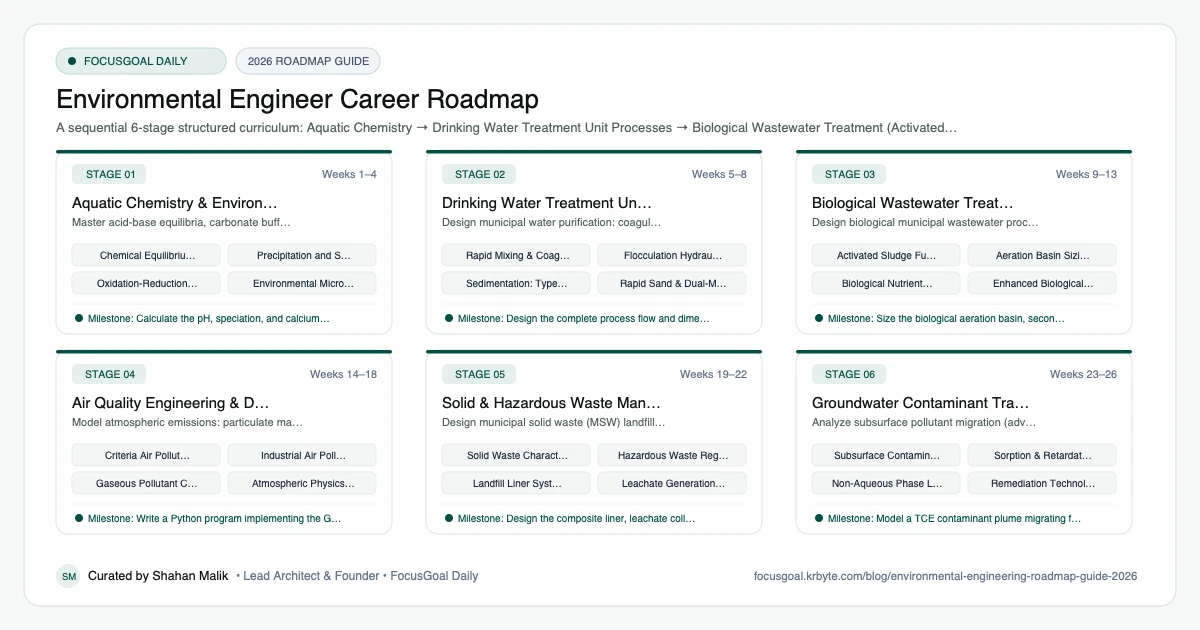
The 6 Production Stages
Follow these structured, sequential stages to systematically build production competence:
Aquatic Chemistry & Environmental Microbiology
Master acid-base equilibria, carbonate buffering systems, redox potential (pe-pH diagrams), and microbial metabolism.
Drinking Water Treatment Unit Processes
Design municipal water purification: coagulation, flocculation, sedimentation, granular media filtration, and disinfection.
Biological Wastewater Treatment (Activated Sludge & BNR)
Design biological municipal wastewater processes: aeration basins, secondary clarifiers, nitrification, and phosphorus removal.
Air Quality Engineering & Dispersion Modeling (AERMOD)
Model atmospheric emissions: particulate matter, NOx, SOx, photochemical smog, cyclone collectors, and Gaussian plume dispersion.
Solid & Hazardous Waste Management (Engineered Landfills)
Design municipal solid waste (MSW) landfills: composite geosynthetic liners, leachate collection, and landfill gas (methane) extraction.
Groundwater Contaminant Transport & Site Remediation
Analyze subsurface pollutant migration (advection, dispersion, sorption) and engineer in-situ remediation systems.
Is Environmental Engineering a Good Career in 2026?
Environmental engineering addresses water and wastewater treatment, air quality, solid and hazardous waste, and site remediation. Demand is shaped by regulation, infrastructure renewal, and growing attention to climate adaptation and sustainability.
Caveats: jobs often depend on public funding and regulation, which can change with policy, and some roles involve fieldwork or compliance paperwork. Pay and hiring vary by country, so check official labour statistics and local employers.
- Good fit if you want engineering work with a public-health or environmental purpose.
- Employers include consultancies, utilities, industry, and government.
- Regulatory knowledge is a major part of the job.
Software & Tools Environmental Engineers Use
Environmental engineers use modelling, mapping, and monitoring tools, plus regulatory frameworks that depend on the country. Strong data skills help in compliance and impact assessment.
Sampling and lab analysis are core field skills that inform every design decision.
- GIS: QGIS and ArcGIS.
- Water and wastewater modelling: EPANET, SWMM, and BioWin-type process simulators.
- Air dispersion modelling: tools such as AERMOD.
- Data analysis: Excel, Python, R.
- Frameworks: environmental impact assessment and local discharge or air quality regulations.
Degrees, Licensing & How to Get Your First Environmental Engineering Job
A bachelor's degree in environmental or civil engineering is the common route, and some chemical engineering graduates also enter the field. In the US, FE and PE exams exist for environmental engineers; licensing matters more for consulting and public works than for some industry roles. Requirements vary by country, so check your local licensing body.
Internships with consultancies, utilities, or regulators are valuable. Useful portfolio items include a treatment system sizing exercise, a water quality dataset analysis, or a GIS-based site study, each with clear assumptions.
- Seek internships with utilities, consultancies, or regulators.
- Build GIS and data-analysis skills.
- Document a treatment or monitoring project with assumptions.
- Check local registration requirements early.
Beginner Pitfalls vs Production Reality
Self-taught developers commonly waste months making avoidable structural mistakes. Here is how production engineers approach these challenges:
Master Environmental Engineering with FocusGoal Daily
Environmental engineering requires mastering chemical reaction kinetics, microbiological ecosystems, and fluid transport equations. FocusGoal Daily turns this wide curriculum into disciplined daily milestones.
- Daily micro-tasks for water treatment unit sizing, Monod kinetics, and plume dispersion formulas.
- Track study streaks offline while performing field water sampling or plant walk-throughs.
- Instant AI explanations for BNR nitrification cycles, Monod bacterial growth, and Gaussian plume equations.
Track this roadmap,
one topic at a time.
Download FocusGoal, pick this roadmap and finish your first daily topic in minutes.
Frequently Asked Questions
What software do environmental engineers use?
EPA SWMM is standard for stormwater and sewer modeling. BioWin and GPS-X are industry standards for wastewater biological process simulation. EPA AERMOD is standard for air dispersion, and MODFLOW is standard for groundwater transport.
What is the difference between Environmental Science and Environmental Engineering?
Environmental scientists study and quantify environmental problems (sampling ecology, observing pollution). Environmental engineers design the physical technology and civil infrastructure that fixes and prevents those problems (treatment plants, scrubbers, remediation barriers).
What are PFAS chemicals and why are they important?
Per- and polyfluoroalkyl substances (PFAS) are synthetic 'forever chemicals' resistant to degradation. In 2026, removing PFAS from municipal water supplies using granular activated carbon (GAC), ion-exchange resins, and high-pressure reverse osmosis is one of the biggest priorities in environmental engineering.
What does an environmental engineer do?
An environmental engineer designs and manages systems that protect people and the environment, including water and wastewater treatment, air pollution control, waste management, and site cleanup. They also help organisations meet environmental regulations.
Is environmental engineering hard?
It is challenging because it blends chemistry, biology, hydraulics, and regulation. With steady study and practical projects it is manageable.
How long does it take to become an environmental engineer?
A bachelor's degree typically takes about four years in many countries. Licensing, where it applies, usually needs further supervised experience.
Environmental vs civil engineering: what is the difference?
Environmental engineering focuses on pollution control, treatment, and sustainability, while civil engineering is broader, covering structures, transport, and more. Environmental engineering is often a branch of civil.
Do I need a PE license as an environmental engineer?
It depends on the role. Consulting and public works often prefer or require it, while many industry roles do not. Rules vary by country, so check locally.
Start Your Environmental Engineer Today
Follow structured daily goals, study 100% offline with local SQLite, and get on-demand AI guidance with FocusGoal Daily on Android.
Get FocusGoal Daily Free on Google Play