Electrical Engineering Roadmap (2026): From Circuit Theory to Renewable Power Grids
Master fundamental circuit laws, three-phase power distribution, transformer design, renewable energy integration, electromagnetic field theory, and automated industrial power systems.

What's in this guide
The Short Answer: Electrical Engineering in 2026
The global transition to electrification, smart grids, electric vehicles, and renewable energy has made electrical engineering one of the most critical engineering disciplines in the world. In 2026, electrical engineers are solving massive challenges in grid resilience, high-voltage DC (HVDC) transmission, and power converter efficiency.
A successful electrical engineer combines rock-solid mathematical models (phasors, Laplace transforms, Maxwell's equations) with simulation tools like MATLAB/Simulink, LTspice, and PSCAD.
Power systems require strict adherence to safety, power factor correction, and harmonic distortion standards (IEEE 519). Always verify phase angles and reactive power balance before scaling simulations.
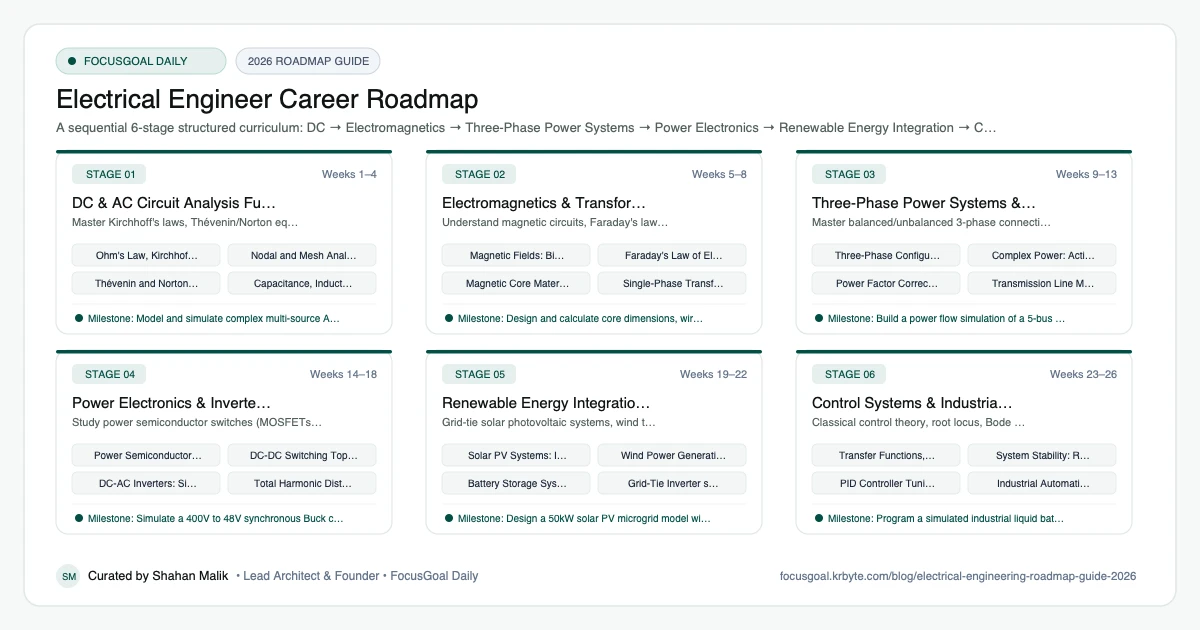
The 6 Production Stages
Follow these structured, sequential stages to systematically build production competence:
DC & AC Circuit Analysis Fundamentals
Master Kirchhoff's laws, Thévenin/Norton equivalents, phasor domain analysis, and transient RLC responses.
Electromagnetics & Transformer Theory
Understand magnetic circuits, Faraday's law of induction, mutual inductance, and ideal/real transformer models.
Three-Phase Power Systems & Grid Transmission
Master balanced/unbalanced 3-phase connections, real/reactive/apparent power (P, Q, S), and transmission line modeling.
Power Electronics & Inverter Topologies
Study power semiconductor switches (MOSFETs, IGBTs, SiC, GaN), DC-DC converters, and DC-AC inverters.
Renewable Energy Integration & Battery Storage
Grid-tie solar photovoltaic systems, wind turbine generators, Battery Energy Storage Systems (BESS), and microgrids.
Control Systems & Industrial Automation (PLCs)
Classical control theory, root locus, Bode plots, state-space representations, and programmable logic controllers (PLCs).
Is Electrical Engineering a Good Career in 2026?
Electrical engineering underpins power grids, renewable energy, electric vehicles, industrial automation, and telecommunications, so long-term demand is tied to electrification and infrastructure investment. The field is wide, which lets you move between power, controls, and signal-related work.
The caveats are that the maths is abstract, some areas such as power systems change slowly and reward patience, and conditions vary by country and sector. Check national labour statistics and local job listings for pay and demand rather than trusting generalised figures.
- Good fit if you like maths-driven problem solving and invisible systems.
- Strong links to energy transition, EVs, and automation.
- Power work often involves safety standards and formal sign-off.
Software & Standards Electrical Engineers Use
Electrical engineers use simulation and drafting tools plus a set of national and international standards. The standards depend on your country, so learn which ones apply where you plan to work.
Tools are secondary to fundamentals: Ohm's and Kirchhoff's laws, three-phase power, and per-unit analysis show up in every package.
- Simulation: MATLAB/Simulink, LTspice, PSpice.
- Power systems: ETAP, PowerWorld, PSS/E, DIgSILENT PowerFactory.
- Drafting: AutoCAD Electrical, EPLAN.
- PLC and controls: Siemens TIA Portal, Rockwell Studio 5000.
- Standards: IEC and IEEE families, plus local electrical codes such as the NEC in the US.
Degrees, Licensing & How to Get Your First Electrical Engineering Job
A bachelor's degree in electrical engineering from an accredited programme is the usual entry point. In the US, graduates can sit the FE exam and later the PE exam; a PE in power is especially relevant for utilities and consulting, while many electronics and controls jobs do not need it. Other countries have chartered engineer or registered engineer routes.
Requirements vary, so check your local licensing body. To land your first job, seek internships with utilities, manufacturers, or automation firms, and build projects such as a motor controller, a small solar charge system simulation, or a PLC demo with clear documentation.
- Pursue summer internships at utilities or industrial firms.
- Learn one simulation tool and one PLC platform well.
- Publish project write-ups with schematics and test notes.
- Look at your local engineering body for registration steps.
Beginner Pitfalls vs Production Reality
Self-taught developers commonly waste months making avoidable structural mistakes. Here is how production engineers approach these challenges:
Master Electrical Engineering with FocusGoal Daily
Electrical engineering requires retaining complex impedance formulas, phasor rotations, and grid standards. FocusGoal Daily structures your studies into clean daily learning targets.
- Daily micro-tasks for AC phasors, power calculations, and transformer formulas.
- Track offline study streaks while in research labs, substations, or workshops.
- AI tutor explanations for Laplace domain transforms, symmetrical components, and converter topologies.
Track this roadmap,
one topic at a time.
Download FocusGoal, pick this roadmap and finish your first daily topic in minutes.
Frequently Asked Questions
What is the difference between Electrical Engineering and Electronics Engineering?
Electrical Engineering generally focuses on large-scale electricity: power generation, transmission grids, motors, and high-voltage systems. Electronics Engineering focuses on low-voltage, small-scale signals: microchips, semiconductors, PCBs, and embedded systems.
Which simulation software is most valued in industry?
MATLAB/Simulink and PSCAD are dominant in power systems and control engineering. LTspice is standard for analog circuits, while ETAP is standard for industrial power distribution studies.
Is knowing code necessary for an electrical engineer?
Yes. Python and MATLAB are essential for numerical modeling, while C/C++ is required for microcontroller firmware and PLC structured text.
What does an electrical engineer do?
An electrical engineer designs, tests, and maintains electrical systems such as power distribution, motors, control systems, and lighting. The work can range from calculations and simulation to commissioning equipment on site.
Is electrical engineering hard?
It is considered one of the more mathematically demanding engineering degrees because of circuits, signals, and electromagnetics. Consistent practice with problem sets and building small circuits makes the abstract topics much easier.
How long does it take to become an electrical engineer?
A bachelor's degree usually takes around four years in many countries, though it varies. Professional registration, where applicable, generally requires additional supervised experience and an exam.
Electrical vs electronics engineering: what is the difference?
Electrical engineering focuses on power and large systems, while electronics focuses on small circuits, chips, and devices. Many degrees cover both, so you can decide on a specialty later.
Do I need a PE license as an electrical engineer?
Only for certain roles, such as signing power-system or building electrical designs in some jurisdictions. Many industry roles do not need it, and rules vary by country, so check your local licensing board.
Start Your Electrical Engineer Today
Follow structured daily goals, study 100% offline with local SQLite, and get on-demand AI guidance with FocusGoal Daily on Android.
Get FocusGoal Daily Free on Google Play