Mechanical Engineering Roadmap (2026): From Fundamental Physics to Advanced Simulation
Learn how to transform physics principles into manufacturable physical hardware. Master statics, parametric CAD, thermal analysis, structural FEA, and modern mechatronic control.

What's in this guide
The Short Answer: Mechanical Engineering in 2026
Mechanical engineering is the bedrock of hardware innovation—from electric vehicles and consumer electronics to aerospace components and robotic arms. In 2026, the modern mechanical engineer does not merely sketch parts; they leverage parametric 3D CAD, generative design, cloud-accelerated FEA simulations, and automated mechatronics.
The key to mastering mechanical engineering as a self-directed learner is pairing rigorous mathematical first principles (vector mechanics, stress tensors, thermodynamics) with hands-on CAD modeling and physical prototyping.
Never design components without considering manufacturing tolerances (GD&T) and stress concentrations. Validate your CAD models with analytical calculations before trusting FEA simulations.
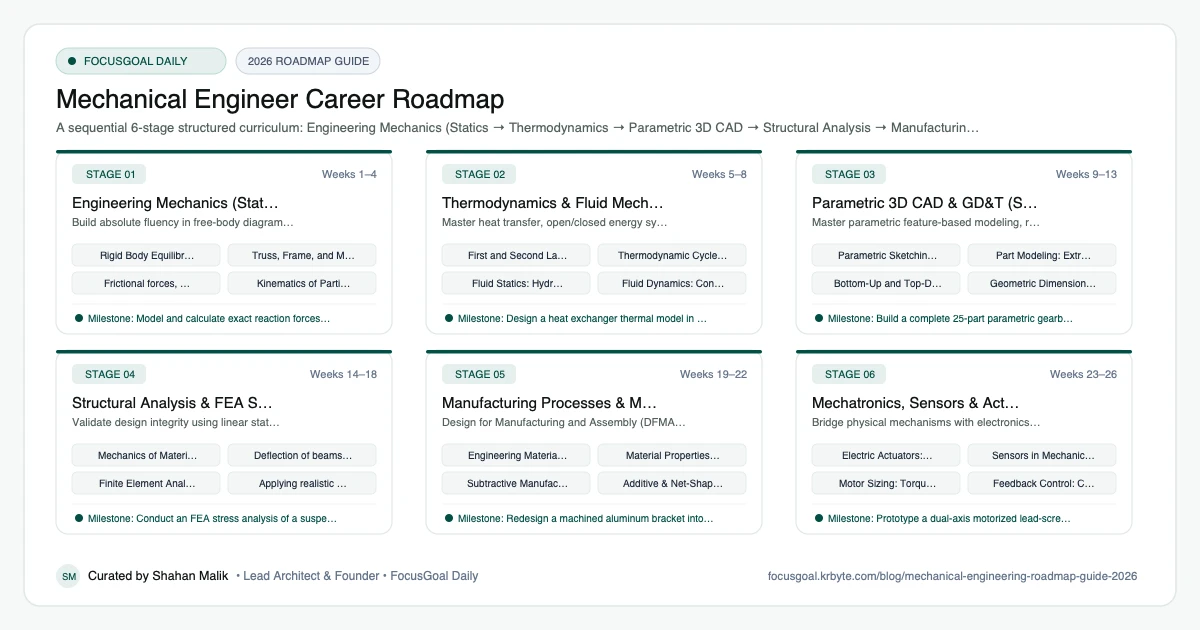
The 6 Production Stages
Follow these structured, sequential stages to systematically build production competence:
Engineering Mechanics (Statics & Dynamics)
Build absolute fluency in free-body diagrams, force equilibrium, moments, kinematic equations, and Newton-Euler dynamics.
Thermodynamics & Fluid Mechanics
Master heat transfer, open/closed energy systems, fluid statics, Bernoulli equation, and Navier-Stokes principles.
Parametric 3D CAD & GD&T (SolidWorks / Fusion 360)
Master parametric feature-based modeling, robust assembly constraints, sheet metal, and professional manufacturing drawings.
Structural Analysis & FEA Simulation (ANSYS)
Validate design integrity using linear static, modal, and thermal finite element analysis (FEA).
Manufacturing Processes & Material Selection
Design for Manufacturing and Assembly (DFMA): CNC machining, injection molding, sheet metal stamping, and metallurgy.
Mechatronics, Sensors & Actuators
Bridge physical mechanisms with electronics: electric motors, encoders, PID feedback loops, and microcontroller interfacing.
Is Mechanical Engineering a Good Career in 2026?
Mechanical engineering remains one of the broadest engineering degrees, which is its main career advantage. The same fundamentals in mechanics, thermodynamics and materials apply to machinery, energy systems, consumer products, medical devices, and transport. Demand tends to follow manufacturing, energy transition, and product development investment, so it varies by region and industry cycle.
The honest caveats: the field is broad enough that you need to specialise to stand out, and many roles now expect programming and simulation skills alongside CAD. Pay and hiring conditions differ widely by country, so check your national labour statistics and local job boards rather than relying on a general figure.
- Good fit if you like physical systems, hands-on prototyping, and quantitative problem solving.
- Strong crossover into automation, energy, and product design roles.
- Expect to keep learning software tools throughout your career.
Software & Tools Mechanical Engineers Use
Most mechanical roles involve a 3D CAD package, a simulation tool, and some scripting. Which exact tools you use depends on your employer, but the concepts transfer between packages, so learn the workflow rather than memorising menus.
Beyond software, you will meet measurement and drawing standards such as GD&T, which communicates tolerances on engineering drawings, and basic workshop tools like calipers, micrometers, and test rigs.
- CAD: SolidWorks, Autodesk Inventor, Fusion 360, CATIA, Siemens NX, PTC Creo.
- Simulation: ANSYS, Abaqus, COMSOL, and open-source options such as CalculiX.
- Analysis and scripting: MATLAB and Python.
- Manufacturing: CAM software and 3D printing slicers.
- Documentation: GD&T per ASME Y14.5 or ISO equivalents.
Degrees, Licensing & How to Get Your First Mechanical Engineering Job
The standard route is a bachelor's degree in mechanical engineering from an accredited programme. In the United States, graduates may take the Fundamentals of Engineering (FE) exam and later the Professional Engineer (PE) exam; many mechanical roles, especially in manufacturing and product design, do not require a PE licence, while consulting and public-facing work often does. Other countries use different chartership or registration systems.
Requirements vary by country, so check your local licensing or engineering body. For your first job, internships, co-ops, student competition teams, and a portfolio of two or three well-documented design projects (CAD, drawings, test results) usually matter more than extra certificates.
- Join a student design team such as Formula SAE or Baja SAE if available.
- Document projects with drawings, assumptions, and what you would change.
- Apply for internships early, in your second or third year.
- Check your local engineering body for accreditation and registration rules.
Beginner Pitfalls vs Production Reality
Self-taught developers commonly waste months making avoidable structural mistakes. Here is how production engineers approach these challenges:
Master Mechanical Engineering with FocusGoal Daily
Mechanical engineering requires consistent retention of complex formulas, standard material properties, and CAD shortcuts. FocusGoal Daily breaks your 26-week journey into bite-sized daily milestones.
- Daily micro-goals for mechanics formulas, GD&T symbols, and CAD design exercises.
- Track study streaks offline during workshops, machine shops, or field visits.
- AI concept tutor for immediate explanations of shear stress tensors, thermodynamic cycles, and Von Mises yield criteria.
Track this roadmap,
one topic at a time.
Download FocusGoal, pick this roadmap and finish your first daily topic in minutes.
Frequently Asked Questions
What software should I learn first: SolidWorks, Fusion 360, or Inventor?
SolidWorks remains the industry standard across aerospace, automotive, and consumer product design. Fusion 360 is an excellent modern, accessible alternative for individuals and hobbyists, with built-in CAM and generative design.
Do mechanical engineers need to know programming?
Yes. Python and MATLAB are essential for data analysis, numerical simulation, and mathematical optimization. Modern mechanical engineers frequently write scripts for parametric CAD generation and automated test data processing.
How can I practice without expensive laboratory equipment?
Use desktop 3D printers, open-source FEA tools like FreeCAD/CalculiX or student editions of ANSYS, and affordable microcontroller kits (Arduino/ESP32) for mechatronic experiments.
What does a mechanical engineer do?
A mechanical engineer designs, analyses, tests, and improves mechanical systems and products, from engines and HVAC systems to medical devices and machinery. Day to day that means CAD modelling, calculations, simulation, prototyping, and working with manufacturing teams.
Is mechanical engineering hard?
It is demanding, mainly because of heavy maths and physics in the first two years and the breadth of topics. Most students find it manageable with steady practice on statics, dynamics, and thermodynamics rather than last-minute cramming.
How long does it take to become a mechanical engineer?
A bachelor's degree typically takes about four years in many countries, though this varies. Licensing, where it applies, usually adds supervised work experience before a professional exam, so check your local rules.
Mechanical vs electrical engineering: which should I choose?
Choose mechanical if you are drawn to machines, heat, and structures, and electrical if you prefer circuits, power, and signals. Both overlap in robotics and mechatronics, so you can combine them later.
Do I need a PE license as a mechanical engineer?
Not always. In the US many industry roles do not require a PE licence, but it can be needed for signing off certain public or consulting work. Rules differ by country and state, so confirm with your local licensing board.
Start Your Mechanical Engineer Today
Follow structured daily goals, study 100% offline with local SQLite, and get on-demand AI guidance with FocusGoal Daily on Android.
Get FocusGoal Daily Free on Google Play