Chemical Engineering Roadmap (2026): Transforming Raw Chemistry into Industrial Plants
Learn how to scale chemical laboratory reactions into safe, high-yield commercial industrial processes. Master mass/energy balances, vapor-liquid equilibrium, separation towers, reactor kinetics, and automated process control.

What's in this guide
The Short Answer: Chemical Engineering in 2026
Chemical engineering is the science and art of converting raw materials into valuable chemical products, clean fuels, pharmaceuticals, semiconductors, and advanced polymers at massive scale. In 2026, the discipline is central to the clean energy transition: hydrogen production, carbon capture, lithium battery refining, and sustainable biomanufacturing.
A chemical engineer is not merely a chemist; they are masters of transport phenomena (fluid flow, heat transfer, mass transfer), mathematical reaction kinetics, and thermodynamic phase equilibria operating inside complex plant piping networks.
Mass and energy can never disappear. Every single process simulation or real-world plant design must close its material and energy balances with 100% mathematical precision before selecting equipment.
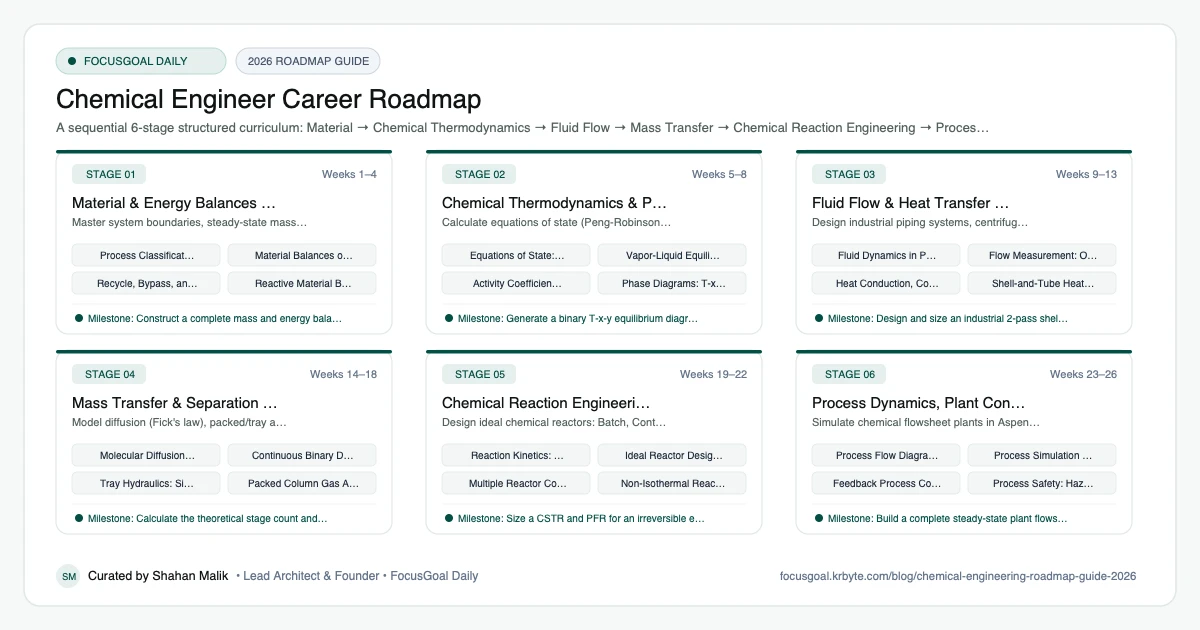
The 6 Production Stages
Follow these structured, sequential stages to systematically build production competence:
Material & Energy Balances (Conservation Laws)
Master system boundaries, steady-state mass balances with and without chemical reactions, recycle streams, purge loops, and enthalpy balances.
Chemical Thermodynamics & Phase Equilibria (VLE)
Calculate equations of state (Peng-Robinson), fugacity, chemical potential, and vapor-liquid equilibrium (VLE) for non-ideal mixtures.
Fluid Flow & Heat Transfer Operations
Design industrial piping systems, centrifugal pumps, shell-and-tube heat exchangers, and boiling/condensation equipment.
Mass Transfer & Separation Processes (Distillation & Absorption)
Model diffusion (Fick's law), packed/tray absorption columns, multi-component distillation, and membrane separations.
Chemical Reaction Engineering & Reactor Kinetics
Design ideal chemical reactors: Batch, Continuous Stirred-Tank (CSTR), and Plug Flow Reactors (PFR).
Process Dynamics, Plant Control & Aspen Plus Simulation
Simulate chemical flowsheet plants in Aspen Plus / DWSIM, read P&IDs, and design plant feedback control loops.
Is Chemical Engineering a Good Career in 2026?
Chemical engineering applies chemistry, physics, and maths to processes that transform materials, including fuels, pharmaceuticals, food, plastics, batteries, and water treatment. This breadth lets graduates work in industries beyond traditional petrochemicals.
Caveats: demand is linked to commodity cycles and regional industry, and plant roles can involve shift work or remote sites. The energy transition is shifting emphasis toward hydrogen, batteries, and sustainability. Check national labour statistics and local employers for realistic prospects.
- Good fit if you enjoy chemistry, process thinking, and large systems.
- Skills transfer to energy, pharma, food, and environmental work.
- Safety culture is central to the profession.
Software & Tools Chemical Engineers Use
Process simulation is the core software skill, supported by data analysis and process diagrams. Learning to read a P&ID is essential for plant work.
Safety methods such as HAZOP are standard in process industries, so expect to participate in them early in your career.
- Process simulation: Aspen Plus, Aspen HYSYS, DWSIM (open source), ChemCAD.
- Modelling and data: MATLAB, Python, Excel.
- Drawings: P&IDs and process flow diagrams, drafted in AutoCAD or similar.
- Safety methods: HAZOP, process hazard analysis, and layers of protection concepts.
- Control systems: DCS and PLC familiarity.
Degrees, Licensing & How to Get Your First Chemical Engineering Job
A bachelor's degree in chemical engineering from an accredited programme is the standard route. In the US, the FE and PE exams exist for chemical engineers, though many process industry roles do not require a PE. Other countries use chartered or registered engineer systems. Requirements vary, so check your local licensing body.
Internships and co-ops in plants, refineries, or labs are highly valued. A capstone plant design project, simulation models you can explain, and awareness of process safety help you stand out.
- Pursue co-ops or internships at processing plants.
- Learn one process simulator thoroughly.
- Be able to explain a P&ID and basic safety layers.
- Check local registration steps with your engineering body.
Beginner Pitfalls vs Production Reality
Self-taught developers commonly waste months making avoidable structural mistakes. Here is how production engineers approach these challenges:
Master Chemical Engineering with FocusGoal Daily
Chemical engineering requires deep synthesis of mass balance laws, thermodynamic equations, and kinetic rate formulas. FocusGoal Daily breaks your curriculum into structured daily study targets.
- Daily micro-tasks for distillation calculations, McCabe-Thiele steps, and reactor design equations.
- Track study streaks offline while inside plant pilot facilities or processing plants.
- AI concept tutor providing immediate explanations of azeotropes, fugacity coefficients, and CSTR thermal stability.
Track this roadmap,
one topic at a time.
Download FocusGoal, pick this roadmap and finish your first daily topic in minutes.
Frequently Asked Questions
What is the difference between Chemistry and Chemical Engineering?
Chemistry focuses on molecular reactions, synthesizing compounds on a test-tube scale, and atomic mechanisms. Chemical engineering focuses on taking those reactions and manufacturing thousands of tons safely, economically, and continuously in industrial plants.
What software should I learn: Aspen Plus, Aspen HYSYS, or DWSIM?
Aspen Plus is the standard for chemicals, pharmaceuticals, and polymers. Aspen HYSYS dominates oil, gas, and refining. DWSIM is an outstanding free, open-source chemical process simulator that runs on all platforms.
Do chemical engineers only work in oil refineries?
No. Today chemical engineers work extensively in biotechnology, semiconductor chip fabrication (wet etching, chemical vapor deposition), battery manufacturing, pharmaceuticals, and carbon capture.
What does a chemical engineer do?
A chemical engineer designs, optimises, and operates processes that turn raw materials into useful products such as fuels, medicines, food, and materials. Day to day this can involve simulation, troubleshooting plants, and improving safety and efficiency.
Is chemical engineering hard?
It is widely regarded as one of the tougher engineering degrees due to heavy maths, thermodynamics, and transport phenomena. Regular problem practice is the best way to keep up.
How long does it take to become a chemical engineer?
A bachelor's degree typically takes around four years in many countries. Professional registration, where relevant, usually requires additional experience and an exam.
Chemical vs mechanical engineering: what is the difference?
Chemical engineering focuses on processes and reactions, while mechanical engineering focuses on machines and mechanical systems. They overlap in thermodynamics and fluids.
Do I need a PE license as a chemical engineer?
Often no, since many industry roles do not require it. It can matter for consulting or regulated sign-off, and rules vary by country, so check locally.
Start Your Chemical Engineer Today
Follow structured daily goals, study 100% offline with local SQLite, and get on-demand AI guidance with FocusGoal Daily on Android.
Get FocusGoal Daily Free on Google Play