Environmental Law Roadmap (2026): Navigating Regulatory Statutes & Climate Governance
Learn how environmental statutes protect natural resources and regulate industrial emissions. Master the Clean Air Act, Clean Water Act, Superfund cleanup liability, NEPA assessments, and corporate ESG climate reporting.

What's in this guide
The Short Answer: Environmental Law in 2026
Environmental law governs how human industry interacts with air, water, land, and living ecosystems. Environmental attorneys represent government agencies (like the EPA), non-profit conservation organizations, and corporations developing infrastructure projects, manufacturing plants, and renewable energy facilities.
In 2026, environmental law is undergoing radical shifts: landmark Supreme Court rulings transforming administrative rulemaking, corporate ESG sustainability reporting mandates, and novel climate change damages litigation against major energy producers.
Environmental liability is often strict, joint, several, and retroactive (notably under CERCLA). When advising corporate clients, environmental due diligence (Phase I ESAs) is essential to avoid inheriting multi-million dollar cleanup liabilities.
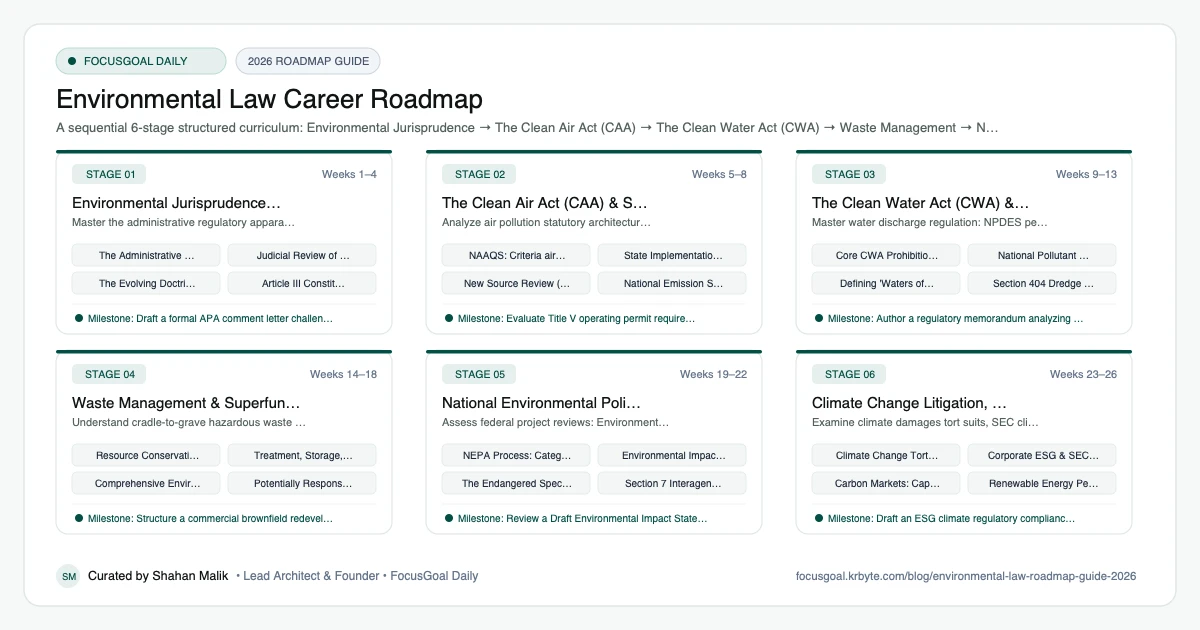
The 6 Production Stages
Follow these structured, sequential stages to systematically build production competence:
Environmental Jurisprudence & Administrative Law
Master the administrative regulatory apparatus: Administrative Procedure Act (APA), agency rulemaking, judicial review, and standing.
The Clean Air Act (CAA) & Stationary/Mobile Sources
Analyze air pollution statutory architecture: National Ambient Air Quality Standards (NAAQS), SIPs, and Title V permits.
The Clean Water Act (CWA) & Wetlands Jurisdiction
Master water discharge regulation: NPDES permits, point source definitions, Waters of the United States (WOTUS), and Section 404 dredge/fill.
Waste Management & Superfund Liability (RCRA & CERCLA)
Understand cradle-to-grave hazardous waste management under RCRA and retroactive toxic cleanup liability under CERCLA Superfund.
National Environmental Policy Act (NEPA) & Endangered Species (ESA)
Assess federal project reviews: Environmental Assessments (EA), Environmental Impact Statements (EIS), and Section 7 ESA consultations.
Climate Change Litigation, Energy Transition & ESG Reporting
Examine climate damages tort suits, SEC climate disclosures, carbon markets, and renewable energy siting.
Is a Career in Environmental Law Worth It in 2026?
Environmental law sits at the crossroads of regulation, science, energy, and public policy. Work exists in law firms, government agencies, non-profits, and company compliance teams, driven by permitting, pollution rules, land and water use, energy projects, and sustainability disclosure requirements.
The caveats: the field is technical, rules change with politics and courts, and some roles are funded by non-profit or public budgets with limited resources. Demand varies by country and region, so research locally. This article is general educational information, not legal advice. Admission, licensing, and practice rules differ by country and by state or province, so always confirm requirements with your local bar association, law society, or regulator.
- Good fit if you like regulatory detail and working with scientists and engineers.
- A science, engineering, or policy background can be a useful advantage.
- Roles range from advocacy to regulatory compliance to project permitting.
Skills, Tools & Resources You Will Use in Environmental Practice
You will need strong skills in statutory and administrative-law reading, because most environmental rules come from legislation, regulations, and agency decisions. Comfort reading technical reports, such as environmental impact assessments, monitoring data, and site investigation findings, is just as important.
Typical resources include official regulator websites, legislative databases, permit and public-comment portals, mapping tools for land and water data, and legal research databases. Working with consultants and engineers means learning enough science vocabulary to ask good questions.
- Primary environmental statutes and regulations of your jurisdiction.
- Regulator and agency websites for guidance, permits, and public records.
- Geographic information system (GIS) maps and public environmental data portals.
- Environmental impact assessment and site investigation reports.
Qualifications, Licensing & How to Get Your First Environmental Law Role
Most environmental lawyers hold a general law qualification and meet their jurisdiction's admission rules, then specialise through work, electives, or postgraduate study in environmental or energy law. A prior science or policy degree can help but is not always required.
For a first role, look for internships with regulators, environmental non-profits, and firms with environmental practices, plus law school clinics and journals. This article is general educational information, not legal advice. Admission, licensing, and practice rules differ by country and by state or province, so always confirm requirements with your local bar association, law society, or regulator.
- Confirm admission rules with your local bar or law society.
- Look for environmental clinics, moot courts, and student journals.
- Consider elective or postgraduate study in environmental, energy, or planning law.
Beginner Pitfalls vs Production Reality
Self-taught developers commonly waste months making avoidable structural mistakes. Here is how production engineers approach these challenges:
Master Environmental Law with FocusGoal Daily
Environmental law requires mastering acronym-heavy statutory schemes, EPA technical standards, and administrative case law. FocusGoal Daily turns this vast curriculum into disciplined daily study goals.
- Daily micro-tasks for CAA standards, CWA WOTUS definitions, and CERCLA PRP liability.
- Track study streaks offline while visiting industrial plant facilities or regulatory field hearings.
- Instant AI explanations for Sackett wetlands tests, Major Questions doctrine, and NEPA EIS requirements.
Track this roadmap,
one topic at a time.
Download FocusGoal, pick this roadmap and finish your first daily topic in minutes.
Frequently Asked Questions
What was the impact of the Supreme Court's Sackett v. EPA decision?
Sackett narrowed Clean Water Act federal jurisdiction, establishing that wetlands are covered only if they have a continuous surface connection to relatively permanent bodies of water, leaving millions of previously protected wetlands to state regulation.
What is the difference between Scope 1, 2, and 3 emissions in ESG reporting?
Scope 1 includes direct emissions from company-owned facilities and vehicles. Scope 2 covers indirect emissions from purchased electricity, steam, and cooling. Scope 3 covers all other indirect supply chain and product lifecycle emissions.
Do environmental lawyers only work for advocacy organizations like the Sierra Club?
No. The majority of environmental attorneys work in corporate law firms advising businesses on regulatory compliance, permitting infrastructure projects, structuring corporate transactions, and defending enforcement actions.
What does an environmental lawyer do?
An environmental lawyer advises on and litigates issues involving pollution, natural resources, land use, permits, and sustainability rules. They may work for companies, governments, or advocacy groups.
Is environmental law hard?
It can be, because it is regulatory and technical, with frequent rule changes. Students who enjoy reading statutes and working with scientific data tend to adapt well.
Do I need a science degree to practise environmental law?
Not usually, since the legal qualification is what authorises you to practise. A science or engineering background can help you understand technical evidence, but you can build that knowledge on the job.
Environmental law vs environmental engineering: what is the difference?
Environmental lawyers interpret and apply legal rules, while environmental engineers design and manage the technical systems that meet those rules. They often work together on permits and clean-ups.
How long does it take to become an environmental lawyer?
The time depends on your country's education and professional training requirements, plus any specialist study you choose. Check with your local regulator for the specifics.
Start Your Environmental Law Today
Follow structured daily goals, study 100% offline with local SQLite, and get on-demand AI guidance with FocusGoal Daily on Android.
Get FocusGoal Daily Free on Google Play