Database Administrator Roadmap (2026): Performance, Replication & High Availability Guide
Master relational database administration, storage engine internals, query tuning with EXPLAIN ANALYZE, WAL replication, disaster recovery, and high availability clusters.

What's in this guide
The Short Answer: Database Administration in 2026
While cloud providers offer managed Database-as-a-Service (DBaaS) like AWS RDS and Google Cloud SQL, the demand for skilled Database Administrators has never been higher. Managed services do not optimize your slow queries, configure appropriate connection pools, or architect disaster recovery failover strategies.
Modern DBAs in 2026 are specialized systems engineers who ensure data integrity, maximum throughput, zero-downtime migrations, and rapid recovery from catastrophic outages.
A database is only as reliable as its restore procedure. Master query execution plans, WAL replication, and automated disaster recovery testing.
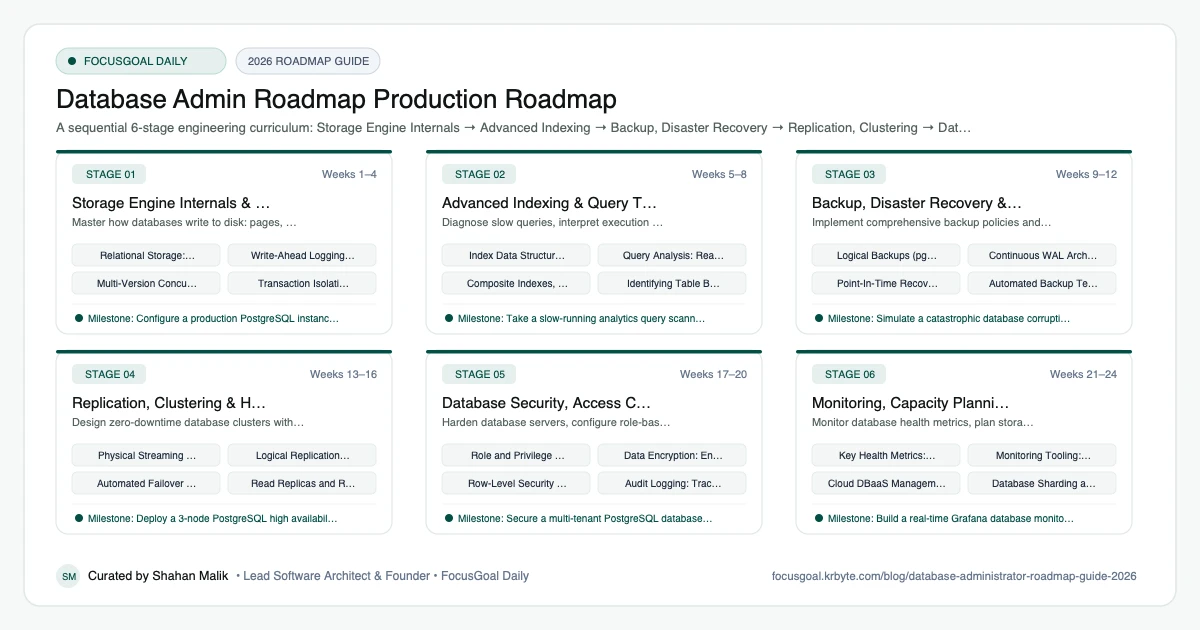
The 6 Production Stages
Follow these structured, sequential stages to systematically build production competence:
Storage Engine Internals & Relational Architecture
Master how databases write to disk: pages, buffers, write-ahead logging (WAL), and concurrency control.
Advanced Indexing & Query Tuning
Diagnose slow queries, interpret execution plans, and design optimal indexing strategies.
Backup, Disaster Recovery & Point-In-Time Recovery
Implement comprehensive backup policies and practice rapid database restores from catastrophic failures.
Replication, Clustering & High Availability (HA)
Design zero-downtime database clusters with streaming replication and automated failover.
Database Security, Access Control & Auditing
Harden database servers, configure role-based permissions, encrypt data, and audit database access.
Monitoring, Capacity Planning & Cloud DBaaS
Monitor database health metrics, plan storage/CPU capacity, and manage cloud database fleets.
Is a Database Administrator Career Worth It in 2026?
Databases sit under almost every application, and someone must keep them fast, secure, backed up, and recoverable. That need does not disappear, but the role is evolving: more databases run as managed cloud services, so modern DBAs spend less time on hardware and more on performance tuning, automation, security, and cost control.
The honest caveat is that job titles are shifting toward database reliability, cloud, and data platform roles. Learning only one product in isolation is riskier than building transferable fundamentals. Pay and demand vary by region and industry, so check current local job listings.
- Best fit: careful, reliability-minded people who like troubleshooting.
- Learning curve: SQL is quick; backup, recovery, and performance tuning require hands-on practice.
- Durable skills: SQL, indexing, backup strategy, security, and automation.
Database Administrator vs Data Engineer vs DevOps: Which to Learn First
A DBA focuses on the health, performance, and security of database systems. A data engineer builds pipelines that move and transform data; see the Data Engineer Roadmap. A DevOps engineer automates deployment and infrastructure, as covered in the DevOps Engineer Roadmap.
Many careers blend these. If you enjoy deep troubleshooting of a single critical system, DBA fits. If you prefer building workflows or automation across many systems, the other paths may suit you better. The Cloud Computing Roadmap is useful in all three.
Database Administrator Setup: Tools You Need
You can build a practice lab for free. Install a database such as PostgreSQL or MySQL locally, or run it in Docker, and load a sample dataset large enough to make performance differences visible. Practice breaking and restoring it on purpose.
Learn one relational engine thoroughly first, then compare how others handle the same concepts.
- A relational database such as PostgreSQL or MySQL.
- Docker to create and reset test environments.
- A SQL client and the database's built-in query-plan tools.
- Shell scripting for scheduled backups and maintenance.
- A cloud free tier to try a managed database service.
Database Administrator Projects and How to Get a Job
Since DBA work is often private, build public lab write-ups. Show a slow query you diagnosed, the index or rewrite that fixed it, and how you measured the difference. Document a backup and restore drill from start to finish.
In interviews, expect questions on indexing, transactions and isolation, replication, backup and recovery, and how you would respond to an outage. Describe your thinking calmly and in steps.
- Tune a set of slow queries using execution plans and document the results.
- Set up scheduled backups and prove a point-in-time recovery.
- Configure replication between two instances and test failover.
- Write a least-privilege access and auditing plan for a sample app.
- Automate routine maintenance with scripts and document them.
Beginner Pitfalls vs Production Reality
Self-taught developers commonly waste months making avoidable structural mistakes. Here is how production engineers approach these challenges:
Master Database Administration with FocusGoal Daily
Database administration requires immense precision and deep architectural comprehension. FocusGoal Daily breaks this critical syllabus into actionable daily learning milestones.
- Structured curriculum covering storage engines, query tuning, replication, and disaster recovery.
- 100% offline study support powered by local SQLite database on Android.
- In-app Ask AI tutor for immediate explanations of EXPLAIN plans, WAL mechanics, and Patroni.
- Daily streak tracking to maintain disciplined study habits.
Track this roadmap,
one topic at a time.
Download FocusGoal, pick this roadmap and finish your first daily topic in minutes.
Frequently Asked Questions
Do companies still hire DBAs now that cloud databases exist?
Yes. While cloud providers handle physical hardware, cloud DBAs are urgently needed to design indexing strategies, diagnose slow queries, manage schema migrations, and ensure business disaster recovery compliance.
Which database should I specialize in: PostgreSQL or MySQL?
PostgreSQL has become the industry standard for modern application development and engineering due to its extensibility (pgvector, PostGIS), robust ACID guarantees, and rich indexing support. Knowing both PostgreSQL and MySQL is ideal.
What is the most critical skill for a DBA?
Disaster recovery and backup verification. Ensuring zero data loss and minimal downtime during unplanned outages is the primary mandate of every database administrator.
How do I become a database administrator?
Learn SQL and one relational database deeply, then practice backup, recovery, indexing, and performance tuning in a home lab. Many DBAs start in support, development, or system administration roles.
Is database administration a dying career?
The role is changing rather than disappearing. Managed cloud databases reduce routine tasks, but performance, security, reliability, and cost management still need skilled people.
Which database should I learn first: MySQL or PostgreSQL?
Either is a good start because both teach core relational concepts. Check job listings in your area, then pick the one that appears more often.
Do database administrators need to code?
Yes, to a degree. SQL is essential, and scripting in Bash, Python, or PowerShell helps you automate backups, monitoring, and maintenance.
What is the difference between a DBA and a data engineer?
A DBA maintains database systems so they are available, fast, and secure. A data engineer designs the pipelines that move and transform data between systems.
How does FocusGoal Daily help aspiring DBAs?
FocusGoal Daily turns the dense database systems documentation into clear, structured daily learning checklists with offline access on Android.
Start Your Database Admin Roadmap Today
Follow structured daily goals, study 100% offline with local SQLite, and get on-demand AI guidance with FocusGoal Daily on Android.
Get FocusGoal Daily Free on Google Play