Data Engineer Roadmap (2026): Distributed Pipelines, Spark & Lakehouse Guide
Master scalable batch and real-time streaming data pipelines using Python, SQL, Apache Spark, Apache Kafka, Airflow orchestration, and modern Lakehouse architectures.

What's in this guide
The Short Answer: Data Engineering in 2026
Data engineering is the foundational bedrock of all modern analytics and AI. Without reliable, clean, high-throughput pipelines, the most sophisticated machine learning algorithms and BI dashboards are useless.
In 2026, data engineering has converged around open table formats (Apache Iceberg, Delta Lake), distributed processing with Apache Spark, real-time event streaming with Apache Kafka, and code-based pipeline orchestration. Modern data engineers are software engineers who specialize in distributed data systems.
Just getting started? Read how to become a data engineer step by step for the beginner-first plan.
Build resilient, idempotent data pipelines. Master distributed computing mechanics, open table formats, and automated data quality checks to ensure reliable data delivery.
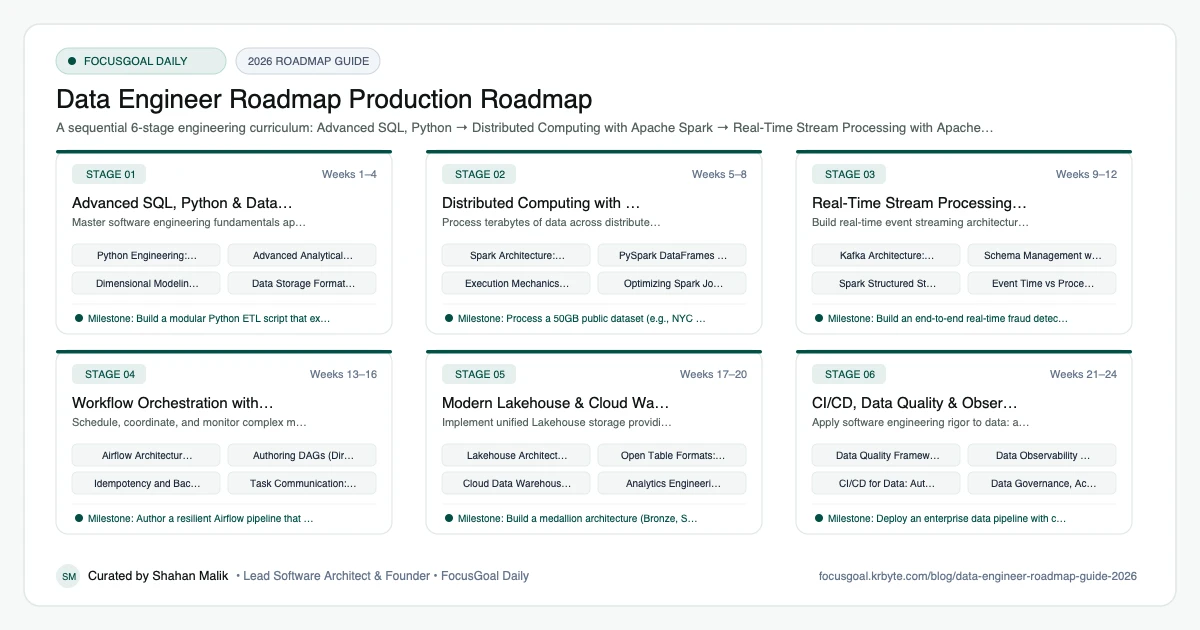
The 6 Production Stages
Follow these structured, sequential stages to systematically build production competence:
Advanced SQL, Python & Data Modeling
Master software engineering fundamentals applied to data: type-safe Python, analytical SQL, and dimensional modeling.
Distributed Computing with Apache Spark
Process terabytes of data across distributed clusters using PySpark and understand execution engine internals.
Real-Time Stream Processing with Apache Kafka
Build real-time event streaming architectures with Apache Kafka and Spark Structured Streaming.
Workflow Orchestration with Apache Airflow
Schedule, coordinate, and monitor complex multi-step data pipelines using Python-defined DAGs.
Modern Lakehouse & Cloud Warehouses (Iceberg/Delta)
Implement unified Lakehouse storage providing ACID transactions on top of cheap object storage.
CI/CD, Data Quality & Observability
Apply software engineering rigor to data: automated testing, CI/CD pipelines, and data quality monitoring.
Is Data Engineering Worth It in 2026?
Data engineering is a strong choice if you like backend-style work: building systems that move, clean, and store data reliably. Analytics and machine learning both depend on trustworthy data, so engineers who maintain the pipelines stay relevant even as modeling tools change.
The honest caveats: it is rarely the first role people land straight from a bootcamp, and many data engineers come from software, analytics, or database backgrounds. The work involves on-call duties and debugging broken pipelines, which is less glamorous than modeling. Check current local job listings for what employers expect in your market.
- Best fit: people who enjoy systems, SQL, and automation.
- Learning curve: SQL and Python are approachable; distributed systems and orchestration take time.
- Durable skills: SQL, data modeling, Python, and understanding of cloud services.
Data Engineer vs Data Analyst vs ML Engineer: Which to Learn First
If you want to deliver insights to business teams, begin with the Data Analyst Roadmap. If you want to train and evaluate models, see the Machine Learning Roadmap. Choose data engineering if you prefer building the infrastructure that both groups rely on.
Cloud knowledge helps in every case; the Cloud Computing Roadmap and the Database Administrator Roadmap cover closely related foundations.
Data Engineering Setup: Tools You Need
You can practice most concepts locally. Install Python, a relational database, and Docker so you can run services such as databases and orchestrators on your own machine. Then add a cloud free tier to experience managed warehouses and storage.
Tools differ by company, so focus on the concepts: extract, transform, load, scheduling, testing, and monitoring.
- SQL and a database such as PostgreSQL.
- Python for scripting and data transformations.
- Docker for reproducible local environments.
- An orchestrator such as Apache Airflow to schedule workflows.
- A cloud account for object storage and a warehouse.
Data Engineering Portfolio Projects and How to Get a Job
Portfolios stand out when they show a complete pipeline: ingestion, transformation, storage, scheduling, and checks that catch bad data. Document your design choices and what happens when something fails.
In interviews, expect heavy SQL, data modeling questions, and discussion of trade-offs such as batch versus streaming. Be ready to explain how you would make a pipeline idempotent and how you would detect silent data errors.
- An end-to-end pipeline pulling from a public API into a warehouse on a schedule.
- A dimensional model for a sample business with documented tables.
- A pipeline with automated data-quality tests and alerting.
- A comparison of a batch and a streaming approach to the same problem.
- A diagram and README for every project so reviewers understand it quickly.
Beginner Pitfalls vs Production Reality
Self-taught developers commonly waste months making avoidable structural mistakes. Here is how production engineers approach these challenges:
Master Data Engineering with FocusGoal Daily
Data engineering requires mastering distributed systems, cloud storage, and database internals. FocusGoal Daily turns this extensive syllabus into disciplined daily micro-goals.
- Complete curriculum from SQL and Python to Spark, Kafka, Airflow, and Iceberg.
- 100% offline study support powered by local SQLite database on Android.
- Interactive Ask AI tutor to clarify Spark DAG plans, Kafka partitions, and Airflow DAGs.
- Daily streak tracking to maintain steady progress toward high-scale systems competence.
Track this roadmap,
one topic at a time.
Download FocusGoal, pick this roadmap and finish your first daily topic in minutes.
Frequently Asked Questions
What programming languages are most important for data engineers?
Python and SQL are the non-negotiable fundamentals. Learning Scala or Java is valuable for deep Apache Spark and Kafka internals, while Go and Rust are increasingly used for modern streaming tools.
What is the difference between a Data Lake and a Data Lakehouse?
A Data Lake stores raw unstructured/semi-structured files without ACID guarantees or schema enforcement. A Lakehouse adds open table formats (like Apache Iceberg or Delta Lake) on top of lake storage to provide ACID transactions, time travel, and schema evolution.
How long does it take to become a production-ready Data Engineer?
If you have prior software development or strong SQL/Python experience, mastering distributed tools (Spark, Kafka, Airflow) typically takes 5 to 7 months of structured daily practice.
How do I become a data engineer?
Build strong SQL and Python skills, learn data modeling and a workflow orchestrator, and create a few end-to-end pipeline projects. Many people enter from software development, analytics, or database roles.
Is data engineering harder than data analysis?
It is usually more technical because it involves programming, infrastructure, and distributed systems. Analysis emphasizes business interpretation, so the difficulty is different rather than strictly higher.
Do data engineers need to know machine learning?
Not deeply. You should understand what data scientists and ML engineers need, such as clean features and reproducible datasets, but model building is not the core of the job.
What is ETL vs ELT?
ETL transforms data before loading it into the destination, while ELT loads raw data first and transforms it inside the warehouse. ELT has become common with powerful cloud warehouses.
Is SQL enough to become a data engineer?
SQL is essential but usually not enough. Employers typically also expect Python, data modeling, workflow tools, and some cloud experience.
How does FocusGoal Daily help Data Engineers?
FocusGoal Daily organizes the vast data engineering ecosystem into clear daily study milestones with offline tracking on Android.
Start Your Data Engineer Roadmap Today
Follow structured daily goals, study 100% offline with local SQLite, and get on-demand AI guidance with FocusGoal Daily on Android.
Get FocusGoal Daily Free on Google Play