DevOps Engineer Roadmap (2026): Linux, Docker, Kubernetes & CI/CD Guide
Master Linux systems administration, Docker containerization, Kubernetes orchestration, automated CI/CD pipelines, and site reliability engineering practices.

What's in this guide
The Short Answer: DevOps in 2026
DevOps in 2026 is the discipline of creating high-velocity, reliable software delivery systems. Modern tech companies ship code dozens of times a day using containerized runtimes and automated test/build/deploy pipelines.
A skilled DevOps engineer eliminates friction between software development and systems operations: automating testing with GitHub Actions, packaging applications into tiny secure Docker containers, orchestrating deployments on Kubernetes, and monitoring live metrics with Prometheus.
Just getting started? Read how to become a DevOps engineer step by step for the beginner-first plan.
Automate everything. Build declarative, reproducible delivery pipelines with Docker, Kubernetes, and GitHub Actions so software deploys with zero downtime.
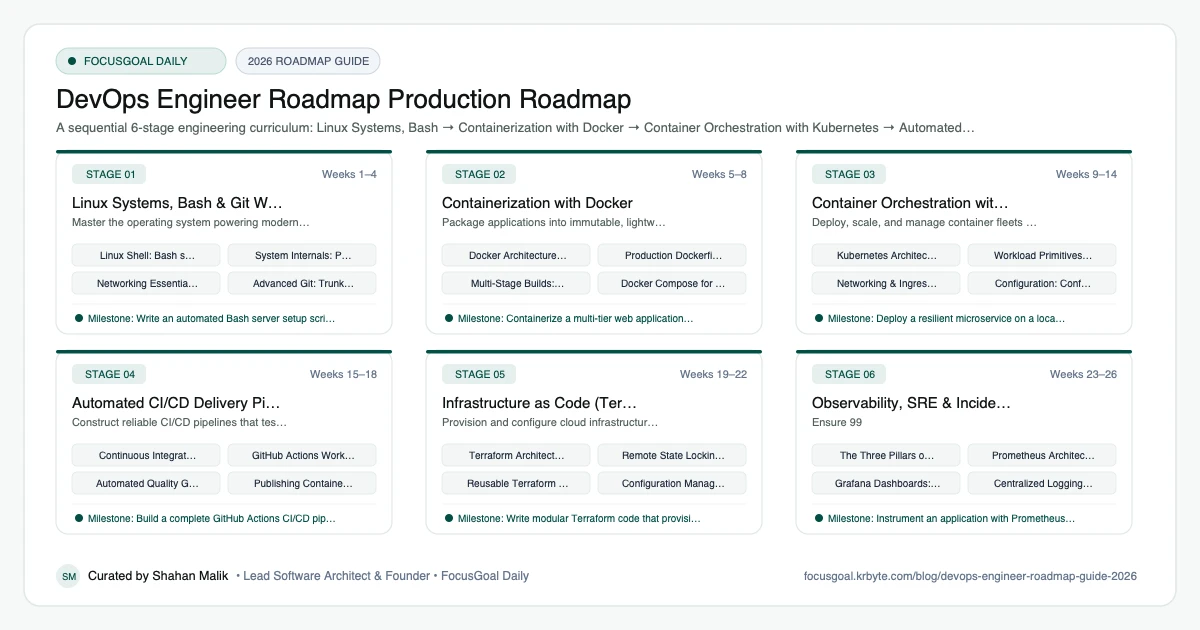
The 6 Production Stages
Follow these structured, sequential stages to systematically build production competence:
Linux Systems, Bash & Git Workflows
Master the operating system powering modern cloud servers, command-line tools, and version control branching.
Containerization with Docker
Package applications into immutable, lightweight container environments with multi-stage builds.
Container Orchestration with Kubernetes
Deploy, scale, and manage container fleets in production with industry-standard Kubernetes (K8s).
Automated CI/CD Delivery Pipelines
Construct reliable CI/CD pipelines that test, build, lint, and deploy code on every Git push. For automated quality gates and browser test sharding, see our dedicated QA Roadmap 2026.
Infrastructure as Code (Terraform & Ansible)
Provision and configure cloud infrastructure programmatically using declarative code.
Observability, SRE & Incident Response
Ensure 99.99% system availability through metrics telemetry, structured logs, and automated alerts.
Is a DevOps Career Worth It in 2026?
If you like automating repetitive work and keeping systems reliable, DevOps remains a strong direction. Teams that ship software frequently need people who own CI/CD pipelines, container platforms, and the practices that keep deployments safe. The related SRE discipline adds a reliability focus: service level objectives, incident response, and capacity planning.
The caveat is that DevOps is rarely a first job. Many engineers arrive from software development or system administration, and the toolchain changes quickly. Demand and pay vary by region and company size, so verify against current local job listings.
- Good fit if you enjoy tooling, scripting, and debugging production behavior.
- On-call work is common, so ask about it when interviewing.
- Learning curve: Linux and Git first, then containers, then orchestration.
DevOps vs SRE vs Platform Engineering: Which to Learn First
The titles overlap, and companies use them inconsistently. DevOps usually centers on delivery pipelines and automation, SRE on reliability targets and incident learning, and platform engineering on building internal tools that make other developers faster. The first skills are the same: Linux, Git, networking basics, and a scripting language.
Start with CI/CD and containers, because both appear in nearly every job description. Move toward SRE if you like metrics and failure analysis, or platform work if you like building developer-facing products. For the infrastructure side, read the Cloud Computing roadmap.
- DevOps: pipelines, release automation, infrastructure as code.
- SRE: SLOs, monitoring, incident response, postmortems.
- Platform engineering: internal tooling and golden paths.
DevOps Setup: Tools You Need
You can build a convincing practice environment on a laptop. Install a Linux environment, Git, Docker, and a local Kubernetes option such as kind or minikube. Add a CI system you can run for free on a public repository, for example GitHub Actions, and a code editor with YAML support.
Then layer in infrastructure as code with Terraform or OpenTofu, a configuration tool such as Ansible, and a monitoring stack like Prometheus and Grafana. Learn one at a time and keep everything in version control.
- Linux shell, Git, and a scripting language (Bash or Python).
- Docker and a local Kubernetes cluster.
- A CI/CD service connected to a real repository.
- Prometheus and Grafana for visibility.
DevOps Portfolio Projects & How to Get a Job
A good DevOps portfolio shows a full path from commit to running service. Take a small application, containerize it, test it in a pipeline, deploy it to Kubernetes, and add monitoring and alerts. Publish the repository with a clear README that explains each decision and how to reproduce it.
On your resume describe outcomes such as faster, safer deployments rather than listing tools. In interviews expect questions on debugging a failing deployment, rollback strategy, and how you would reduce risk in a release, so practice walking through a real failure you caused and fixed in your lab.
- Build a CI/CD pipeline with tests, image build, and automatic deploy.
- Deploy a multi-service app on Kubernetes with health checks.
- Provision infrastructure with Terraform and document teardown.
- Write a postmortem for a deliberately broken release.
Beginner Pitfalls vs Production Reality
Self-taught developers commonly waste months making avoidable structural mistakes. Here is how production engineers approach these challenges:
Master DevOps Discipline with FocusGoal Daily
DevOps encompasses hundreds of tools, practices, and systems. FocusGoal Daily keeps you grounded by structuring the entire DevOps roadmap into focused daily milestones.
- Structured curriculum from Linux and Docker to Kubernetes, CI/CD, and SRE.
- 100% offline study support powered by local SQLite database on Android.
- In-app Ask AI tutor to clarify Kubernetes manifests, Dockerfile caching, and PromQL.
- Daily streak tracking to maintain study momentum without cognitive overload.
Track this roadmap,
one topic at a time.
Download FocusGoal, pick this roadmap and finish your first daily topic in minutes.
Frequently Asked Questions
What programming languages should a DevOps engineer learn?
Bash and Python are essential for daily automation. Learning Go is also highly valuable since Docker, Kubernetes, and Terraform are all written in Go.
What is the difference between DevOps and SRE?
DevOps focuses broadly on unifying software development and IT operations to accelerate delivery. Site Reliability Engineering (SRE) is Google's specific implementation of DevOps focused on reliability, uptime, SLOs, and incident response.
How long does it take to become a hireable DevOps engineer?
With daily focused practice of 2 hours following this roadmap, most engineers with basic programming or IT background transition into junior-to-mid DevOps roles within 5 to 6 months.
Is DevOps a good career in 2026?
Yes for people who enjoy automation and operations, since software teams still need reliable delivery and infrastructure. It is usually reached after some development or sysadmin experience, and demand varies by region.
What is the difference between DevOps and SRE?
DevOps focuses on automating how software is built, tested, and released, while SRE applies engineering to reliability using targets, monitoring, and incident learning. In practice the roles overlap heavily.
Do I need to learn Kubernetes to become a DevOps engineer?
Not on day one, but it appears in many job descriptions. Learn Linux, Git, Docker, and CI/CD first, then Kubernetes.
Can a beginner become a DevOps engineer?
Most people take a stepping-stone role such as sysadmin, support, or junior developer first. You can prepare by building pipeline and container projects in your own lab.
Which programming language should a DevOps engineer learn?
Python or Go are common choices, with Bash for everyday shell automation. Pick one and use it to automate real tasks.
How does FocusGoal Daily help DevOps engineers?
FocusGoal Daily turns the sprawling DevOps ecosystem into manageable daily learning checklists with offline streak tracking on Android.
Start Your DevOps Engineer Roadmap Today
Follow structured daily goals, study 100% offline with local SQLite, and get on-demand AI guidance with FocusGoal Daily on Android.
Get FocusGoal Daily Free on Google Play