Cloud Computing Roadmap (2026): AWS, Enterprise Architecture & Serverless Guide
Master enterprise cloud computing: cloud service models, AWS core architecture (VPC, IAM, EC2, S3), Serverless microservices, cloud security, and financial cost governance (FinOps).

What's in this guide
The Short Answer: Cloud Computing in 2026
Over 90% of global enterprises now run their core applications in the cloud. Cloud computing is no longer just about renting virtual machines; it is about designing resilient, elastic distributed architectures that scale automatically and withstand regional infrastructure failures.
In 2026, AWS remains the enterprise market leader (~32% market share), alongside Microsoft Azure and Google Cloud. Professional cloud engineers distinguish themselves by understanding networking boundaries (VPCs, route tables, subnets), zero-trust IAM policies, and cloud cost governance.
Just getting started? Read how to become a cloud engineer step by step for the beginner-first plan.
Design for failure. Leverage cloud managed services, strict least-privilege IAM policies, and automated autoscaling to build fault-tolerant systems.
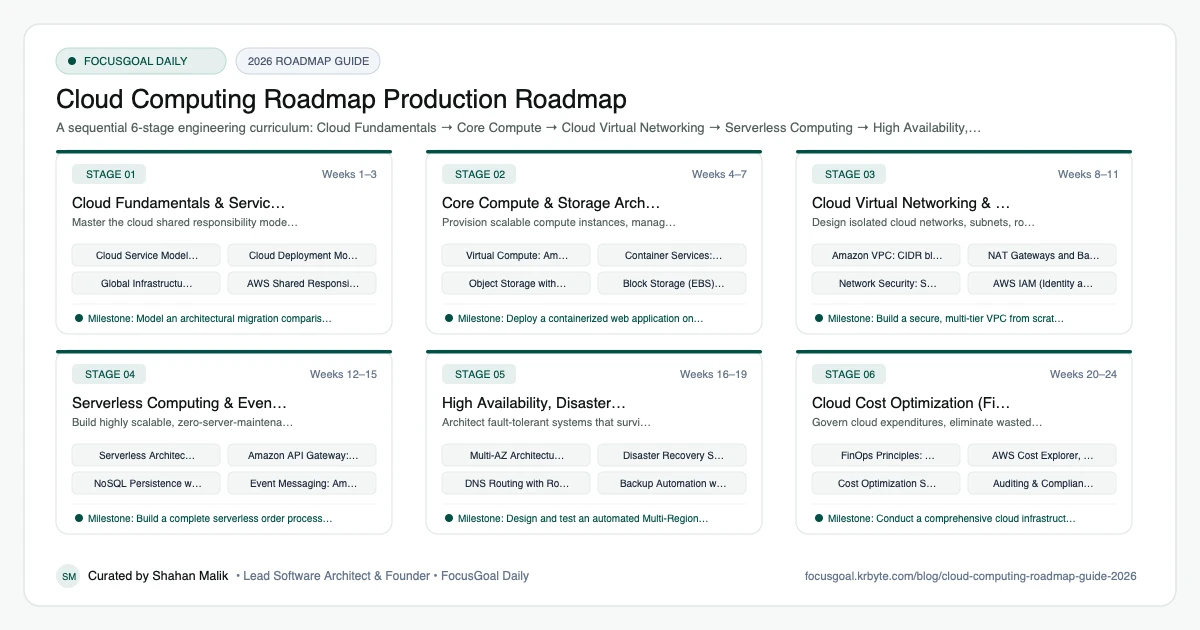
The 6 Production Stages
Follow these structured, sequential stages to systematically build production competence:
Cloud Fundamentals & Service Models (IaaS, PaaS, SaaS)
Master the cloud shared responsibility model, global infrastructure, and service classifications.
Core Compute & Storage Architecture (EC2, ECS, S3)
Provision scalable compute instances, manage container fleets, and architect durable object storage.
Cloud Virtual Networking & Security (VPC & IAM)
Design isolated cloud networks, subnets, route tables, and strict identity permissions.
Serverless Computing & Event-Driven Systems
Build highly scalable, zero-server-maintenance applications using AWS Lambda, API Gateway, and SQS/SNS.
High Availability, Disaster Recovery & Multi-Region
Architect fault-tolerant systems that survive data center outages and disaster scenarios.
Cloud Cost Optimization (FinOps) & Certifications
Govern cloud expenditures, eliminate wasted spend, and prepare for industry cloud certifications.
Is Cloud Computing Worth Learning in 2026?
Cloud skills are useful in almost every technical path, because most new applications run on one of the major providers. Understanding compute, storage, networking, identity, and cost lets you design systems that scale and recover from failure, whether your title is cloud engineer, solutions architect, or backend developer.
The caveat is that cloud knowledge is easiest to learn alongside real workloads, and providers change features constantly. Certifications help you structure study but do not replace hands-on practice. Check current local job listings for the provider your market prefers.
- Good fit if you like system design and trade-off thinking.
- Cost awareness is a core skill, not an afterthought.
- Concepts transfer between providers, even when service names differ.
AWS vs Azure vs GCP: Which to Learn First
AWS has the broadest set of services and is widely used by startups and large companies. Azure is common in organizations built around Microsoft products and Active Directory. Google Cloud is popular for data, analytics, and Kubernetes-heavy teams. None is universally best; the right first choice is the one your target employers use.
Learn the shared concepts first: virtual machines, object storage, managed databases, virtual networks, IAM, and load balancing. Once you know them on one provider, a second is much faster. For the delivery side, see the DevOps Engineer roadmap.
- Check local job listings to see which provider dominates.
- Pick one and go deep before learning a second.
- Pursue the provider's entry-level certification as a study guide.
Cloud Setup & Certification Paths
All three providers offer a free tier or credits for new accounts, though terms change, so read the current terms and set billing alerts before you start. You also need the provider's command-line tool, an infrastructure-as-code tool such as Terraform, and an editor.
Each provider has a fundamentals certification, an associate-level architect or administrator certification, and professional or specialty tracks. A sensible path is fundamentals, then associate, then a specialty that matches your work. Use official exam guides for current objectives.
- Create a budget alert before launching any resource.
- Install the CLI and use it, not just the console.
- Use official exam guides to define your study scope.
Cloud Portfolio Projects & How to Get a Job
Show that you can design for reliability and cost. Build a three-tier web application with a load balancer, managed database, private networking, and least-privilege IAM, then describe it in an architecture diagram and README.
On your resume include a diagram, the trade-offs you considered, and any certification. In interviews expect design questions such as how you would make a service survive a zone failure or reduce a monthly bill, so practice sketching and justifying architectures.
- Deploy a static site with a CDN and custom domain.
- Build a serverless API with a managed database.
- Create a multi-zone web app defined entirely in Terraform.
- Write a short cost-optimization review of your own project.
Beginner Pitfalls vs Production Reality
Self-taught developers commonly waste months making avoidable structural mistakes. Here is how production engineers approach these challenges:
Master Cloud Architecture with FocusGoal Daily
Cloud computing demands mastering dozens of services, networking protocols, and security guardrails. FocusGoal Daily structures this vast syllabus into achievable daily micro-actions.
- Curated curriculum aligned with AWS Solutions Architect and enterprise cloud engineering.
- 100% offline study support powered by local SQLite database on Android.
- In-app Ask AI tutor to clarify VPC subnetting, IAM JSON policies, and serverless cold starts.
- Daily streak tracking to maintain consistent study discipline.
Track this roadmap,
one topic at a time.
Download FocusGoal, pick this roadmap and finish your first daily topic in minutes.
Frequently Asked Questions
Which cloud provider should I learn first: AWS, Azure, or Google Cloud?
AWS is recommended for most beginners due to its leading market share (~32%), extensive documentation, and largest volume of job openings. Core cloud concepts translate smoothly across all three providers.
Is the AWS Solutions Architect Associate certification worth it?
Yes. The AWS SAA certification is one of the most respected and recognized credentials in the technology industry, validating broad architectural capability.
Can I learn cloud computing for free without a massive bill?
Yes. The AWS Free Tier provides 12 months of free access to EC2, S3, RDS, and Lambda. Always set up an AWS Budget alert with a $5 limit to prevent unexpected charges.
Which cloud should I learn first: AWS, Azure, or GCP?
Learn the one most used by employers in your market, since job listings reveal that quickly. The core concepts transfer, so a second provider is easier later.
Are cloud certifications worth it?
They are useful for structuring study and can help get interviews, but hands-on projects matter as much. Treat them as a complement to a portfolio.
Can I learn cloud computing without paying?
Mostly yes, using free tiers, credits, and free documentation, but terms change and mistakes can cost money. Set billing alerts and delete resources when you finish.
What is the difference between a cloud engineer and a DevOps engineer?
Cloud engineers focus on designing and operating infrastructure on a provider, while DevOps engineers focus on delivery pipelines and automation. Many roles combine both.
Do I need to code to work in cloud computing?
Basic scripting and infrastructure-as-code skills are expected for most roles. You do not need to be a software engineer, but you should automate rather than click.
How does FocusGoal Daily help cloud architects?
FocusGoal Daily breaks down the expansive cloud certification syllabus into manageable daily learning checklists with offline progress tracking on Android.
Start Your Cloud Computing Roadmap Today
Follow structured daily goals, study 100% offline with local SQLite, and get on-demand AI guidance with FocusGoal Daily on Android.
Get FocusGoal Daily Free on Google Play