Robotics Engineering Roadmap (2026): Building Autonomous Intelligent Machines
Learn how to build autonomous robotic systems. Master spatial mathematics, Denavit-Hartenberg kinematics, ROS 2 middleware, LiDAR SLAM, and real-time obstacle avoidance planning.

What's in this guide
The Short Answer: Robotics Engineering in 2026
Robotics represents the convergence of mechanical design, embedded electronics, and modern artificial intelligence. In 2026, robotics engineering has shifted permanently toward ROS 2 (Robot Operating System 2), edge compute with NVIDIA Jetson, 3D LiDAR perception, and foundation models for robotic manipulation.
Becoming a robotics engineer requires mastering the mathematical transformation between coordinate frames (quaternions, rotation matrices, transformation trees) alongside software architecture in C++ and Python.
Never underestimate sensor noise and transformation frame drift. Master TF2 in ROS 2 and Kalman filtering early; flawed coordinate math will break both SLAM and manipulation.
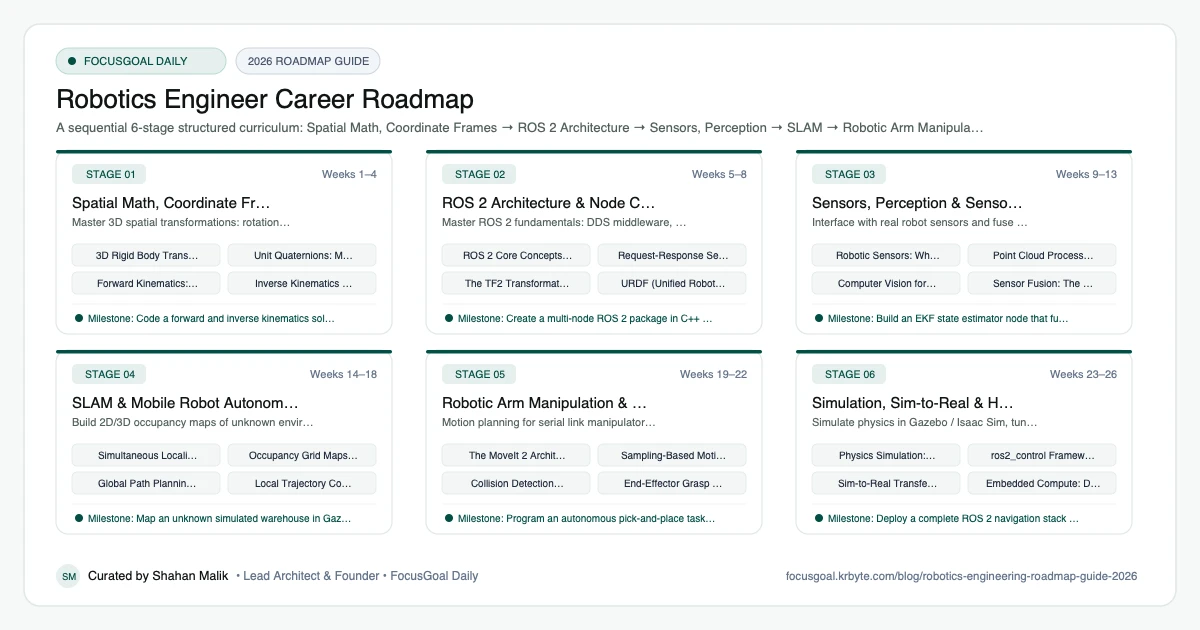
The 6 Production Stages
Follow these structured, sequential stages to systematically build production competence:
Spatial Math, Coordinate Frames & Kinematics
Master 3D spatial transformations: rotation matrices, Euler angles, unit quaternions, homogeneous transformation matrices, and forward/inverse kinematics.
ROS 2 Architecture & Node Communications
Master ROS 2 fundamentals: DDS middleware, nodes, topics, services, actions, custom message types, and TF2 coordinate frame trees.
Sensors, Perception & Sensor Fusion (Extended Kalman Filters)
Interface with real robot sensors and fuse noisy data streams using state estimation algorithms.
SLAM & Mobile Robot Autonomous Navigation (Nav2)
Build 2D/3D occupancy maps of unknown environments and navigate autonomously with obstacle avoidance using Nav2.
Robotic Arm Manipulation & MoveIt 2
Motion planning for serial link manipulators, collision-free trajectory generation, and pick-and-place pipelines.
Simulation, Sim-to-Real & Hardware Deployment
Simulate physics in Gazebo / Isaac Sim, tune controllers, and deploy software stacks to physical hardware.
Is Robotics Engineering a Good Career in 2026?
Robotics draws demand from manufacturing automation, warehousing and logistics, agriculture, healthcare, inspection, and research. Interest in autonomy and AI keeps the field visible, but it is a competitive area with a mix of research-heavy and applied roles.
Honest caveats: robotics is multidisciplinary, so you must be reasonably good at mechanics, electronics, and software at once. Some companies are small or research-funded, so stability varies. Check local job listings and industry reports for demand in your region.
- Good fit if you enjoy integration problems across hardware and software.
- Many roles are really controls, perception, or software engineering with a robotics focus.
- Portfolio projects carry unusual weight.
Software & Tools Robotics Engineers Use
Robotics work centres on a middleware framework, simulators, and mainstream programming languages. ROS 2 is widely used in research and industry for messaging between components.
Learn to test in simulation before hardware, because it saves time and protects equipment.
- Frameworks: ROS and ROS 2.
- Languages: C++ and Python.
- Simulation: Gazebo, Webots, NVIDIA Isaac Sim, MATLAB/Simulink.
- Vision and perception: OpenCV and point cloud libraries.
- Hardware: microcontrollers, motor drivers, IMUs, LiDAR, cameras.
Degrees, Licensing & How to Get Your First Robotics Engineering Job
Common routes are bachelor's degrees in mechanical, electrical, computer, or mechatronics engineering, sometimes followed by a master's degree for research or perception roles. Licensing is generally not required for robotics software or design roles, though safety-related and machinery-compliance work may follow regional standards. Requirements vary by country, so check your local body.
Employers look for evidence that you can build and debug a full system. Compete in robotics contests, contribute to open-source ROS packages, and publish a project with video, code, and an honest list of what failed.
- Build one end-to-end robot, even a small wheeled platform.
- Join university robotics clubs or competitions.
- Contribute to open-source robotics projects.
- Look for internships in automation, labs, or startups.
Beginner Pitfalls vs Production Reality
Self-taught developers commonly waste months making avoidable structural mistakes. Here is how production engineers approach these challenges:
Master Robotics Engineering with FocusGoal Daily
Robotics combines linear algebra, sensor mathematics, and distributed software systems. FocusGoal Daily keeps you on track with clean, structured daily milestones.
- Daily micro-tasks for D-H kinematics, ROS 2 commands, and navigation parameters.
- Track offline study streaks while debugging physical hardware at the lab bench.
- AI concept tutor for immediate explanations of quaternion math, SLAM loop closures, and costmap layers.
Track this roadmap,
one topic at a time.
Download FocusGoal, pick this roadmap and finish your first daily topic in minutes.
Frequently Asked Questions
Do I need a physical robot to learn robotics engineering?
No. High-fidelity simulators like Gazebo Harmonic and NVIDIA Isaac Sim allow you to simulate complete mobile robots, LiDARs, and industrial arms with accurate physics before spending money on hardware.
Should I learn ROS 1 or ROS 2?
ROS 2 exclusively. ROS 1 is officially end-of-life (EOL) and the entire robotics industry has transitioned to ROS 2 for its native DDS support, real-time capabilities, and security.
What programming languages are essential?
Modern C++ (C++17/C++20) for performance-critical sensor drivers and control loops, and Python for rapid prototyping, perception pipelines, and ROS 2 launch scripts.
What does a robotics engineer do?
A robotics engineer designs, builds, programs, and tests robots and automated systems. Responsibilities can include mechanism design, sensor integration, control algorithms, and software for navigation or manipulation.
Is robotics engineering hard?
It is challenging because it spans mechanics, electronics, and programming. Starting with small projects and learning one layer at a time makes it approachable.
How long does it take to become a robotics engineer?
Many people complete a four-year engineering degree and then specialise through projects, internships, or a master's degree. Timelines vary by country and background.
Robotics vs mechanical engineering: which should I study?
Pick mechanical if you want a broad, widely recognised degree you can specialise from. Pick a robotics or mechatronics programme if one exists and you already know you want an integrated hardware-software focus.
Do I need to know programming to be a robotics engineer?
Yes, at least Python and usually C++. Even mechanically focused robotics roles benefit from understanding control code and simulation.
Start Your Robotics Engineer Today
Follow structured daily goals, study 100% offline with local SQLite, and get on-demand AI guidance with FocusGoal Daily on Android.
Get FocusGoal Daily Free on Google Play