Artificial Intelligence Roadmap (2026): LLMs, Autonomous Agents & Production RAG Guide
Master the modern AI developer stack: prompt orchestration, structured JSON outputs, vector embeddings, hybrid RAG pipelines, autonomous multi-agent systems, and local LLM serving.

What's in this guide
The Short Answer: Applied AI in 2026
Artificial Intelligence engineering in 2026 is one of the highest-impact specializations in technology. While researchers focus on training foundation models from scratch, applied AI engineers build software systems that leverage, orchestrate, and ground models into real business workflows.
Building production AI systems is far more demanding than calling a basic completion endpoint. It requires mastering context window economics, semantic chunking, embedding distance metrics, hallucination guardrails, and deterministic tool-calling workflows.
Just getting started? Read how to become a machine learning engineer for the beginner-first plan.
Move beyond simple prompts. Master hybrid vector retrieval, structured outputs, multi-agent state machines, and local model inference to build reliable enterprise AI systems.
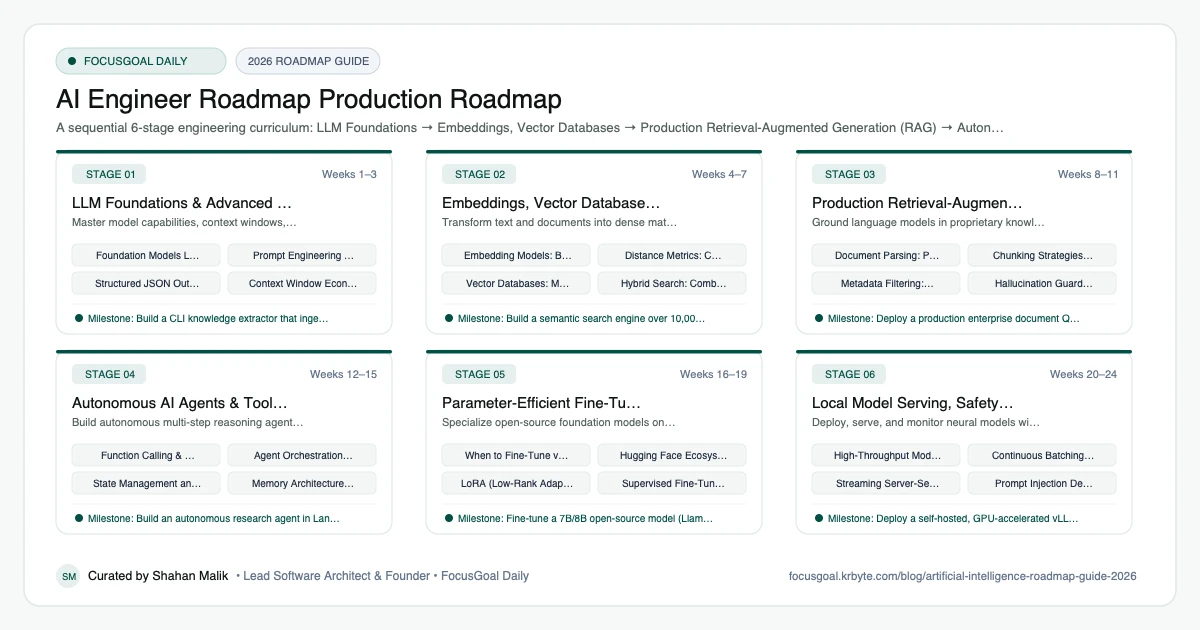
The 6 Production Stages
Follow these structured, sequential stages to systematically build production competence:
LLM Foundations & Advanced Prompt Engineering
Master model capabilities, context windows, few-shot prompting, and structured output formatting.
Embeddings, Vector Databases & Semantic Search
Transform text and documents into dense mathematical vectors and query them with sub-millisecond similarity search.
Production Retrieval-Augmented Generation (RAG)
Ground language models in proprietary knowledge bases with high-accuracy retrieval and citation tracking.
Autonomous AI Agents & Tool Calling
Build autonomous multi-step reasoning agents that execute tools, browse data, and coordinate tasks.
Parameter-Efficient Fine-Tuning (PEFT/LoRA)
Specialize open-source foundation models on custom domains with low-rank adaptation.
Local Model Serving, Safety & Latency Optimization
Deploy, serve, and monitor neural models with low-latency streaming and concurrency.
Is an AI Engineering Career Worth It in 2026?
For people who like building software, yes: companies of all sizes are adding LLM features such as assistants, search, document processing, and workflow automation, and they need engineers who can make those features reliable. The role is closer to software engineering than to research. You spend your time on prompts, retrieval, evaluation, latency, cost, and safety rather than inventing new model architectures.
The honest caveats: the tooling changes quickly, so any framework you learn may be replaced, and a demo that works once is very different from a product that works every day. Employers value people who can measure quality and handle failure. Pay and demand vary widely by country and company, so check current local job listings rather than trusting a headline number.
- Best fit: developers who enjoy APIs, data plumbing, and product thinking.
- Learning curve: calling a model is easy; evaluation, retrieval quality, and guardrails take months of practice.
- Durable skills: Python, API design, testing, observability, and clear written specifications.
AI Engineer vs ML Engineer vs Data Scientist: Which to Learn First
If your goal is shipping LLM-powered products, start with the AI engineering path: prompting, structured outputs, RAG, tool use, and agents. If you want to train and tune your own models, you need the maths and modeling depth covered in the Machine Learning Roadmap. If you mostly want to answer business questions with data, the Data Analyst Roadmap is the faster entry point.
The paths overlap, and you can switch later. Strong Python and a habit of testing your work help in all three. If you are unsure where to begin, the beginner-first AI and Machine Learning Roadmap explains how the fields differ.
AI Engineering Setup: Tools You Need
You do not need a powerful GPU to start. A laptop, Python 3.10 or newer, a virtual environment, and an API key from a model provider are enough for most early projects. Add Git from day one so you can track prompt and code changes together. For local experiments, tools such as Ollama or LM Studio let you run small open models on a consumer machine, though speed depends on your RAM and hardware.
As projects grow, add a vector store, a tracing or evaluation tool, and a simple web framework to expose your work as an API.
- Python with a virtual environment and a notebook or editor you like.
- A hosted model API plus one local runner for offline experiments.
- A vector database or a Postgres extension for embeddings.
- FastAPI or a similar framework to serve your app.
- An evaluation set of real questions with expected answers, kept in version control.
AI Portfolio Projects and How to Get an AI Engineer Job
Hiring managers want evidence that you can build something that works and know when it does not. Choose projects with a real user and a measurable result, and write up what failed. A short README showing your evaluation method is worth more than a flashy demo.
In interviews, expect to explain trade-offs: when to use RAG versus fine-tuning, how you would reduce hallucinations, how you would control cost, and how you would defend against prompt injection. Practice explaining these with examples from your own projects.
- A RAG assistant over a real document set, with a test set measuring answer quality.
- A tool-using agent with a human approval step for risky actions.
- A structured-extraction pipeline that turns messy text into validated JSON.
- A cost and latency dashboard comparing two models on the same task.
- A short blog post or demo video for each project, linked from your resume.
Beginner Pitfalls vs Production Reality
Self-taught developers commonly waste months making avoidable structural mistakes. Here is how production engineers approach these challenges:
Master AI Engineering with FocusGoal Daily
Artificial Intelligence changes daily. FocusGoal Daily keeps you grounded by structuring this vast, fast-moving landscape into disciplined daily micro-goals.
- Structured path covering Prompt Engineering, Vector Search, RAG, and AI Agents.
- 100% offline study support powered by local SQLite database on Android.
- In-app Ask AI tutor for immediate explanations of embedding spaces, LoRA, and LangGraph.
- Daily streak tracking to maintain study momentum without cognitive burnout.
Track this roadmap,
one topic at a time.
Download FocusGoal, pick this roadmap and finish your first daily topic in minutes.
Frequently Asked Questions
What is the difference between an AI Engineer and a Machine Learning Engineer?
An AI Engineer primarily works with foundation models, LLMs, prompt engineering, RAG, and application integration. A Machine Learning Engineer focuses more on data pipelines, training algorithms, loss functions, and custom neural architectures.
Do I need to be a Python expert to learn AI?
Intermediate Python is essential, as the vast majority of AI libraries (LangChain, LlamaIndex, PyTorch, Hugging Face) are Python-native.
Can I run modern AI models locally on my laptop?
Yes. Tools like Ollama and LM Studio allow you to run quantized 4-bit open-source models (Llama 3 8B, Gemma 2, Mistral) smoothly on modern consumer laptops with 16GB+ RAM.
How do I become an AI engineer with no experience?
Start with solid Python, then learn to call model APIs, build a small RAG app, and measure its quality. Publish two or three projects with write-ups, since proof of work matters more than certificates.
Do I need a degree to get an AI engineering job?
Not always, but requirements vary by employer. A degree helps in research roles, while application-focused AI engineering roles often weigh projects and software skills heavily. Check the job listings in your target market.
What is RAG and why do AI engineers need it?
RAG (retrieval-augmented generation) fetches relevant documents and gives them to a model along with the question. It lets a model answer from your own up-to-date data without retraining it.
Will AI replace AI engineers?
Nobody can say for certain, but tools that automate parts of the work still need people to specify requirements, evaluate outputs, and handle failures. Engineers who focus on evaluation, reliability, and domain knowledge are best placed.
What should I learn first: prompt engineering or Python?
Learn Python first. Prompting is quick to pick up, but Python lets you automate, test, and integrate it into real applications.
How does FocusGoal Daily help AI engineers?
FocusGoal Daily turns the sprawling AI curriculum into actionable daily learning milestones with offline progress tracking on Android.
Start Your AI Engineer Roadmap Today
Follow structured daily goals, study 100% offline with local SQLite, and get on-demand AI guidance with FocusGoal Daily on Android.
Get FocusGoal Daily Free on Google Play