Embedded Systems Roadmap (2026): Low-Level C, ARM Cortex & RTOS Guide
Master hardware-level firmware engineering using modern C, ARM Cortex-M microcontrollers (STM32/ESP32), register manipulation, peripheral buses (SPI, I2C, UART), and FreeRTOS multitasking.

What's in this guide
The Short Answer: Embedded Engineering in 2026
Embedded systems power the physical world: medical devices, automotive control units, aerospace avionics, and smart consumer IoT. In 2026, embedded firmware is dominated by ARM Cortex-M microcontrollers and low-power wireless SoCs (ESP32, Nordic nRF52).
Unlike web development where memory is virtually unlimited, embedded engineers work with kilobytes of RAM and milliwatt power budgets. True engineering competence comes from reading hardware datasheets, manipulating register bits directly, and writing deterministic firmware.
Understand the silicon. Master bitwise operations, memory-mapped I/O, interrupt service routines, and FreeRTOS concurrency to build reliable hardware firmware.
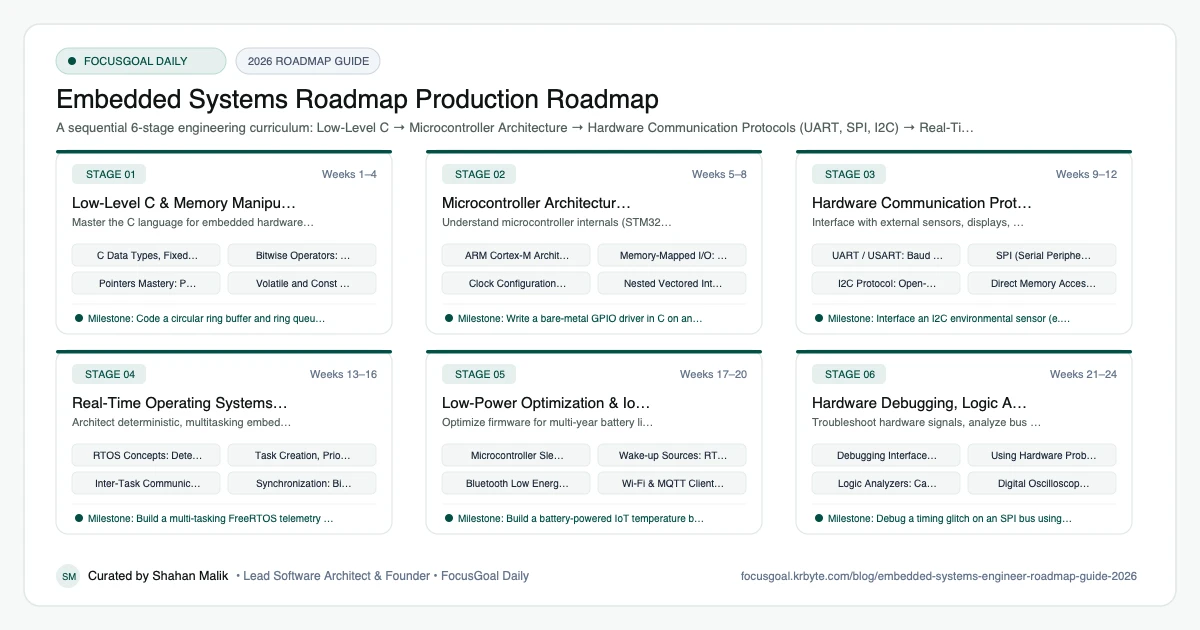
The 6 Production Stages
Follow these structured, sequential stages to systematically build production competence:
Low-Level C & Memory Manipulation
Master the C language for embedded hardware: pointers, bitwise arithmetic, memory alignment, and struct padding.
Microcontroller Architecture & Bare-Metal Programming
Understand microcontroller internals (STM32 or ESP32), memory-mapped registers, and Interrupt Service Routines (ISRs).
Hardware Communication Protocols (UART, SPI, I2C)
Interface with external sensors, displays, and memories using standard hardware serial communication buses.
Real-Time Operating Systems (FreeRTOS)
Architect deterministic, multitasking embedded applications using FreeRTOS tasks, queues, and semaphores.
Low-Power Optimization & IoT Connectivity
Optimize firmware for multi-year battery lifespans and transmit data via low-power wireless protocols (BLE / Wi-Fi).
Hardware Debugging, Logic Analyzers & Oscilloscopes
Troubleshoot hardware signals, analyze bus protocols, and debug firmware using hardware probes and SWD.
Is Embedded Systems Engineering Worth It in 2026?
For people who like working close to hardware, yes. Embedded engineers build the firmware inside devices such as sensors, appliances, medical equipment, vehicles, and industrial controllers. That work is not going away as more products become connected, and it rewards careful, low-level thinking.
The caveat is the learning curve: you combine C or C++, electronics basics, datasheets, and debugging with an oscilloscope or logic analyzer. Progress can feel slower than in web development. Demand varies by industry and region, so check current local job listings.
- Good fit if you enjoy hardware, constraints, and real-world behavior.
- Debugging is physical as well as logical.
- Many roles sit in automotive, industrial, medical, and consumer devices.
Embedded vs Electronics vs Robotics: Which to Learn First
Embedded engineering is firmware-centered, electronics engineering leans toward circuit and PCB design, and robotics adds motion, sensing, and control software on top. If you are stronger at programming, start with embedded; if you prefer circuits, see the Electronics Engineer roadmap.
Robotics is a natural next step once you are comfortable with microcontrollers, sensors, and control loops, as covered in the Robotics Engineer roadmap. Whichever route you choose, C and basic electronics are the shared foundation.
- Embedded: firmware, drivers, RTOS, communication protocols.
- Electronics: analog and digital design, PCBs.
- Robotics: control, perception, and integration.
Embedded Setup: Tools You Need
Start with an inexpensive development board such as an STM32 Nucleo, an ESP32, or an Arduino-compatible board, a USB cable, and a breadboard with common components. Install a toolchain such as the ARM GCC compiler with an editor, or the vendor IDE, plus Git.
As you progress, add a multimeter, a logic analyzer, and ideally an oscilloscope, because many bugs are visible only on the wire. Learn to read datasheets and reference manuals early; they are your primary documentation.
- A development board and breadboard kit.
- C toolchain, debugger, and Git.
- Multimeter and a logic analyzer; oscilloscope when possible.
- Datasheets and reference manuals as daily reading.
Embedded Portfolio Projects & How to Get a Job
Choose projects that show hardware interaction and good firmware structure. Include a short video of the device working, a schematic or wiring diagram, and source code with clear module boundaries. Employers like to see that you handled interrupts, timing, and communication correctly.
On your resume describe the constraints you managed, such as memory or power, rather than only the board used. In interviews expect questions on pointers, volatile, interrupts, and bus protocols like I2C and SPI, so review these thoroughly.
- A sensor data logger using I2C or SPI with timestamps.
- A motor controller with PWM and a simple PID loop.
- An RTOS-based multi-task device with a UART command interface.
- A low-power battery device with measured consumption notes.
Beginner Pitfalls vs Production Reality
Self-taught developers commonly waste months making avoidable structural mistakes. Here is how production engineers approach these challenges:
Master Embedded Engineering with FocusGoal Daily
Embedded firmware requires precise mastery of both hardware silicon and low-level software. FocusGoal Daily turns this deep technical syllabus into disciplined daily micro-goals.
- Curated curriculum covering low-level C, ARM registers, FreeRTOS, and hardware debugging.
- 100% offline study support powered by local SQLite database on Android.
- In-app Ask AI tutor to clarify registers, bitmasks, and FreeRTOS task synchronization.
- Daily streak tracking to maintain momentum toward senior firmware engineering.
Track this roadmap,
one topic at a time.
Download FocusGoal, pick this roadmap and finish your first daily topic in minutes.
Frequently Asked Questions
Which microcontroller board should I buy as a beginner?
An STM32 Nucleo board (e.g., STM32F401RE or STM32G4) or an ESP32 development board (ESP32-S3). Both are affordable ($10–$20) and supported by extensive professional tooling.
Is C or Rust better for embedded systems in 2026?
C is still the overwhelming industry standard (powering >80% of active firmware). Embedded Rust is growing rapidly for safety-critical systems. Learn C deeply first; transitioning to Rust will be much easier.
Do I need an electronics degree to become an embedded engineer?
No. While understanding basic circuit theory (Ohm's law, pull-ups, capacitors) is necessary, modern embedded engineering is primarily software development focused on silicon hardware.
Is embedded systems engineering a good career in 2026?
Yes for people who enjoy hardware and low-level programming, as connected devices continue to need firmware. Check local job listings to see which industries hire near you.
Which language should I learn for embedded systems?
C is the essential starting point, followed by C++ for larger projects. Python or MicroPython can help for prototyping.
Do I need an electrical engineering degree to work in embedded?
Not always, since many embedded engineers come from computer science or self-study. You do need solid electronics basics and demonstrable hardware projects.
Arduino vs STM32 vs ESP32: which should a beginner use?
Arduino-style boards are easiest for a first project, ESP32 is great for wireless projects, and STM32 teaches professional-style toolchains and peripherals. Many learners start simple and move to STM32.
What is an RTOS and do I need to learn it?
A real-time operating system schedules tasks with predictable timing, and it appears in many professional projects. Learn bare-metal basics first, then FreeRTOS or Zephyr.
How does FocusGoal Daily help embedded developers?
FocusGoal Daily organizes the dense embedded firmware syllabus into actionable daily learning checklists with offline access on Android.
Start Your Embedded Systems Roadmap Today
Follow structured daily goals, study 100% offline with local SQLite, and get on-demand AI guidance with FocusGoal Daily on Android.
Get FocusGoal Daily Free on Google Play