Aerospace Engineering Roadmap (2026): From Atmospheric Flight to Orbital Spacecraft
Learn how to design aircraft and spacecraft. Master compressible aerodynamics, gas turbine and rocket propulsion, orbital trajectory design, flight control avionics, and space-grade structures.

What's in this guide
The Short Answer: Aerospace Engineering in 2026
Aerospace engineering is the pinnacle of high-performance physics and systems engineering. From commercial sustainable aviation and hypersonic vehicles to reusable orbital launch vehicles and deep-space probes, aerospace engineers operate at the bleeding edge of structural limits, fluid dynamics, and automated control.
In 2026, the modern aerospace curriculum synthesizes classical aeronautics (Prandtl lifting-line theory, boundary layers) with computational fluid dynamics (CFD), state-of-the-art trajectory optimization, and robust autonomous GNC algorithms.
In aerospace, every gram of weight carries an exponential cost. Structural safety margins (typically 1.5x) are much tighter than civil engineering, requiring exact aerodynamic load modeling and aeroelastic flutter validation.
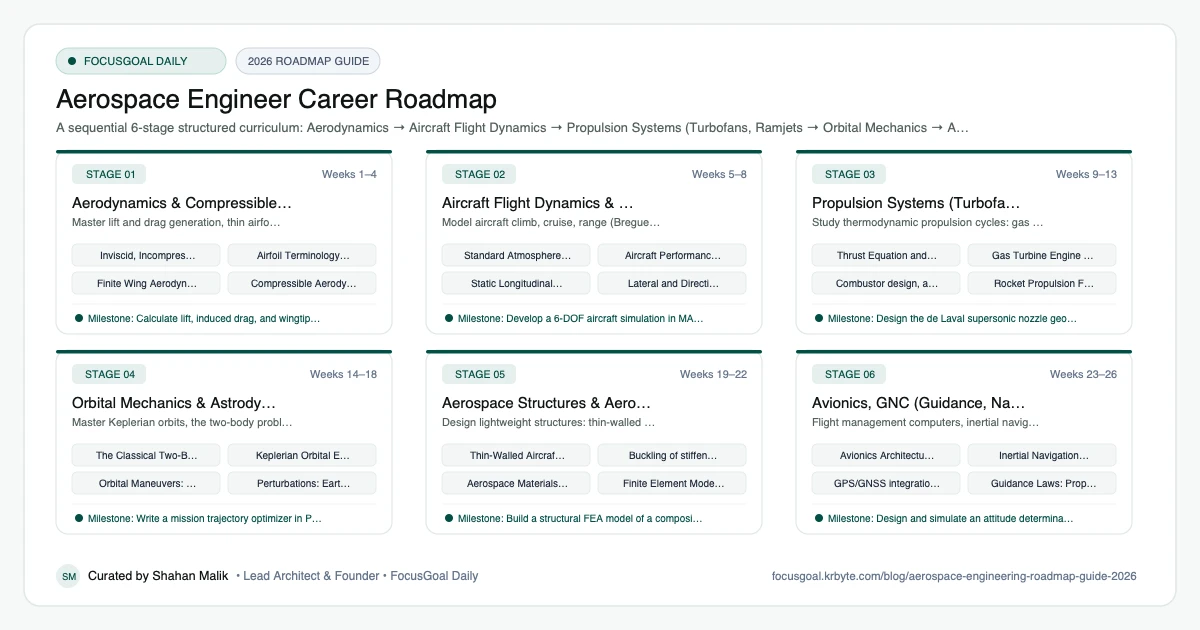
The 6 Production Stages
Follow these structured, sequential stages to systematically build production competence:
Aerodynamics & Compressible Flow
Master lift and drag generation, thin airfoil theory, finite wing vortex theory, shock waves, and supersonic expansion fans.
Aircraft Flight Dynamics & Performance
Model aircraft climb, cruise, range (Breguet equation), longitudinal/lateral stability, and dynamic flight modes.
Propulsion Systems (Turbofans, Ramjets & Rockets)
Study thermodynamic propulsion cycles: gas turbine jet engines, bypass turbofans, and chemical rocket engine nozzles.
Orbital Mechanics & Astrodynamics
Master Keplerian orbits, the two-body problem, orbital maneuvering (Hohmann transfers), and interplanetary trajectories.
Aerospace Structures & Aeroelasticity (Nastran)
Design lightweight structures: thin-walled shear webs, stringer-skin panels, fatigue analysis, and aeroelastic flutter.
Avionics, GNC (Guidance, Navigation & Control)
Flight management computers, inertial navigation systems (INS), Kalman filtering, and autopilot design.
Is Aerospace Engineering a Good Career in 2026?
Aerospace engineering covers aircraft, spacecraft, drones, and defence-related systems. Demand depends on commercial aviation cycles, government programmes, and the growth of private space and uncrewed systems, so hiring can be uneven by region and year.
Honest caveats: some roles require citizenship or security clearance, certain employers are concentrated geographically, and certification and safety processes make development slow and documentation-heavy. Check official labour statistics and company career pages for realistic local demand.
- Good fit if you like physics, rigorous process, and long-lifecycle products.
- Skills transfer well to automotive, energy, and robotics.
- Some positions have nationality or clearance restrictions.
Software & Tools Aerospace Engineers Use
Aerospace teams use CAD, analysis, and simulation tools, plus systems engineering practices to track requirements. Process matters as much as software in this field.
Learn the concepts behind each tool, such as finite element analysis and computational fluid dynamics, so you can sanity-check results.
- CAD: CATIA, Siemens NX, SolidWorks.
- Structures: Nastran, Abaqus, ANSYS Mechanical.
- Aerodynamics: ANSYS Fluent, OpenFOAM, XFLR5 for small-scale studies.
- Analysis and control: MATLAB/Simulink, Python.
- Process: requirements management and standards such as DO-178C for airborne software and AS9100 quality systems.
Degrees, Licensing & How to Get Your First Aerospace Engineering Job
Entry is usually through a bachelor's degree in aerospace or mechanical engineering. A PE licence is less common in aerospace than in civil engineering, but the FE exam may still be useful in the US. Requirements vary by country, so check your licensing body and employer requirements, including any security or citizenship conditions.
Build credibility through student rocketry, UAV, or CubeSat teams, internships with manufacturers or agencies, and projects such as a documented drone design or a trajectory simulation.
- Join student rocket, drone, or satellite teams.
- Seek internships with aircraft, space, or defence suppliers.
- Learn MATLAB or Python for simulation work.
- Check clearance or citizenship rules early.
Beginner Pitfalls vs Production Reality
Self-taught developers commonly waste months making avoidable structural mistakes. Here is how production engineers approach these challenges:
Master Aerospace Engineering with FocusGoal Daily
Aerospace engineering demands absolute precision across orbital equations, thermodynamic cycles, and aerodynamics. FocusGoal Daily structures your studies into disciplined daily milestones.
- Daily study goals for orbital mechanics, compressible flow formulas, and propulsion cycles.
- Track offline study streaks while in hangars, cleanrooms, or propulsion testing sites.
- AI concept tutor explaining de Laval nozzles, Tsiolkovsky equation, and Dutch roll dynamics on demand.
Track this roadmap,
one topic at a time.
Download FocusGoal, pick this roadmap and finish your first daily topic in minutes.
Frequently Asked Questions
What is the difference between Aeronautical and Astronautical Engineering?
Aeronautical engineering focuses on vehicles operating inside Earth's atmosphere (airplanes, helicopters, UAVs). Astronautical engineering focuses on vehicles operating in space (satellites, rockets, space stations, planetary rovers). Together, they form Aerospace Engineering.
Which tools are most critical in the aerospace industry?
MATLAB/Simulink is standard for GNC and flight dynamics. MSC Nastran is the gold standard for structural analysis, and ANSYS Fluent / Siemens STAR-CCM+ are industry standards for aerodynamic CFD.
Can I self-study aerospace engineering without physical aircraft access?
Yes. Open-source tools like XFLR5 (airfoil/wing analysis), OpenModelica, Orekit (orbit propagation), and flight simulators like X-Plane or JSBSim provide incredible environments for testing real physics.
What does an aerospace engineer do?
An aerospace engineer designs and analyses aircraft, spacecraft, and related systems, covering areas such as structures, aerodynamics, propulsion, and controls. Much of the work is analysis, testing, and documentation to meet safety requirements.
Is aerospace engineering hard?
It is a demanding degree with heavy maths and physics, including fluid mechanics and dynamics. Steady practice and hands-on team projects help considerably.
How long does it take to become an aerospace engineer?
A bachelor's degree typically takes about four years in many countries, and some roles prefer a master's degree. Timelines vary by country and employer.
Aerospace vs mechanical engineering: which is better?
Mechanical is broader and keeps more career options open, while aerospace is more specialised toward flight and space. Many aerospace engineers started with mechanical degrees.
Do aerospace engineers need a PE license?
Usually not, since most aerospace work is done under company quality systems. Requirements differ by country and employer, so check with your local licensing body.
Start Your Aerospace Engineer Today
Follow structured daily goals, study 100% offline with local SQLite, and get on-demand AI guidance with FocusGoal Daily on Android.
Get FocusGoal Daily Free on Google Play