Automotive Engineering Roadmap (2026): From Vehicle Dynamics to Electric Powertrains
Master the engineering behind modern vehicles. Learn chassis kinematics, electric vehicle battery packs, high-voltage inverters, CAN bus communication, AUTOSAR, and ADAS active safety.

What's in this guide
The Short Answer: Automotive Engineering in 2026
The automotive industry is undergoing the greatest technological revolution in its history: transitioning from internal combustion to software-defined electric vehicles. Modern automotive engineers design battery packs, write functional safety-compliant firmware, model tire friction under dynamic load transfer, and integrate sensor suites for active crash prevention.
In 2026, becoming an automotive engineer requires a blend of mechanical domain expertise (vehicle dynamics, chassis kinematics), electrical engineering (high-voltage 800V architectures, BMS), and embedded software (AUTOSAR, CAN bus).
Vehicle safety is governed by rigorous functional safety standards (ISO 26262). A software bug or mechanical failure in steering or braking can be fatal; every design must include fail-operational redundancy.
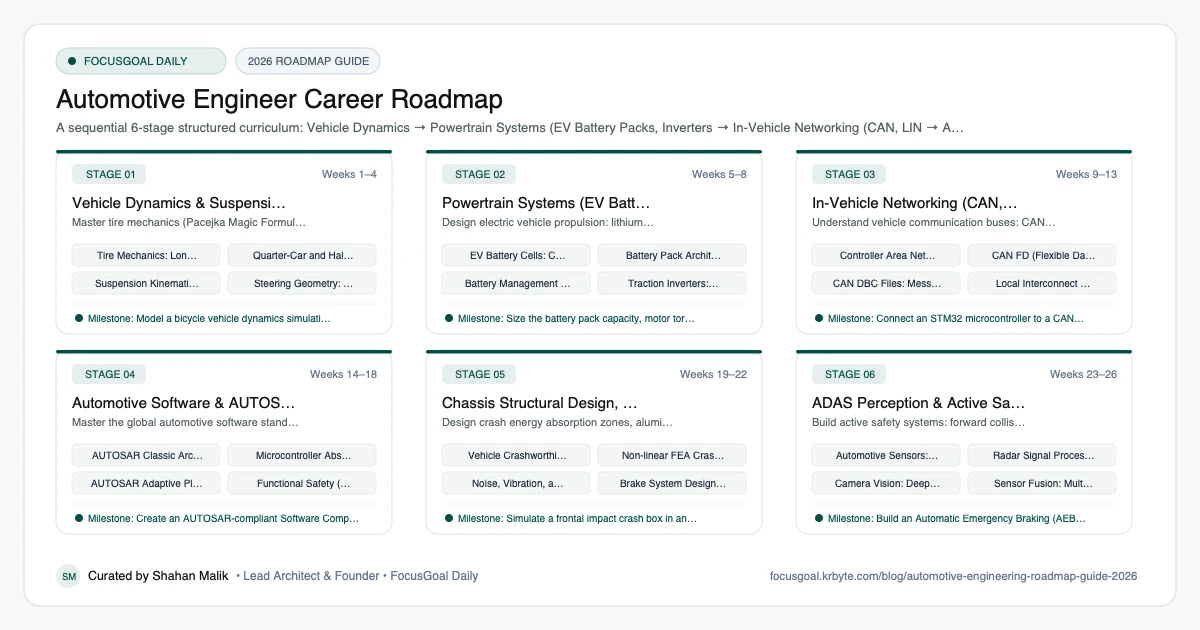
The 6 Production Stages
Follow these structured, sequential stages to systematically build production competence:
Vehicle Dynamics & Suspension Kinematics
Master tire mechanics (Pacejka Magic Formula), load transfer during braking and cornering, and suspension geometry.
Powertrain Systems (EV Battery Packs, Inverters & Motors)
Design electric vehicle propulsion: lithium battery chemistry, Battery Management Systems (BMS), thermal loops, and PMSM motors.
In-Vehicle Networking (CAN, LIN & Automotive Ethernet)
Understand vehicle communication buses: CAN 2.0B, CAN FD, LIN, FlexRay, and high-bandwidth Automotive Ethernet.
Automotive Software & AUTOSAR Architecture
Master the global automotive software standard: AUTOSAR Classic and Adaptive, RTE, and functional safety.
Chassis Structural Design, Crashworthiness & NVH
Design crash energy absorption zones, aluminum/steel unibody structures, and noise/vibration damping.
ADAS Perception & Active Safety (ISO 26262)
Build active safety systems: forward collision warning, automatic emergency braking (AEB), lane keep assist, and sensor fusion.
Is Automotive Engineering a Good Career in 2026?
The automotive industry is changing quickly, with electrification, software-defined vehicles, driver assistance, and new manufacturing methods reshaping jobs. This creates demand for engineers who understand batteries, power electronics, embedded software, and traditional vehicle dynamics.
Caveats: the industry is cyclical, tied to global supply chains and regulation, and some legacy roles are shrinking while new ones grow. Flexibility is key. Check national labour data and local manufacturer and supplier listings for current demand.
- Good fit if you are passionate about vehicles and systems integration.
- Growth areas include EV powertrains, ADAS, and vehicle software.
- Expect to work with large supplier networks and strict validation.
Software & Tools Automotive Engineers Use
Automotive teams use CAD, simulation, and model-based development tools, along with communication standards for in-vehicle networks. Knowing the vehicle architecture helps you understand where your component fits.
Functional safety is a major theme; ISO 26262 is the well-known standard for road-vehicle functional safety, and you will encounter its concepts in many electronics and software roles.
- CAD: CATIA, Siemens NX, SolidWorks.
- Simulation: MATLAB/Simulink, CarSim, Adams, ANSYS, GT-SUITE.
- Networks: CAN, LIN, and Automotive Ethernet with tools like CANalyzer.
- Software: AUTOSAR concepts, C and C++.
- Quality and safety: ISO 26262 and IATF 16949 concepts.
Degrees, Licensing & How to Get Your First Automotive Engineering Job
Most entrants hold a bachelor's degree in mechanical, electrical, mechatronics, or automotive engineering. Professional licensing is not typically required for vehicle design roles, though requirements vary by country, so check your local engineering body.
Student competitions such as Formula Student or Formula SAE, internships with OEMs and suppliers, and personal projects like an EV conversion study or CAN data logger are strong portfolio items. Document what you designed, tested, and learned.
- Join a Formula Student or Formula SAE team if available.
- Apply to supplier internships as well as OEMs.
- Learn Simulink or CAN basics for a practical edge.
- Check local registration rules with your engineering body.
Beginner Pitfalls vs Production Reality
Self-taught developers commonly waste months making avoidable structural mistakes. Here is how production engineers approach these challenges:
Master Automotive Engineering with FocusGoal Daily
Automotive engineering combines mechanical chassis dynamics, high-voltage battery electronics, and AUTOSAR software. FocusGoal Daily turns this wide curriculum into disciplined daily milestones.
- Daily micro-tasks for vehicle dynamics equations, CAN DBC parsing, and EV battery math.
- Track offline study streaks while in automotive workshops, testing tracks, or design studios.
- Instant AI explanations for Pacejka tire models, ISO 26262 ASIL ratings, and Field-Oriented Control.
Track this roadmap,
one topic at a time.
Download FocusGoal, pick this roadmap and finish your first daily topic in minutes.
Frequently Asked Questions
What software is standard in the automotive industry?
MATLAB/Simulink is the dominant industry standard for vehicle dynamics and Model-Based Design (MBD). CATIA and Siemens NX dominate CAD chassis modeling, while CANoe (Vector) is standard for network diagnostics.
How important is ISO 26262 for automotive engineers?
Crucial. ISO 26262 is the international functional safety standard for road vehicles. Any engineer working on steering, brakes, powertrains, or ADAS must understand ASIL ratings and safety case documentation.
Is ICE knowledge still useful with the rise of EVs?
While EV market share is growing rapidly, hybrid vehicles, commercial freight, and motorsports still rely heavily on combustion engines. However, new automotive graduates should prioritize EV powertrains, battery systems, and embedded software.
What does an automotive engineer do?
An automotive engineer designs, develops, and tests vehicles and their components, such as powertrains, chassis, body structures, and electronics. Work spans simulation, prototyping, validation, and coordination with suppliers and manufacturing.
Is automotive engineering hard?
It is challenging because vehicles combine mechanics, electronics, and software. A solid base in mechanical or electrical fundamentals plus hands-on projects makes it manageable.
How long does it take to become an automotive engineer?
A bachelor's degree usually takes about four years in many countries, and some people add a master's degree for specialisation. Timelines vary by country.
Automotive vs mechanical engineering: what is the difference?
Mechanical is the broader discipline, while automotive focuses on road vehicles and their systems. Many automotive engineers hold mechanical degrees.
Is automotive engineering still a good career with electric vehicles?
Yes, but the skills in demand are shifting toward batteries, power electronics, and software alongside classic vehicle engineering. Staying flexible across these areas is wise.
Start Your Automotive Engineer Today
Follow structured daily goals, study 100% offline with local SQLite, and get on-demand AI guidance with FocusGoal Daily on Android.
Get FocusGoal Daily Free on Google Play