Industrial Engineering Roadmap (2026): Optimizing Complex Human & Machine Systems
Learn how to eliminate waste, optimize production throughput, and design resilient supply chains. Master mathematical operations research, statistical process control, Lean manufacturing, and discrete-event simulation.

What's in this guide
The Short Answer: Industrial Engineering in 2026
Industrial engineering is about making complex systems operate faster, safer, cheaper, and with higher quality. While other engineers build parts, industrial engineers build the entire system that manufactures, assembles, and delivers those parts to customers.
In 2026, industrial engineering combines classical Lean Six Sigma and ergonomics with Python-based mathematical optimization (PuLP, Gurobi), automated warehousing robotics, and AI-driven predictive supply chains.
A local optimization that does not relieve the primary system bottleneck (Goldratt's Theory of Constraints) yields zero throughput benefit. Always identify and subordinate everything to the constraint.
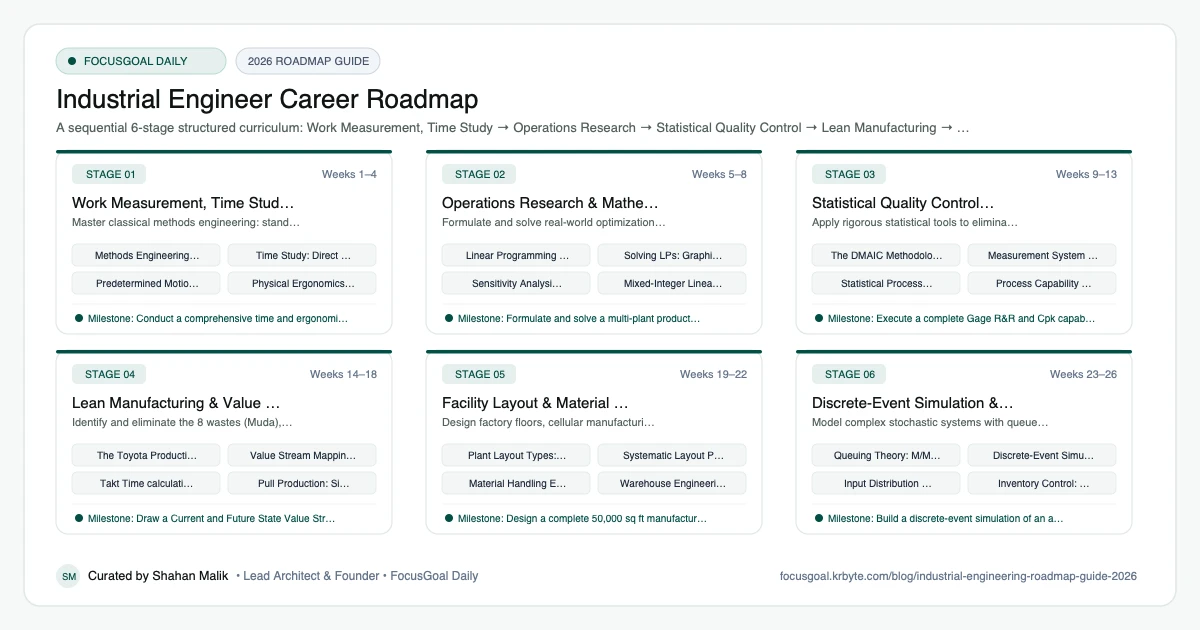
The 6 Production Stages
Follow these structured, sequential stages to systematically build production competence:
Work Measurement, Time Study & Ergonomics
Master classical methods engineering: standard times, allowances, predetermined motion time systems (MOST/MTM), and ergonomic workstation design.
Operations Research & Mathematical Optimization
Formulate and solve real-world optimization problems: Linear Programming (LP), Integer Programming (IP), and network flows.
Statistical Quality Control & Six Sigma (DMAIC)
Apply rigorous statistical tools to eliminate defects and achieve 3.4 defects per million opportunities (DPMO).
Lean Manufacturing & Value Stream Mapping
Identify and eliminate the 8 wastes (Muda), balance cycle times with Takt time, and design pull systems (Kanban).
Facility Layout & Material Handling Systems
Design factory floors, cellular manufacturing layouts, Automated Guided Vehicle (AGV) routing, and warehouse storage.
Discrete-Event Simulation & Supply Chain Logistics
Model complex stochastic systems with queues, breakdowns, and variability using simulation tools and inventory models.
Is Industrial Engineering a Good Career in 2026?
Industrial engineering focuses on making systems more efficient, spanning manufacturing, logistics, healthcare, finance, and services. Because it is about improving processes rather than a single product, graduates work in many sectors.
Caveats: job titles vary widely, such as process engineer, supply chain analyst, or operations analyst, and roles can overlap with business and data analytics. Check local job listings and official statistics for demand and pay. It rewards people who can combine analytics with communication.
- Good fit if you like improving systems and working with people and data.
- Strong crossover into supply chain, analytics, and operations management.
- Communication and change management matter as much as technical skill.
Software & Methods Industrial Engineers Use
Industrial engineering combines analytical software with improvement methodologies. Methods like Lean and Six Sigma are widely used frameworks, and certifications exist through various bodies, although their value varies by employer.
Learn statistics well; it is the backbone of quality control and experiment design.
- Simulation: Arena, Simio, AnyLogic, FlexSim.
- Analytics: Excel, Python, R, Minitab, SQL.
- Optimisation: linear programming and solvers such as Gurobi or open-source alternatives.
- Methods: Lean, Six Sigma, DMAIC, value stream mapping.
- Systems: ERP and MES familiarity such as SAP.
Degrees, Licensing & How to Get Your First Industrial Engineering Job
A bachelor's degree in industrial engineering or a related field is typical. Licensing is less common than in civil engineering, though the FE and PE exams exist in the US for industrial engineers. Requirements vary by country, so check your local licensing body.
Internships in manufacturing, logistics, or healthcare operations are valuable. A project showing measurable improvement, such as a process map, simulation, and recommended changes, tells employers you can deliver results. Lean or Six Sigma training can add credibility.
- Complete a process-improvement project with before and after analysis.
- Seek internships in operations, logistics, or quality.
- Build statistics and Python or Excel skills.
- Check local registration options with your engineering body.
Beginner Pitfalls vs Production Reality
Self-taught developers commonly waste months making avoidable structural mistakes. Here is how production engineers approach these challenges:
Master Industrial Engineering with FocusGoal Daily
Industrial engineering bridges advanced statistical analysis, optimization math, and factory floor management. FocusGoal Daily breaks your roadmap into structured daily habits.
- Daily micro-tasks for operations research formulas, control chart rules, and inventory models.
- Track study streaks offline while auditing warehouse floors or manufacturing assembly lines.
- AI concept tutor explaining Simplex pivot rules, Gage R&R variance, and Takt time balancing.
Track this roadmap,
one topic at a time.
Download FocusGoal, pick this roadmap and finish your first daily topic in minutes.
Frequently Asked Questions
What programming languages are most valuable for industrial engineers?
Python is the undisputed leader for operations research (using PuLP, Gurobi, SciPy) and data science. SQL is crucial for querying enterprise ERP databases, and R is popular for advanced statistical experiments.
Should I get a Lean Six Sigma Green Belt certification?
Yes. An accredited Six Sigma Green Belt (from ASQ or IASSC) is widely recognized by manufacturing, logistics, and healthcare recruiters.
Do industrial engineers only work in manufacturing plants?
No. Industrial engineers are heavily employed in supply chain logistics (Amazon, FedEx), healthcare hospital management, airlines (crew scheduling), and consulting firms (McKinsey, BCG).
What does an industrial engineer do?
An industrial engineer analyses and improves processes to reduce waste, cost, and delays while keeping quality and safety. Typical tasks include process mapping, simulation, scheduling, layout design, and quality control.
Is industrial engineering hard?
It is generally seen as less theory-heavy than some engineering fields, but it still needs strong statistics and optimisation skills. Combining analysis with communication is the biggest challenge.
How long does it take to become an industrial engineer?
A bachelor's degree usually takes about four years in many countries. Timelines vary, and certifications such as Lean Six Sigma can be added alongside.
Industrial vs mechanical engineering: which should I choose?
Choose industrial if you enjoy systems, data, and efficiency, and mechanical if you prefer designing physical machines. Both can lead into manufacturing.
Is industrial engineering a good career?
It can be, particularly for people who like analytics and operations across many industries. Check local job listings and official statistics for pay and demand where you live.
Start Your Industrial Engineer Today
Follow structured daily goals, study 100% offline with local SQLite, and get on-demand AI guidance with FocusGoal Daily on Android.
Get FocusGoal Daily Free on Google Play