Machine Learning Roadmap (2026): Mathematics, Scikit-Learn & Deep Learning PyTorch Guide
Master the mathematical bedrock of machine learning: vector matrices, cost functions, gradient descent, classical Scikit-Learn algorithms, and deep neural architectures in PyTorch.

What's in this guide
The Short Answer: Machine Learning in 2026
Machine Learning is the mathematical engine powering modern prediction, computer vision, natural language processing, and recommendation systems. While tools have become more accessible, true machine learning engineers understand the underlying optimization mathematics.
Copying code from tutorials without understanding bias-variance tradeoffs, gradient descent learning rates, or backpropagation leads to overfitting models that fail completely on real production data. Job-ready competence requires mastering data preparation, mathematical intuitions, and hands-on PyTorch training.
Just getting started? Read how to become a machine learning engineer step by step for the beginner-first plan.
Master the optimization math. Understand gradients, loss surfaces, and validation curves to build models that generalize reliably to unseen data.
The 6 Production Stages
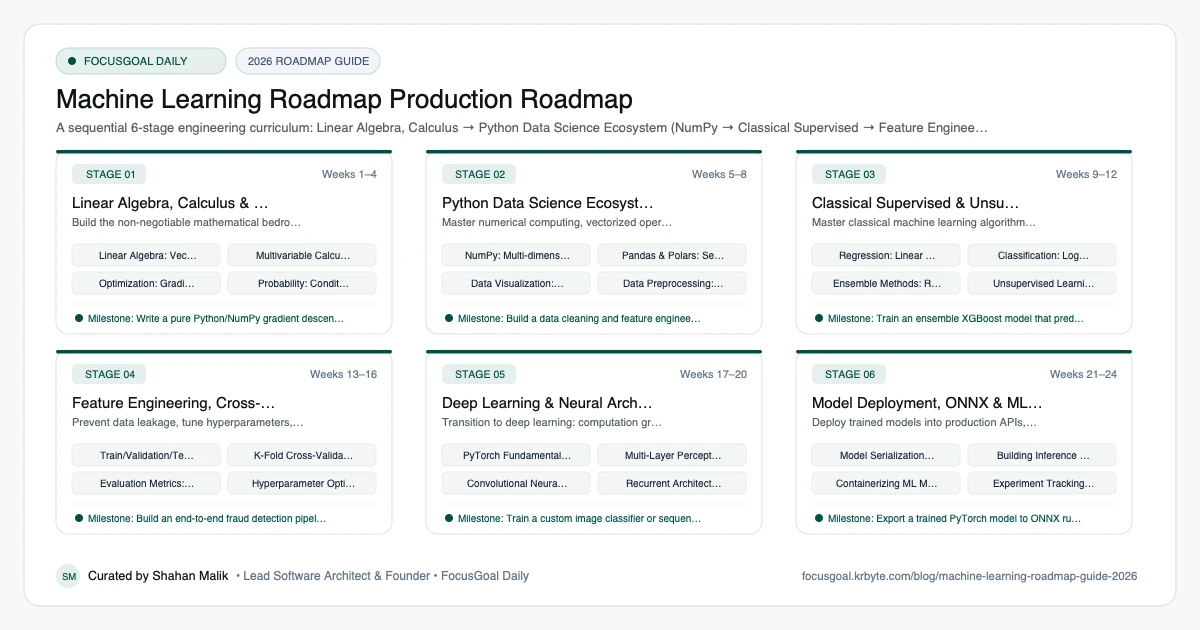
Follow these structured, sequential stages to systematically build production competence:
Linear Algebra, Calculus & Probability Foundations
Build the non-negotiable mathematical bedrock: matrices, vector spaces, partial derivatives, and probability distributions.
Python Data Science Ecosystem (NumPy & Pandas)
Master numerical computing, vectorized operations, and dataset wrangling.
Classical Supervised & Unsupervised Learning
Master classical machine learning algorithms with Scikit-Learn: regressions, decision trees, and clustering.
Feature Engineering, Cross-Validation & Metrics
Prevent data leakage, tune hyperparameters, and evaluate models using rigorous validation strategies.
Deep Learning & Neural Architectures with PyTorch
Transition to deep learning: computation graphs, activation functions, backpropagation, and PyTorch modules.
Model Deployment, ONNX & MLOps Pipelines
Deploy trained models into production APIs, optimize weights with ONNX, and track experiments.
Is a Machine Learning Career Worth It in 2026?
Yes, if you enjoy maths, data, and experimentation. Machine learning underpins recommendations, forecasting, fraud detection, search ranking, and computer vision, and these systems need people who understand why a model behaves the way it does, not only how to call one. Even as pretrained models become easier to use, teams still need people who can frame problems, clean data, pick metrics, and debug poor results.
The caveat is that many roles ask for more than a course certificate: solid statistics, clean code, and evidence of real modeling work. Entry-level positions can be competitive, and some employers prefer a degree. Check current local job listings to see what your target market expects.
- Best fit: people who like probability, linear algebra, and careful experiments.
- Learning curve: libraries are easy; understanding bias, variance, leakage, and evaluation is the hard part.
- Durable skills: statistics, Python, data handling, and clear communication of results.
Machine Learning vs Data Science vs AI Engineering: Which to Learn First
Choose machine learning if you want to build and evaluate predictive models and are willing to learn the maths behind them. Choose data science or analytics if your focus is insights, dashboards, and business decisions; the Data Analyst Roadmap is a good starting point. Choose AI engineering if you mainly want to build products on top of existing large language models; see the Artificial Intelligence Roadmap.
If you are not sure yet, the AI and Machine Learning Roadmap compares them side by side. Models also need reliable data, which is the focus of the Data Engineer Roadmap.
Machine Learning Setup: Tools You Need
A modern laptop with Python is enough to learn the fundamentals. Classical algorithms in scikit-learn run comfortably on a CPU. For deep learning with PyTorch, free hosted notebooks can provide GPU access for small experiments, and you can rent GPUs by the hour later if needed.
Keep experiments reproducible from the start. Fix random seeds, record which data version and parameters produced each result, and keep code in Git rather than only in notebooks.
- Python, NumPy, pandas, and matplotlib for data work and plotting.
- scikit-learn for classical models, pipelines, and cross-validation.
- PyTorch for neural networks.
- Jupyter or a similar notebook, plus a normal editor for production code.
- An experiment tracker such as MLflow or Weights & Biases once you run many trials.
Machine Learning Portfolio Projects and How to Get an ML Job
Strong ML portfolios show the whole process, not just a high accuracy score. Include how you split data, why you chose your metric, what baseline you beat, and where the model fails. Use real or messy datasets rather than only the most common tutorial ones.
In interviews, expect questions on overfitting, regularization, evaluation metrics, class imbalance, and how you would deploy and monitor a model. Practice explaining your own projects clearly, including mistakes you caught.
- A tabular prediction project with a simple baseline, feature engineering, and error analysis.
- A time-series forecasting project validated with time-aware splits.
- An image or text classifier fine-tuned in PyTorch.
- A model served behind an API with basic input validation and monitoring notes.
- A write-up on a model failure you diagnosed, such as data leakage.
Beginner Pitfalls vs Production Reality
Self-taught developers commonly waste months making avoidable structural mistakes. Here is how production engineers approach these challenges:
Master Machine Learning Discipline with FocusGoal Daily
Machine learning requires deep mathematical intuition combined with disciplined programming habits. FocusGoal Daily structures this syllabus into manageable daily learning steps.
- Structured curriculum from linear algebra to Scikit-Learn, PyTorch, and ONNX deployment.
- 100% offline study support powered by local SQLite database on Android.
- In-app Ask AI tutor for immediate explanations of gradients, eigenvalues, and backprop.
- Daily streak tracking to maintain coding discipline every day.
Track this roadmap,
one topic at a time.
Download FocusGoal, pick this roadmap and finish your first daily topic in minutes.
Frequently Asked Questions
Do I need a PhD to work as a Machine Learning Engineer?
No. While theoretical research roles at top labs require advanced degrees, the vast majority of industry ML engineering roles prioritize practical software engineering, data preparation, and applied PyTorch skills.
Why is PyTorch preferred over TensorFlow in modern machine learning?
PyTorch offers dynamic computation graphs ('define-by-run'), Pythonic syntax, and transparent debugging, making it the overwhelming favorite for AI research and modern industry deployments.
How long does it take to learn machine learning from scratch?
With consistent daily practice of 2 hours, most learners build strong junior-to-mid competence in 5 to 6 months by completing 3–4 documented portfolio projects.
How long does it take to learn machine learning?
It depends on your background and weekly time. Many learners need several months to be comfortable with the basics and longer to build job-ready projects. Consistent practice matters more than speed.
Do I need advanced maths for machine learning?
You need working knowledge of linear algebra, probability, statistics, and basic calculus. You do not need to be a mathematician to start, but the maths becomes more important as you debug and improve models.
Should I learn scikit-learn or PyTorch first?
Learn scikit-learn first. It teaches the full modeling workflow on tabular data, and many real business problems never need deep learning. Move to PyTorch when you want to work with images, text, or custom networks.
Can I get a machine learning job without a degree?
It is possible but harder, and it depends on the employer. A portfolio with rigorous, well-explained projects and strong fundamentals can offset the lack of a degree in some roles.
What is the difference between machine learning and deep learning?
Deep learning is a subset of machine learning that uses multi-layer neural networks. Classical machine learning includes methods such as linear models and decision trees, which often work well on smaller tabular datasets.
How does FocusGoal Daily help machine learning students?
FocusGoal Daily organizes the extensive machine learning curriculum into actionable daily learning checklists with offline streak tracking on Android.
Start Your Machine Learning Roadmap Today
Follow structured daily goals, study 100% offline with local SQLite, and get on-demand AI guidance with FocusGoal Daily on Android.
Get FocusGoal Daily Free on Google Play