AI & Machine Learning Roadmap (2026): The Complete Engineering Guide
Master Python mathematics, PyTorch deep learning, vector databases, retrieval-augmented generation (RAG), and production LLM serving without getting overwhelmed by mathematical theory.

What's in this guide
The Short Answer: AI Engineering in 2026
Artificial Intelligence has experienced a seismic shift. In 2026, being an AI engineer is no longer confined to writing abstract academic equations—it requires bridging software engineering, large language model orchestration, and production systems.
Most learners get stuck in one of two extremes: either drown in abstract theoretical mathematics for months without ever training a model, or become 'API wrappers' who merely call commercial endpoints without understanding embeddings, context windows, or latency constraints. Real engineering competence comes from mastering the full stack: numerical Python, neural architecture mechanics, vector retrieval, and efficient local/cloud deployment.
Just getting started? Read how to become a machine learning engineer step by step for the beginner-first plan.
Do not just call external APIs. Build genuine foundational competence by understanding tensors, loss functions, embedding distances, and real retrieval pipelines step by step.
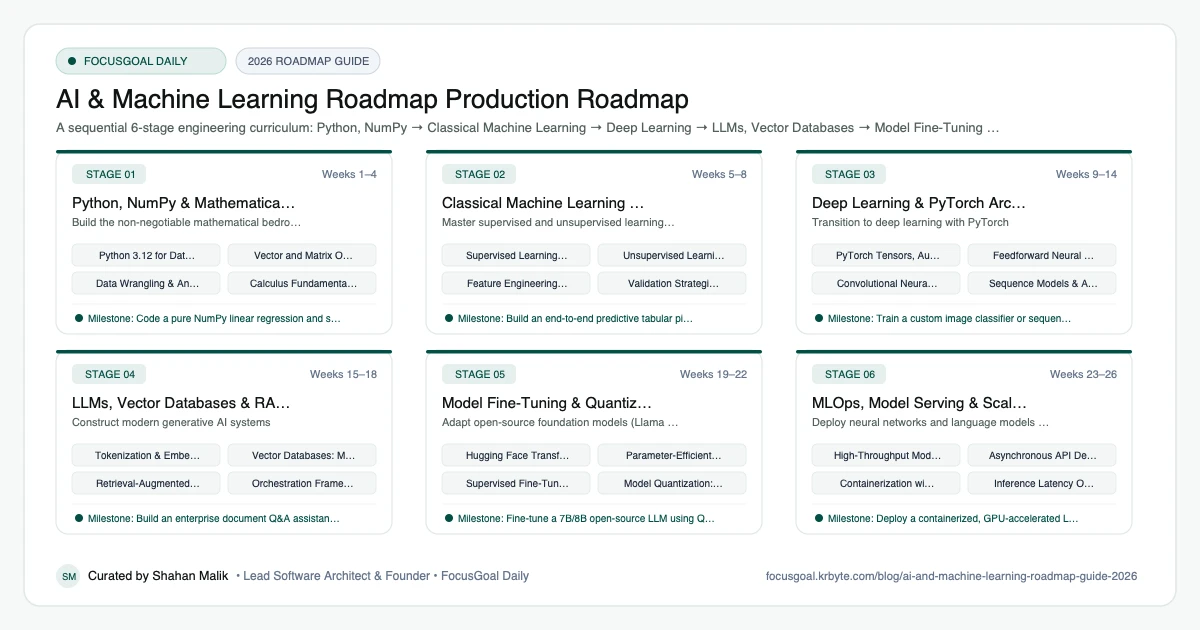
The 6 Production Stages
Follow these structured, sequential stages to systematically build production competence:
Python, NumPy & Mathematical Foundations
Build the non-negotiable mathematical bedrock: vectorized computation, multivariable derivatives, and matrix transformations.
Classical Machine Learning & Feature Engineering
Master supervised and unsupervised learning algorithms, tabular data pipelines, and validation metrics.
Deep Learning & PyTorch Architectures
Transition to deep learning with PyTorch. Understand computation graphs, loss functions, optimizers, and neural layers.
LLMs, Vector Databases & RAG Systems
Construct modern generative AI systems. Learn embedding spaces, semantic search, and Retrieval-Augmented Generation.
Model Fine-Tuning & Quantization (PEFT/LoRA)
Adapt open-source foundation models (Llama 3, Mistral, Gemma) to specific domains with parameter-efficient techniques.
MLOps, Model Serving & Scalable Inference
Deploy neural networks and language models into production with low latency, concurrency, and observability.
Is Learning AI and Machine Learning Worth It in 2026?
For most beginners, yes, even if you never become a full-time specialist. Understanding how models learn, where they fail, and how to evaluate them is useful in software, analytics, product, and many other roles. The field is broad, so the real challenge is choosing a first step instead of trying to learn everything at once.
Be realistic about the timeline. Job-ready skills take sustained practice, and entry-level roles can be competitive. Treat the first few months as building foundations: Python, basic statistics, and a couple of small projects. Check current local job listings to see which titles and skills employers in your region actually request.
- Good news: you can start with free tools and a normal laptop.
- Common trap: jumping straight to advanced topics without Python and statistics basics.
- Useful even outside AI roles: data literacy and skepticism about model outputs.
AI vs Machine Learning vs Data Science: Where to Start
Artificial intelligence is the broad goal of making software perform tasks that normally need human intelligence. Machine learning is one way to get there, by learning patterns from data instead of hand-written rules. Data science is about drawing insights from data, using statistics, visualization, and sometimes machine learning.
If you want to build apps with chatbots and assistants, go deeper with the Artificial Intelligence Roadmap. If you want to train models and understand the maths, follow the Machine Learning Roadmap. If you like answering business questions with data, begin with the Data Analyst Roadmap.
Beginner Setup for AI and ML: Tools You Need
Keep your first setup simple. Install Python, create a virtual environment for each project, and use a notebook for experiments. A free hosted notebook service is enough to follow most beginner courses without installing anything locally.
Add tools only when a project needs them. Beginners often lose weeks configuring GPUs and frameworks when a small dataset and a CPU would teach the same lesson.
- Python and a notebook environment such as Jupyter.
- pandas and matplotlib to explore and plot data.
- scikit-learn for your first models.
- Git and GitHub to save and share your work.
- One beginner course or book to follow, rather than five at once.
First Projects and How to Get Started in AI and ML
Your first projects should be small enough to finish. Pick a dataset you care about, build a simple baseline, and write down what you learned. Finishing three small projects teaches more than abandoning one ambitious one.
When you apply for roles or internships, show your thinking: why you chose a metric, what went wrong, and how you would improve it. If you want to understand how data reaches models in the first place, the Data Engineer Roadmap is a useful companion.
- Predict a simple outcome from a small tabular dataset and compare it with a trivial baseline.
- Build a text classifier, for example for spam or topic labels.
- Make a small chatbot or summarizer using a hosted model API.
- Create a data-cleaning and visualization notebook on a public dataset.
- Write a one-page summary of each project for your portfolio.
Beginner Pitfalls vs Production Reality
Self-taught developers commonly waste months making avoidable structural mistakes. Here is how production engineers approach these challenges:
Master AI & Machine Learning with FocusGoal Daily
AI moves faster than any other engineering discipline. FocusGoal Daily keeps you grounded by structuring massive AI curriculum into achievable daily micro-actions.
- Structured curriculum from linear algebra to PyTorch, LLMs, and RAG pipelines.
- 100% offline study support powered by local SQLite database on Android.
- Interactive Ask AI feature for immediate clarifications on backprop, embeddings, and tensors.
- Daily streak tracking to maintain study discipline without burning out.
Track this roadmap,
one topic at a time.
Download FocusGoal, pick this roadmap and finish your first daily topic in minutes.
Frequently Asked Questions
Do I need a PhD in Mathematics to become an AI Engineer in 2026?
No. While research scientist roles require deep theoretical physics or math backgrounds, modern AI engineers primarily need strong applied math (linear algebra, calculus, probability) combined with robust software engineering and systems skills.
Which deep learning framework should I learn: PyTorch or TensorFlow?
PyTorch is overwhelmingly the standard for modern deep learning research, open-source model releases (Hugging Face), and AI industry development in 2026.
Can I learn AI without an expensive GPU?
Yes. For early stages, Google Colab and Kaggle provide free GPU tiers (T4/P100). For local quantization and smaller models (1B to 3B parameters), modern laptops and desktops can run CPU/Metal inference smoothly.
What is the difference between AI and machine learning?
AI is the broad field of making machines perform intelligent tasks, while machine learning is a subset where systems learn patterns from data. Deep learning is a further subset of machine learning.
Where should a complete beginner start with AI?
Start with Python and basic statistics, then build a simple model with scikit-learn. After that, choose a direction: LLM applications, classical machine learning, or data analysis.
Do I need to learn machine learning before AI?
Not necessarily. You can build AI applications with existing models before studying how they are trained, but understanding machine learning basics helps you evaluate and debug them.
Is data science the same as machine learning?
No. Data science is broader and covers data cleaning, analysis, visualization, and communication, with machine learning as one possible tool. Many data science tasks need no model at all.
Can I learn AI and machine learning for free?
Yes. Many universities and communities publish free courses, and free notebook services let you practice without buying hardware. Paid options mainly add structure, feedback, or credentials.
How does FocusGoal Daily help me learn AI consistently?
FocusGoal Daily breaks down intimidating machine learning topics into bite-sized daily objectives, ensuring you practice coding every day and build long-term retention.
Start Your AI & Machine Learning Roadmap Today
Follow structured daily goals, study 100% offline with local SQLite, and get on-demand AI guidance with FocusGoal Daily on Android.
Get FocusGoal Daily Free on Google Play