Full-Stack Developer Roadmap (2026): The Complete Engineering Guide
Learn how to architect, build, and deploy robust end-to-end web applications with modern TypeScript, React, Node.js, relational PostgreSQL persistence, and secure JWT authentication.

What's in this guide
The Short Answer: Full-Stack in 2026
Full-stack development in 2026 is no longer about throwing an unvalidated front-end together with a haphazard database connection. Modern full-stack engineering is centered on unified type safety across client and server boundaries, clean architectural layering, and robust data integrity.
The most effective full-stack developers possess end-to-end mental models: they understand how a user click in React translates into an HTTP request, how middleware authenticates tokens, how the database handles concurrency and row locking, and how responses are cached across CDNs.
Just getting started? Read how to become a full-stack developer step by step for the beginner-first plan.
Bridge client and server with unified TypeScript. Understand data lifecycles, database normalization, and secure authentication to build resilient production applications.
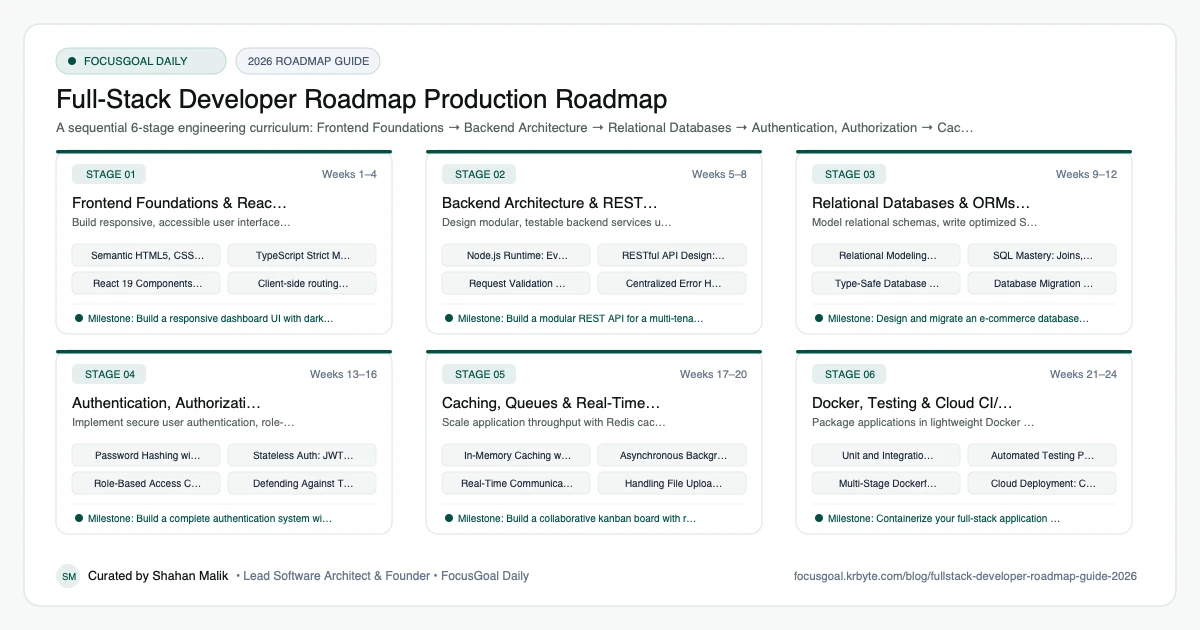
The 6 Production Stages
Follow these structured, sequential stages to systematically build production competence:
Frontend Foundations & React Architecture
Build responsive, accessible user interfaces using TypeScript, modern CSS, and React component state.
Backend Architecture & RESTful APIs
Design modular, testable backend services using Node.js, Express, or NestJS with robust error handling.
Relational Databases & ORMs (PostgreSQL & Prisma)
Model relational schemas, write optimized SQL queries, and manage migrations with PostgreSQL and Prisma or Drizzle ORM.
Authentication, Authorization & Security
Implement secure user authentication, role-based access control (RBAC), and web defense fundamentals.
Caching, Queues & Real-Time WebSockets
Scale application throughput with Redis caching, asynchronous job processing, and bi-directional WebSockets.
Docker, Testing & Cloud CI/CD Deployment
Package applications in lightweight Docker containers, write integration tests, and automate deployment with GitHub Actions. For comprehensive testing patterns, see the QA Roadmap 2026.
Is Full-Stack Development Worth It in 2026?
It is worth it if you like seeing a feature through from database to browser. Full-stack developers are especially valuable at startups and small teams where one person often owns an entire feature. The breadth also helps you understand how decisions on one side affect the other.
The caveat is breadth versus depth. Trying to master everything leads to shallow knowledge, so pick one frontend stack and one backend stack and go deep. Salaries and demand vary by region and company size, so review current local job listings before setting expectations.
- Strong fit if you like end-to-end ownership and shipping whole features.
- Learning curve: wider than specialist paths, so pace yourself over months.
- Specialist roles may eventually pay off at large companies; full-stack is a great starting base.
Full-Stack vs Frontend vs Backend: Which to Learn First
If you are new to programming, begin with one side. Frontend gives faster visual feedback; backend teaches data modeling, APIs, and security. Once one side feels comfortable, add the other. This is easier than trying to learn both at once.
Compare the focused paths: the Frontend Developer Roadmap for interfaces, the Node.js Developer Roadmap for a JavaScript backend, or the Java Backend Developer Roadmap for enterprise services.
Full-Stack Developer Setup: Tools You Need
A modern laptop, VS Code, Node.js, Git, and a GitHub account cover the basics. You also need a database you can run locally (PostgreSQL is a common choice), an API client such as Postman or Bruno, and browser DevTools for debugging network requests.
Docker is helpful for reproducing your environment, and a free hosting tier from a major platform lets you deploy practice projects. Always check each tool's official documentation for current setup steps.
- Editor, Node.js, Git, and GitHub.
- Local database such as PostgreSQL, plus a database GUI.
- API client for testing endpoints.
- Docker for consistent local environments.
Full-Stack Portfolio Projects & How to Get a Job
Build at least two complete, deployed applications with authentication, a relational database, a documented API, and a polished UI. Examples include a task or habit tracker with user accounts, a booking app, or a small marketplace. Complexity matters less than finishing and deploying.
Show the whole system: link a live demo, the repository, and a short architecture write-up with a diagram. In interviews, be ready to explain data modeling, authentication flow, and how you would debug a slow request end to end.
- Project idea: a multi-user app with role-based access.
- Project idea: a REST or GraphQL API with tests and a React client.
- Add CI that runs tests on every commit.
- Document trade-offs you made and what you would improve.
Beginner Pitfalls vs Production Reality
Self-taught developers commonly waste months making avoidable structural mistakes. Here is how production engineers approach these challenges:
Master Full-Stack Engineering with FocusGoal Daily
Full-stack development spans both sides of the network. FocusGoal Daily structures this vast curriculum into focused daily learning objectives.
- Structured curriculum spanning React 19, Node.js, PostgreSQL, and Docker.
- 100% offline study support powered by local SQLite database on Android.
- On-demand AI tutor to clarify SQL joins, JWT architectures, and Docker configs.
- Habit streak tracking to keep your coding progress steady every day.
Track this roadmap,
one topic at a time.
Download FocusGoal, pick this roadmap and finish your first daily topic in minutes.
Frequently Asked Questions
What is the best full-stack stack for beginners in 2026?
A TypeScript-based stack (React frontend, Node/Express or NestJS backend, and PostgreSQL with Prisma/Drizzle) offers the highest job demand and shared typing across the entire system.
Should I learn monolithic frameworks like Next.js or separate client/server?
Learn the fundamentals of separate client and server architectures first. Understanding standard REST APIs and database layers makes full-stack frameworks like Next.js or Remix much easier to master.
How long does it take to become a full-stack engineer?
With structured daily dedication of 2 hours, most learners develop strong junior full-stack competence in 6 to 8 months by completing 3 production-grade portfolio projects.
How do I become a full-stack developer from scratch?
Learn web basics (HTML, CSS, JavaScript), then one frontend framework, then one backend language with a database. Build complete apps along the way. Expect to study consistently for many months.
Is full-stack development still worth learning in 2026?
Yes, especially for startups and small teams that value people who can ship whole features. Aim for depth in one stack rather than shallow knowledge of many.
Full-stack vs frontend: which should I learn first?
Learn frontend first if you want fast visual progress; see the Frontend Developer Roadmap. Then add backend skills to become full-stack.
Do I need a degree to become a full-stack developer?
Not necessarily. Many employers weigh a deployed portfolio and interview performance heavily, although some roles prefer a degree. Requirements differ by company and country.
How does FocusGoal Daily help full-stack developers?
FocusGoal Daily turns the full-stack engineering syllabus into manageable daily checklists, tracks your habit streaks, and provides offline learning tools on Android.
Start Your Full-Stack Developer Roadmap Today
Follow structured daily goals, study 100% offline with local SQLite, and get on-demand AI guidance with FocusGoal Daily on Android.
Get FocusGoal Daily Free on Google Play