Node.js Developer Roadmap (2026): Scalable Backend Systems Guide
Master the Node.js asynchronous event loop, streams, Buffers, enterprise NestJS architecture, Redis caching, and microservices for high-throughput production backends.

What's in this guide
The Short Answer: Node.js in 2026
Node.js remains the dominant runtime for server-side JavaScript and TypeScript. In 2026, modern Node (Node 22 LTS) includes native TypeScript execution, built-in test runners, native fetch, and high-performance Web Crypto APIs.
However, writing scalable Node.js services requires understanding its single-threaded event loop and libuv thread pool. Blocking the event loop with synchronous CPU-intensive tasks or unhandled promise rejections can bring down an entire service handling thousands of concurrent users.
Just getting started? Read how to become a backend developer and which language to choose for the beginner-first plan.
Never block the event loop. Understand streams, asynchronous non-blocking I/O, and worker threads to build high-throughput Node.js microservices.
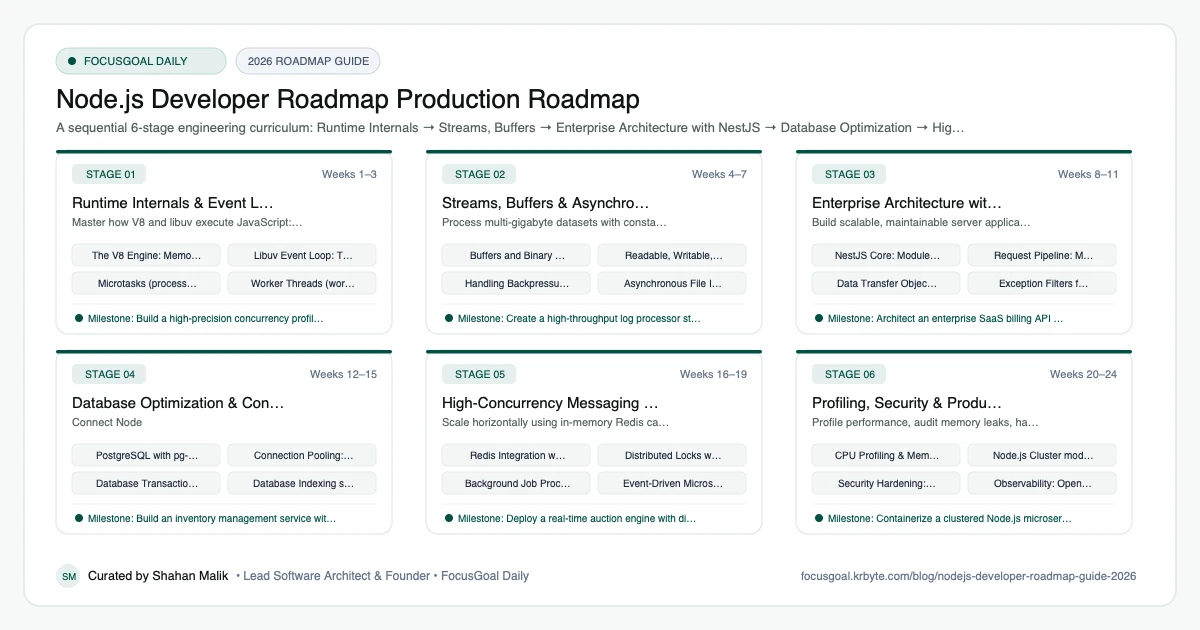
The 6 Production Stages
Follow these structured, sequential stages to systematically build production competence:
Runtime Internals & Event Loop Mechanics
Master how V8 and libuv execute JavaScript: timers, I/O polling, check phase, and process.nextTick.
Streams, Buffers & Asynchronous File I/O
Process multi-gigabyte datasets with constant memory footprint using Node.js streaming pipelines.
Enterprise Architecture with NestJS
Build scalable, maintainable server applications using NestJS, dependency injection, and modular architecture.
Database Optimization & Connection Pooling
Connect Node.js backends to relational databases, manage connection pools, and prevent query bottlenecks.
High-Concurrency Messaging & Redis
Scale horizontally using in-memory Redis caching, message brokers, and distributed background queues.
Profiling, Security & Production Deployment
Profile performance, audit memory leaks, harden security headers, and deploy containerized Node clusters.
Is Node.js Development Worth It in 2026?
Node.js remains a widely used backend runtime, particularly for APIs, real-time features, and tooling, and it lets you use JavaScript or TypeScript across the whole stack. That makes it a practical choice for frontend developers moving to the server and for startups that want one language everywhere.
The caveats: Node.js is single-threaded for JavaScript execution, so CPU-heavy work needs care, and the ecosystem offers many competing libraries, which can overwhelm beginners. Demand and pay vary by region, so check current local job listings.
- Strong fit if you already know JavaScript.
- Learning curve: easy to start, but async behavior and error handling take practice.
- Choose your framework deliberately (Express, Fastify, NestJS) rather than chasing trends.
Node.js vs Java vs Go: Which to Learn First
Pick Node.js if you know JavaScript and want fast iteration. Pick Java and Spring for large enterprise environments and strong structure. Pick Go for lightweight, high-concurrency services and cloud tooling. All three can build excellent APIs; the right choice depends on the jobs and teams you are targeting.
Read the Java Backend Developer Roadmap and the Go Backend Developer Roadmap to compare. The core concepts (HTTP, databases, auth, caching) transfer across all of them.
Node.js Setup: Tools You Need
Install the current LTS release of Node.js, ideally via a version manager so you can switch versions per project. Use VS Code with TypeScript support, Git, and an API client to test endpoints. Add PostgreSQL or another database locally, and Docker for reproducible environments.
For quality, add a linter, a test runner such as Vitest or Jest, and a tool for structured logging. Check official documentation for current versions and install instructions.
- Node.js LTS with a version manager.
- TypeScript and a linter.
- Database and a GUI client.
- API client and a test runner.
Node.js Portfolio Projects & How to Get a Job
Build APIs that look like real work: a REST service with authentication, validation, pagination, and a relational database, plus tests and OpenAPI documentation. Add a real-time project using WebSockets, such as a chat or live dashboard, and a background job queue example.
On your resume, describe design choices: how you handled errors, rate limiting, and security. Interviews often cover the event loop, promises and async/await, and API design, so be ready to explain them clearly.
- Project idea: a URL shortener with analytics.
- Project idea: a real-time chat with persistent history.
- Project idea: a job queue that processes uploads.
- Deploy with Docker and document how to run it.
Beginner Pitfalls vs Production Reality
Self-taught developers commonly waste months making avoidable structural mistakes. Here is how production engineers approach these challenges:
Master Node.js Systems with FocusGoal Daily
High-throughput backend engineering demands deep conceptual mastery. FocusGoal Daily structures the entire Node.js curriculum into achievable daily micro-tasks.
- Curriculum covering event loop internals, streams, NestJS, and Redis.
- 100% offline study support powered by local SQLite database on Android.
- Interactive Ask AI tutor to clarify libuv phases, backpressure, and Docker setups.
- Habit streak tracking to keep your backend learning consistent every single day.
Track this roadmap,
one topic at a time.
Download FocusGoal, pick this roadmap and finish your first daily topic in minutes.
Frequently Asked Questions
Is Node.js still relevant with modern runtimes like Deno and Bun?
Yes. Node.js continues to power the vast majority of enterprise production systems with unmatched package ecosystem stability, long-term support (LTS) guarantees, and tooling matureness.
When should I use NestJS instead of raw Express?
Use NestJS when building medium-to-large enterprise applications that require structured dependency injection, testability, and standard architectural patterns across teams.
How does Node.js handle thousands of requests with a single thread?
Node delegates asynchronous I/O (network calls, file reads, database queries) to the operating system kernel and libuv thread pool, freeing the main thread to handle incoming requests without waiting.
How do I become a Node.js developer from scratch?
Learn JavaScript and then TypeScript, understand HTTP and the event loop, and build REST APIs with a database. Add testing and deployment as you progress. A structured roadmap keeps you from skipping fundamentals.
Is Node.js still worth learning in 2026?
Yes. It is widely used for APIs and real-time services and lets you share a language with the frontend. Check current job listings in your region to confirm demand.
Node.js vs Go: which should I learn?
Choose Node.js if you know JavaScript and want fast development; choose Go for high-concurrency services and cloud tooling. See the Go Backend Developer Roadmap for details.
Do I need a degree to become a Node.js developer?
No degree is strictly required for many roles. Employers mostly look at your projects and your understanding of backend fundamentals. Requirements vary by company.
How does FocusGoal Daily help Node.js developers?
FocusGoal Daily turns complex backend systems concepts into clear daily study goals with streak tracking and offline access on Android.
Start Your Node.js Developer Roadmap Today
Follow structured daily goals, study 100% offline with local SQLite, and get on-demand AI guidance with FocusGoal Daily on Android.
Get FocusGoal Daily Free on Google Play