Java Backend Developer Roadmap (2026): Spring Boot 3 & Modern Java Guide
Master Java 21 LTS, Virtual Threads (Project Loom), Spring Boot 3, Spring Data JPA, PostgreSQL, Apache Kafka, and cloud-native microservices architecture.

What's in this guide
The Short Answer: Enterprise Java in 2026
Modern Java is fast, modern, and lean. With Java 21 LTS and Spring Boot 3, the JVM has introduced Virtual Threads (Project Loom), enabling lightweight high-throughput concurrency that rivals Go goroutines without the complexity of reactive programming.
Enterprise organizations—banks, healthcare providers, and high-volume commerce platforms—rely heavily on Java for their core transaction systems. Learning modern Java means mastering clean OOP, JVM memory management, Spring Boot conventions, and distributed event systems.
Just getting started? Read how to become a backend developer and which language to choose for the beginner-first plan.
Java 21 Virtual Threads combined with Spring Boot 3 allows you to write clean synchronous code that scales to hundreds of thousands of concurrent connections.
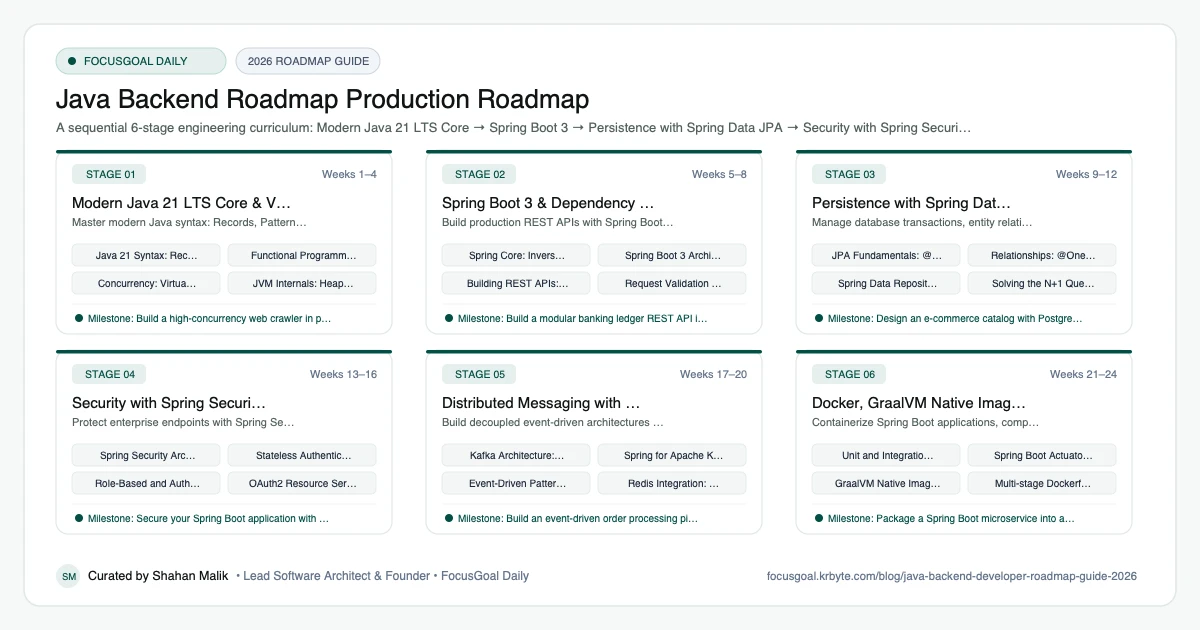
The 6 Production Stages
Follow these structured, sequential stages to systematically build production competence:
Modern Java 21 LTS Core & Virtual Threads
Master modern Java syntax: Records, Pattern Matching, Sealed Classes, and Virtual Threads.
Spring Boot 3 & Dependency Injection
Build production REST APIs with Spring Boot 3, Inversion of Control (IoC), and auto-configuration.
Persistence with Spring Data JPA & Hibernate
Manage database transactions, entity relationships, and query optimization with Hibernate and PostgreSQL.
Security with Spring Security & OAuth2
Protect enterprise endpoints with Spring Security filter chains, JWT authentication, and role authorization.
Distributed Messaging with Apache Kafka
Build decoupled event-driven architectures with Apache Kafka producers, consumers, and topic partitions.
Docker, GraalVM Native Images & Kubernetes
Containerize Spring Boot applications, compile ahead-of-time (AOT) native binaries, and deploy to Kubernetes.
Is Java Backend Development Worth It in 2026?
Java remains a mainstay of enterprise software, notably in banking, insurance, e-commerce, and large internal platforms, and Spring Boot is a very widely used framework there. Skills are long-lived, and the language is heavily documented and well supported.
The caveats are a steeper learning curve and more ceremony than lighter stacks, plus a lot of framework concepts (dependency injection, annotations, configuration). Many roles also expect experience with databases, testing, and cloud basics. Check current local job listings to gauge demand and pay.
- Strong fit if you like structure, typing, and large systems.
- Learning curve: moderate to steep, but rewarding.
- Modern Java has records, streams, and virtual threads that make code more concise.
Java vs Node.js vs .NET: Which to Learn First
Java and C#/.NET are close cousins: statically typed, object-oriented, and common in enterprises. Choose based on the employers near you or the ones you want to target. Node.js is quicker to start and suits startups and JavaScript developers.
Compare directly with the .NET Backend Developer Roadmap and the Node.js Developer Roadmap. If you are undecided, review local job listings and pick the stack that appears most often.
Java Backend Setup: Tools You Need
Install a current LTS JDK, a build tool (Maven or Gradle), and an IDE such as IntelliJ IDEA or VS Code with Java extensions. Add Git, a local database like PostgreSQL, and Docker for running dependencies.
Use Spring Initializr to bootstrap projects, and add JUnit for testing. Check each tool's official documentation for current versions.
- JDK (LTS) and Maven or Gradle.
- IntelliJ IDEA or VS Code.
- PostgreSQL and a DB client.
- Docker and Git.
Java Backend Portfolio Projects & How to Get a Job
Build a Spring Boot REST API with layered architecture, JPA with a relational database, validation, authentication, and automated tests. Examples: an e-commerce backend, a banking-style ledger demo, or a booking system with transactions.
Include a README, OpenAPI docs, and a Docker setup. Interviews typically cover core Java, collections, concurrency, Spring concepts, SQL, and system design basics, so practice explaining each clearly.
- Project idea: an order management service with transactions.
- Project idea: a microservice pair communicating over a message broker.
- Write unit and integration tests.
- Be ready to discuss how you'd handle concurrency and data consistency.
Beginner Pitfalls vs Production Reality
Self-taught developers commonly waste months making avoidable structural mistakes. Here is how production engineers approach these challenges:
Master Enterprise Java with FocusGoal Daily
Enterprise Java demands strong architectural discipline. FocusGoal Daily structures the entire modern Java and Spring Boot ecosystem into manageable daily learning steps.
- Structured curriculum from Java 21 and Virtual Threads to Spring Boot 3 and Kafka.
- 100% offline study support powered by local SQLite database on Android.
- On-demand AI tutor to clarify JVM memory, JPA mappings, and security configs.
- Daily streak tracking to maintain steady progress toward enterprise backend competence.
Track this roadmap,
one topic at a time.
Download FocusGoal, pick this roadmap and finish your first daily topic in minutes.
Frequently Asked Questions
What makes Java 21 and Virtual Threads a game-changer?
Virtual Threads allow Java servers to handle hundreds of thousands of concurrent I/O requests with simple imperative code, eliminating the cognitive overhead of reactive frameworks like WebFlux.
Is Java still in high demand in 2026?
Yes. Java remains one of the top three enterprise programming languages globally, powering backend infrastructure across Fortune 500 enterprises, fintech, and cloud platforms.
Should I learn Maven or Gradle?
Both are industry standards. Maven uses structured XML and is dominant in enterprise banking; Gradle uses Kotlin DSL and is widely used in modern cloud and Android projects. Learn Maven first, then Gradle.
How do I become a Java backend developer from scratch?
Learn core Java, then SQL, then Spring Boot to build REST APIs, and add testing and Docker. Build a few deployed projects. Follow a structured roadmap to keep the order sensible.
Is Java still worth learning in 2026?
Yes, it remains widely used in enterprise software and is actively developed. Check local job listings to see how much demand exists in your region.
Java vs .NET: which should I learn?
They are very similar in style, so choose based on local employers. See the .NET Backend Developer Roadmap to compare.
Do I need a degree to become a Java developer?
Not always, although enterprise employers often prefer one. Projects and strong fundamentals can compensate. Requirements vary widely.
How does FocusGoal Daily help Java developers?
FocusGoal Daily organizes the vast Java and Spring ecosystem into bite-sized daily micro-goals with streak tracking and offline access on Android.
Start Your Java Backend Roadmap Today
Follow structured daily goals, study 100% offline with local SQLite, and get on-demand AI guidance with FocusGoal Daily on Android.
Get FocusGoal Daily Free on Google Play