QA Roadmap 2026: From Manual Testing to Test Automation Engineering
Master SDLC STLC principles, gain structured manual testing experience, build professional automation skills with Playwright, execute k6 performance testing, and orchestrate GitHub Actions Docker CI quality gates.

What's in this guide
The Short Answer: Quality Engineering in 2026
What is QA testing and what does a QA tester do? Quality Assurance (QA) in software testing is the systematic engineering practice of evaluating digital applications to catch defects, verify business logic, and ensure flawless user experience. A modern QA tester analyzes software requirements, designs exploratory testing charters, writes structured test cases, and executes automated QA testing across web and mobile platforms.
Software QA has transitioned from manual spreadsheet checklists into Quality Engineering (SDET). While high-earning QA automation engineer roles require deep programming and automation skills in TypeScript and Python, foundational manual testing experience remains the bedrock of quality. An engineer with hands-on manual testing experience understands boundary conditions, edge-case discovery, and writing test scenarios that prevent catastrophic production outages.
In 2026, the modern quality engineering standard aligns across the full SDLC STLC lifecycle: from writing test specifications during sprint grooming, to Microsoft Playwright web automation, to k6 performance testing under peak traffic, to running isolated test runners in GitHub Actions Docker containers. Following this comprehensive QA roadmap 2026 will guide you step-by-step on how to become a QA tester and transition into a senior QA automation engineer.
Just getting started? Read how to become a QA tester step by step for the beginner-first plan.
Flaky tests are worse than no tests. Learn reliable test selectors, auto-waiting assertions in Playwright, and contract-based API testing to build rock-solid regression suites.
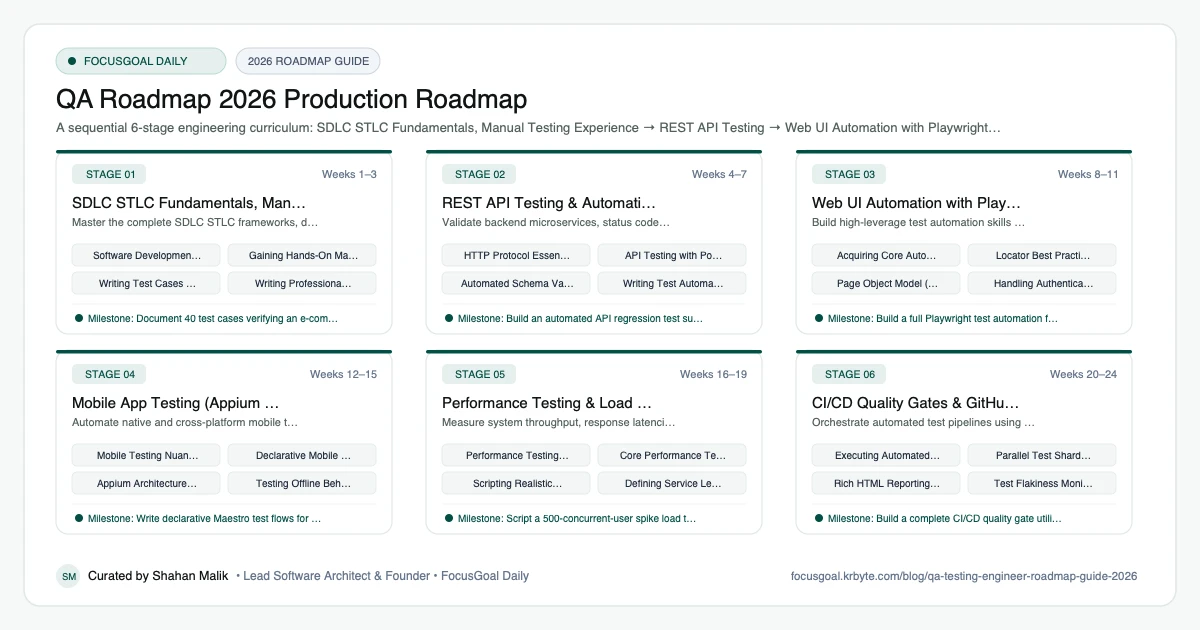
The 6 Production Stages
Follow these structured, sequential stages to systematically build production competence:
SDLC STLC Fundamentals, Manual Testing Experience & Test Design
Master the complete SDLC STLC frameworks, develop foundational manual testing experience, and cultivate precision in writing test cases, bug reports, and traceability matrices.
REST API Testing & Automation (Postman & REST-Assured)
Validate backend microservices, status codes, headers, and payload schemas before touching the UI, writing test scripts for regression validation.
Web UI Automation with Playwright & TypeScript
Build high-leverage test automation skills using Microsoft Playwright and the Page Object Model design pattern.
Mobile App Testing (Appium & Maestro)
Automate native and cross-platform mobile tests on Android and iOS devices using Maestro and Appium.
Performance Testing & Load Testing with k6
Measure system throughput, response latencies, and breaking points using code-driven performance testing with Grafana k6.
CI/CD Quality Gates & GitHub Actions Docker Test Runners
Orchestrate automated test pipelines using GitHub Actions Docker containers for reproducible, parallel test execution.
Is a QA Testing Career Worth It in 2026?
Yes, particularly if you like finding edge cases and care about product quality. Software teams still need people who think about risk, design tests, and automate checks so releases are safe. Modern QA is much more technical than manual clicking: it involves code, APIs, pipelines, and observability.
The honest caveat is that purely manual roles are shrinking in many teams, so learning automation is the safer route. Titles and pay differ widely by company and country, so compare current local job listings for QA, SDET, and test automation roles.
- Good fit if you are curious, detail-oriented, and enjoy breaking things.
- Low barrier to a first role, but growth depends on automation skills.
- Strong bridge into development, DevOps, or security testing.
Manual QA vs Automation QA vs SDET: Which to Learn First
Start with manual testing fundamentals: test design, exploratory testing, bug reporting, and understanding requirements. Without them, automation just produces fast, useless checks. Then add automation with a framework such as Playwright, Cypress, or Selenium, and API testing with a tool like Postman or a code-based client.
An SDET (software development engineer in test) writes test infrastructure and frameworks and is close to a developer. If that appeals, strengthen your programming with the Frontend Developer roadmap or the Node.js Developer roadmap.
- Manual: test design, exploratory testing, clear bug reports.
- Automation: UI and API tests in code, run in CI.
- SDET: frameworks, tooling, and test architecture.
QA Setup: Tools You Need
You can assemble a useful toolkit for free. You need a code editor, Git, Node.js or Python, browser developer tools, and a test framework such as Playwright or Cypress. Add Postman or an equivalent for API checks, and a tracker such as Jira or a free alternative for bug reports.
Practice on public demo applications built for testing, and later connect your tests to a CI service so they run on every commit. Learning to read logs and network requests will make your bug reports far more useful.
- Playwright or Cypress for end-to-end tests.
- Postman or code-based API clients.
- Git and a CI service to run suites automatically.
- Browser DevTools for debugging and evidence.
QA Portfolio Projects & How to Get a Job
Build a repository that tests a public demo site: a documented test plan, a set of automated UI and API tests, and a CI workflow that runs them. Include a few well-written sample bug reports with steps, expected versus actual results, and evidence.
On your resume emphasize how you reduce risk, not how many test cases you wrote. In interviews expect exercises such as testing a login form or a shopping cart, so practice listing positive, negative, and boundary scenarios aloud.
- Write a test plan and automated suite for a demo e-commerce site.
- Add API tests with schema and error-case checks.
- Run everything in GitHub Actions or similar and publish results.
- Reduce a flaky test and document the fix.
Beginner Pitfalls vs Production Reality
Self-taught developers commonly waste months making avoidable structural mistakes. Here is how production engineers approach these challenges:
Master Quality Engineering with FocusGoal Daily
Becoming a high-value SDET requires mastering both QA intuition and software engineering automation. FocusGoal Daily structures this syllabus into manageable daily learning steps.
- Structured curriculum from test case design to Playwright, k6, and CI/CD pipelines.
- 100% offline study support powered by local SQLite database on Android.
- In-app Ask AI tutor for immediate code analysis and locator recommendations.
- Daily streak tracking to maintain momentum toward senior QA automation roles.
Track this roadmap,
one topic at a time.
Download FocusGoal, pick this roadmap and finish your first daily topic in minutes.
Frequently Asked Questions
What is QA testing and what does a QA tester do?
QA testing (Quality Assurance in software testing) is the disciplined process of verifying that software meets technical specifications, business rules, and security benchmarks before release. A QA tester investigates software behavior, designs test cases, identifies regressions, validates backend APIs, and automates end-to-end user journeys.
How to become a QA tester and advance to a QA automation engineer in 2026?
To become a QA tester in 2026, first learn testing principles (SDLC STLC lifecycles, bug reproduction, boundary value analysis). To advance into a high-paying QA automation engineer role, master TypeScript or Python, build automated browser tests with Microsoft Playwright, practice REST API validation in Postman, and configure automated GitHub Actions CI/CD quality gates.
Which QA automation tools are essential to master first?
The most in-demand QA automation tools in 2026 are Microsoft Playwright (for fast, resilient end-to-end browser testing), Postman and Supertest (for REST API testing), Grafana k6 (for code-driven performance load testing), and Maestro or Appium (for mobile iOS and Android automation).
Why is Playwright preferred over Selenium for automated QA testing in 2026?
Playwright offers built-in auto-waiting, native async execution, isolated browser contexts, multiple tab support, and trace debugging tools out-of-the-box, eliminating the intermittent flakiness and maintenance overhead of legacy Selenium.
Do QA automation engineers need to know programming?
Yes. High-earning QA automation engineer roles (SDETs) write production-grade test automation in TypeScript, Python, or Java. Modern automated QA testing is a specialized software engineering discipline.
How long does it take to transition from manual QA to automation?
With structured daily practice of 1.5 to 2 hours, most manual testers build strong Playwright/API automation competence in 3 to 5 months.
Is QA testing a good career in 2026?
Yes, especially if you build automation and API testing skills alongside manual fundamentals. Roles that combine testing and coding tend to offer more room to grow.
Do QA testers need to know how to code?
For manual-only roles not strictly, but most growing QA jobs expect at least basic scripting. Learning one language and a framework like Playwright makes you much more employable.
What is the difference between a QA engineer and an SDET?
A QA engineer designs and executes tests, while an SDET also builds test frameworks and tooling and works closer to development. The boundary varies by company.
Which automation tool should I learn first: Selenium, Cypress, or Playwright?
Check job listings in your market, but Playwright and Cypress are good modern starting points and Selenium remains widely used. The testing concepts transfer between them.
How do I get my first QA job with no experience?
Build a portfolio testing a public demo app, with a test plan, bug reports, and automated tests in CI. Apply for junior QA, test analyst, and trainee roles.
How does FocusGoal Daily help aspiring QA testers and engineers?
FocusGoal Daily turns this sprawling QA roadmap into manageable daily study goals with streak tracking, 100% offline access powered by local SQLite on Android, and an on-demand AI tutor to clarify test scripts, locators, and framework architecture.
Start Your QA Roadmap 2026 Today
Follow structured daily goals, study 100% offline with local SQLite, and get on-demand AI guidance with FocusGoal Daily on Android.
Get FocusGoal Daily Free on Google Play