Civil Law Roadmap (2026): From Fundamental Obligations to Civil Litigation
Learn how private disputes, commercial agreements, and civil remedies operate. Master contract law, negligence, rules of civil procedure, electronic discovery, alternative dispute resolution, and courtroom advocacy.

What's in this guide
The Short Answer: Civil Law in 2026
Civil law governs private rights, commercial disputes, and personal relationships between individuals, corporations, and organizations. Unlike criminal law, which punishes offenses against the state, civil law focuses on compensating injured parties, enforcing contractual obligations, and resolving boundary or property disputes.
In 2026, modern civil practice integrates electronic discovery (e-discovery), AI-accelerated case law research, and alternative dispute resolution (arbitration and mediation). Mastering civil law requires combining analytical case-briefing skills (IRAC method) with persuasive legal drafting and trial strategy.
A civil lawsuit is won or lost during pre-trial discovery and motion practice. Clear pleading of elements, preserving evidence, and knowing Federal Rules of Civil Procedure (FRCP) are far more decisive than courtroom theatrics.
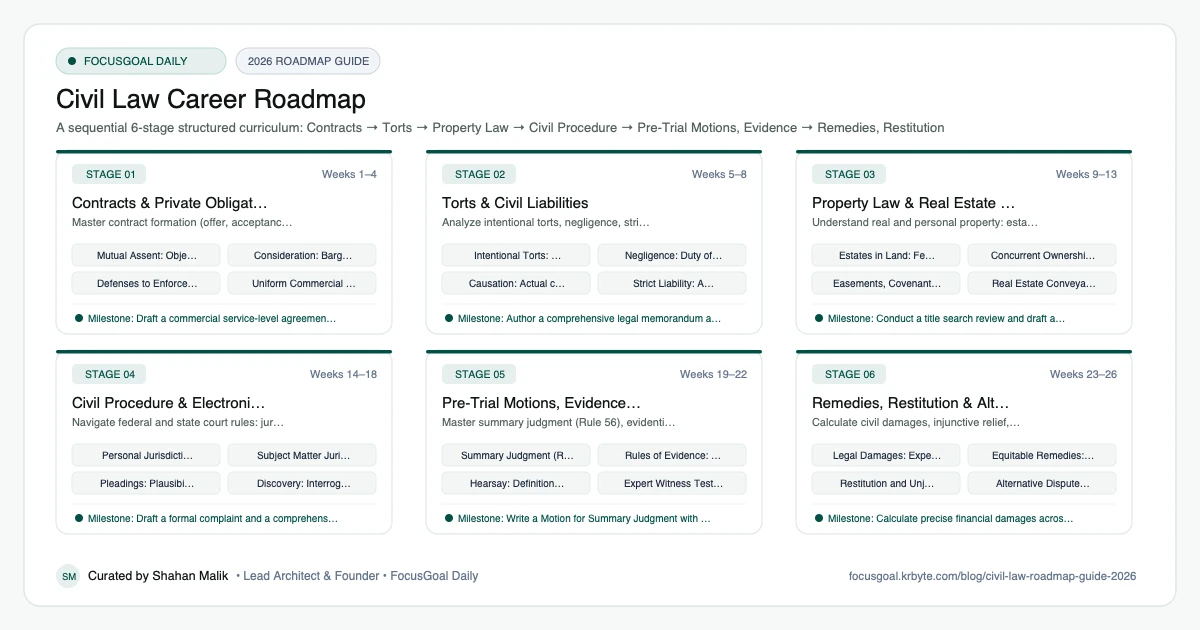
The 6 Production Stages
Follow these structured, sequential stages to systematically build production competence:
Contracts & Private Obligations
Master contract formation (offer, acceptance, consideration), defenses to enforceability, interpretation, and breach.
Torts & Civil Liabilities
Analyze intentional torts, negligence, strict product liability, proximate causation, and affirmative defenses.
Property Law & Real Estate Transactions
Understand real and personal property: estates in land, easements, deeds, recording statutes, and landlord-tenant disputes.
Civil Procedure & Electronic Discovery (FRCP)
Navigate federal and state court rules: jurisdiction, complaints, motions to dismiss (Rule 12(b)(6)), and e-discovery.
Pre-Trial Motions, Evidence & Trial Advocacy
Master summary judgment (Rule 56), evidentiary objections (hearsay, relevance, privilege), and trial preparation.
Remedies, Restitution & Alternative Dispute Resolution (ADR)
Calculate civil damages, injunctive relief, enforce arbitration clauses, and conduct structured negotiations.
Is a Career in Civil Law Worth It in 2026?
Civil law is one of the broadest areas of practice, because almost every business and individual eventually has a contract, property, or injury dispute. That breadth means steady work across litigation firms, in-house legal teams, insurers, public-interest organisations, and government bodies. It also lets you specialise later in areas such as commercial disputes, employment, or real estate.
The honest caveats: legal training is long, early-career hours can be demanding, and much of the daily work is document review, drafting, and negotiation rather than courtroom drama. Pay and demand vary widely by country, city, and type of employer, so check local conditions before committing. This article is general educational information, not legal advice. Admission, licensing, and practice rules differ by country and by state or province, so always confirm requirements with your local bar association, law society, or regulator.
- Good fit if you like structured reasoning, writing, and problem-solving under deadlines.
- Most civil disputes resolve by settlement or alternative dispute resolution, so negotiation skills matter as much as advocacy.
- Legal technology (e-discovery, contract review tools) is changing routine tasks, which rewards judgement and client skills.
Civil Law vs Criminal Law vs Corporate Law: What Is the Difference?
Civil law deals with disputes between private parties, such as people or companies, where the usual outcome is compensation or an order to do or stop doing something. Criminal law deals with offences against the state, where the possible outcome is punishment, and the burden of proof is higher. Corporate law focuses on how businesses are formed, governed, financed, and sold, and is often more transactional than adversarial.
Many lawyers move between these areas, and the foundations overlap. If you are still choosing, compare our Criminal Law Roadmap, Corporate Law Roadmap, and Family Law Roadmap alongside this one.
Skills, Tools & Resources You Will Use in Civil Practice
Civil practice rests on a small set of durable skills: reading statutes and cases closely, structuring arguments with a framework such as IRAC, drafting clear pleadings and contracts, and managing evidence. Legal research is done through primary sources (statutes, regulations, court decisions) and commercial or free legal databases available in your jurisdiction.
Alongside research, you will use document management, e-discovery platforms, case-management software, and ordinary productivity tools. Learning to explain a legal position in plain language to a client is a skill that no tool replaces.
- Legal research databases and your court system's published rules of procedure.
- Contract drafting and redlining in word processors, plus clause libraries and templates.
- E-discovery and document review platforms for large evidence sets.
- Case-management and time-recording software used by most firms.
Qualifications, Licensing & How to Get Your First Civil Law Role
The usual route is a law degree or an equivalent academic qualification, followed by a professional step that authorises you to practise, such as a bar examination, a practical training course, an apprenticeship, or a period of supervised training. The exact sequence is different in every country and, in some countries, in every state or province.
To get a first role, build practical exposure early: internships with law firms or courts, legal aid or university law clinics, mooting and writing competitions, and paralegal work. This article is general educational information, not legal advice. Admission, licensing, and practice rules differ by country and by state or province, so always confirm requirements with your local bar association, law society, or regulator.
- Check your local regulator or professional body for the authoritative admission requirements.
- Seek clinic, pro bono, or court-placement experience while you study.
- Build a small writing sample, such as a case note or research memo, for applications.
Beginner Pitfalls vs Production Reality
Self-taught developers commonly waste months making avoidable structural mistakes. Here is how production engineers approach these challenges:
Master Civil Law with FocusGoal Daily
Civil law requires mastering intricate multi-prong legal tests, statutory timelines, and rules of evidence. FocusGoal Daily turns extensive legal syllabi into disciplined daily milestones.
- Daily micro-goals for FRCP rules, contract doctrines, and tort liability elements.
- Maintain offline study streaks while in law libraries, courthouses, or legal clinics.
- AI concept tutor for immediate explanations of personal jurisdiction minimum contacts, hearsay exceptions, and Hadley consequential damages.
Track this roadmap,
one topic at a time.
Download FocusGoal, pick this roadmap and finish your first daily topic in minutes.
Frequently Asked Questions
What is the difference between Civil Law and Common Law systems?
Common Law systems (US, UK, Canada, Australia) rely heavily on judicial precedents and judge-made case law. Civil Law jurisdictions (continental Europe, Latin America) rely primarily on comprehensive codified statutes.
Do civil lawyers spend most of their time in court?
No. Over 95% of civil lawsuits settle before trial. Civil attorneys spend the vast majority of their time conducting discovery, drafting legal motions, reviewing contracts, taking depositions, and negotiating settlements.
What is the IRAC method in legal analysis?
IRAC stands for Issue, Rule, Application, and Conclusion. It is the universal framework for structuring legal writing, memoranda, and bar exam answers.
What does a civil lawyer do?
A civil lawyer advises and represents clients in non-criminal disputes such as contract breaches, property conflicts, and personal injury claims. Most of the work is research, drafting, negotiation, and managing evidence, with only some cases reaching a trial.
Is civil law hard to study?
It is demanding because it requires precise reading, memorisation of core rules, and careful application to facts. Most students find it manageable with steady practice on problem questions and a framework like IRAC.
How long does it take to become a civil lawyer?
It depends on the country, because the length of the degree and the required practical training both vary. Check your local bar association or law society for the exact sequence and time involved.
Civil law vs criminal law: which should I choose?
Choose civil law if you prefer disputes about money, rights, and obligations, and criminal law if you are drawn to liberty, evidence, and trial work. Both are valid, and you can often try each through internships before committing.
Do I need a license to practise civil law?
In most places, yes: you must be admitted or licensed by a bar, law society, or similar body before representing clients in court. Requirements differ by country and state, so confirm them with your local regulator.
Start Your Civil Law Today
Follow structured daily goals, study 100% offline with local SQLite, and get on-demand AI guidance with FocusGoal Daily on Android.
Get FocusGoal Daily Free on Google Play