Corporate Law Roadmap (2026): From Startup Formation to Public Company Securities
Learn how modern businesses are formed, governed, funded, and acquired. Master Delaware corporate law, board fiduciary duties, venture funding rounds, M&A due diligence, and SEC securities disclosure rules.

What's in this guide
The Short Answer: Corporate Law in 2026
Corporate law forms the legal framework of modern enterprise. Corporate lawyers advise boards of directors, structure cross-border acquisitions, negotiate startup financing rounds, draft commercial contracts, and ensure compliance with global regulatory authorities like the SEC.
In 2026, corporate lawyers navigate complex challenges: AI governance, cross-border export controls, CFIUS national security reviews, and volatile private credit markets. Success requires an astute understanding of both corporate doctrine and commercial balance sheets.
Corporate law is transactional, not adversarial. A great corporate lawyer does not just say 'no'; they design creative legal structures that mitigate risk while enabling commercial deals to close.
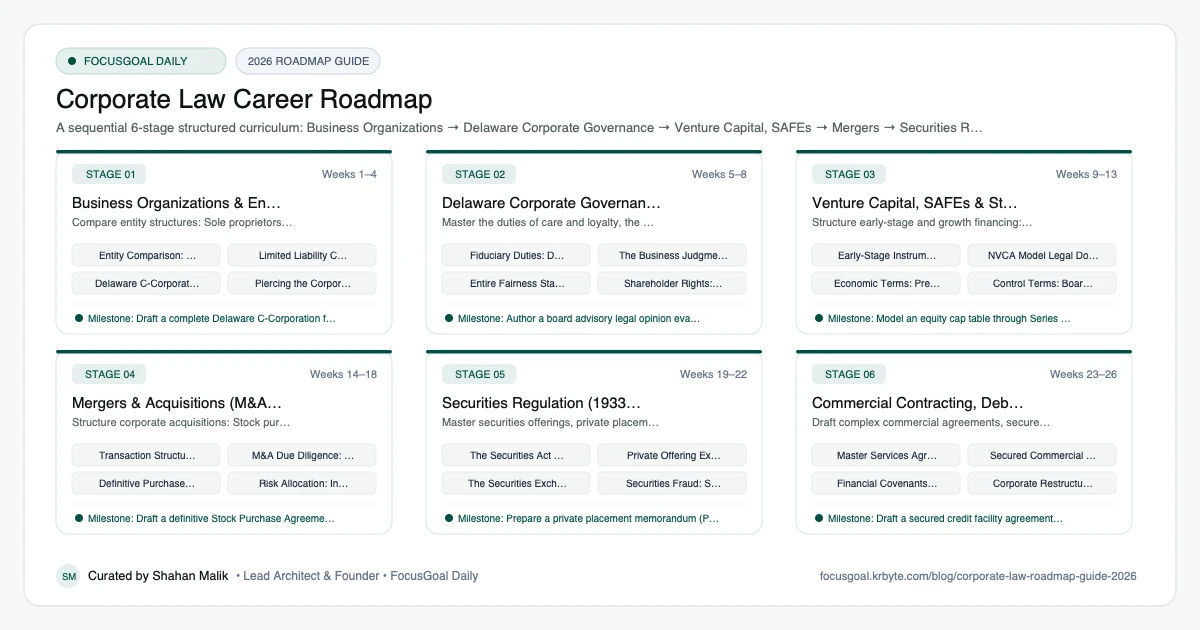
The 6 Production Stages
Follow these structured, sequential stages to systematically build production competence:
Business Organizations & Entity Selection
Compare entity structures: Sole proprietorships, partnerships, LLCs, and C-Corporations (taxation, liability, governance).
Delaware Corporate Governance & Fiduciary Duties
Master the duties of care and loyalty, the Business Judgment Rule, conflicts of interest, and shareholder derivative suits.
Venture Capital, SAFEs & Startup Equity Financing
Structure early-stage and growth financing: SAFEs, convertible notes, Series Seed/A NVCA model agreements, and cap tables.
Mergers & Acquisitions (M&A) Deal Architecture
Structure corporate acquisitions: Stock purchases, asset purchases, statutory mergers, due diligence, and purchase agreements.
Securities Regulation (1933 & 1934 Acts, SEC Filing)
Master securities offerings, private placement exemptions (Reg D), insider trading rules (Rule 10b-5), and periodic reporting.
Commercial Contracting, Debt Financing & Restructuring
Draft complex commercial agreements, secured syndicated credit facilities (UCC Article 9), and corporate restructuring.
Is a Career in Corporate Law Worth It in 2026?
Corporate law suits people who enjoy structuring deals, reading detailed documents, and working closely with business teams. Demand tends to follow business activity: financings, acquisitions, restructurings, and regulatory change all create work, and in-house legal roles at companies offer an alternative to law firm practice.
The caveats are real. Transactional work can involve long hours around closing deadlines, activity is cyclical, and the work is precision-heavy. Pay and hiring vary by country, city, and employer type, so research local conditions. This article is general educational information, not legal advice. Admission, licensing, and practice rules differ by country and by state or province, so always confirm requirements with your local bar association, law society, or regulator.
- Good fit if you like drafting, negotiation, and understanding how businesses make money.
- Startup and venture work rewards comfort with ambiguity and fast-moving clients.
- In-house roles trade deal variety for closer involvement in one business.
Skills, Tools & Resources You Will Use in Corporate Practice
Core skills include contract drafting, negotiation, reading financial statements at a basic level, and project-managing a transaction with many moving parts. You will rely on primary sources such as company statutes, securities regulations, and stock exchange rules, plus precedent documents from your firm or team.
Technology is a daily part of the job: virtual data rooms for due diligence, contract lifecycle and review tools, document comparison software, and entity-management systems. Commercial awareness, meaning understanding what the client is actually trying to achieve, is often what separates strong junior lawyers.
- Virtual data rooms used in due diligence and acquisitions.
- Document comparison and redlining tools for negotiated drafts.
- Basic accounting and finance literacy for reading balance sheets and deal terms.
- Official company registries and securities regulator filings in your jurisdiction.
Qualifications, Licensing & How to Get Your First Corporate Law Role
Typical routes combine a law degree or equivalent with the professional qualification required in your jurisdiction, such as a bar exam, a training contract, or supervised practice. Some lawyers add finance, business, or tax coursework to stand out. Rules on who may give legal advice differ widely between countries and states.
For first roles, target internships and vacation schemes at firms, in-house legal departments, and startups, and consider paralegal or legal-operations work as a stepping stone. This article is general educational information, not legal advice. Admission, licensing, and practice rules differ by country and by state or province, so always confirm requirements with your local bar association, law society, or regulator.
- Confirm admission rules with your local bar association, law society, or regulator.
- Develop commercial awareness by following business and deal news.
- Consider short courses in accounting or finance basics.
Beginner Pitfalls vs Production Reality
Self-taught developers commonly waste months making avoidable structural mistakes. Here is how production engineers approach these challenges:
Master Corporate Law with FocusGoal Daily
Corporate law demands thorough retention of statutory sections, Delaware Court of Chancery precedents, and complex deal clauses. FocusGoal Daily turns extensive corporate doctrines into structured daily habits.
- Daily micro-tasks for corporate governance tests, NVCA term sheet clauses, and SEC regulations.
- Track study streaks offline while reviewing deal rooms or corporate board minutes.
- Instant AI explanations for Delaware 220 inspections, BJR exceptions, and Howey securities tests.
Track this roadmap,
one topic at a time.
Download FocusGoal, pick this roadmap and finish your first daily topic in minutes.
Frequently Asked Questions
Why are most US corporations incorporated in Delaware?
Delaware has a highly sophisticated Court of Chancery dedicated exclusively to business disputes without juries, centuries of predictable case law precedents, and flexible DGCL corporate statutes favored by institutional investors.
Do corporate lawyers need an MBA or finance background?
No formal MBA is required, but an understanding of accounting principles (balance sheets, income statements, cash flows, enterprise value, and EBITDA) is essential for reviewing M&A purchase prices and debt covenants.
What is the difference between In-House Counsel and Law Firm Corporate Lawyers?
Law firm corporate attorneys typically specialize in specific transactions (M&A, venture capital, or public securities) across many clients. In-house corporate counsel works directly inside a single company advising executive management on day-to-day legal strategy.
What does a corporate lawyer do?
A corporate lawyer advises businesses on formation, governance, financing, mergers and acquisitions, and regulatory compliance. Day to day, that means drafting and negotiating agreements, running due diligence, and coordinating closings.
Is corporate law hard?
It is demanding because documents are detailed and deadlines can be tight. The concepts become manageable with practice, especially if you build basic finance literacy early.
How long does it take to become a corporate lawyer?
The timeline depends on your country's degree, training, and admission requirements. Check your local bar association or law society for the exact route.
Corporate law vs litigation: which is better?
Neither is better; they suit different working styles. Corporate law is deal-focused and collaborative, while litigation is dispute-focused and adversarial, and many lawyers try both early on.
Do I need a license to practise corporate law?
Generally yes: giving legal advice to clients usually requires admission to the bar or an equivalent regulated body. The rules vary by jurisdiction, so check with your local regulator.
Start Your Corporate Law Today
Follow structured daily goals, study 100% offline with local SQLite, and get on-demand AI guidance with FocusGoal Daily on Android.
Get FocusGoal Daily Free on Google Play