Criminal Law Roadmap (2026): From Constitutional Protections to Courtroom Verdicts
Learn how criminal justice systems enforce laws and protect constitutional rights. Master substantive penal statutes, search and seizure jurisprudence, interrogation rules, grand jury proceedings, and trial advocacy.

What's in this guide
The Short Answer: Criminal Law in 2026
Criminal law stands at the intersection of government power and individual constitutional liberty. Whether serving as a prosecutor representing the state or a defense attorney protecting an accused citizen, criminal attorneys operate in high-stakes environments where human freedom is on the line.
In 2026, criminal practice requires understanding both traditional penal codes and modern digital evidence: cell phone geofencing warrants, encrypted messaging, automated license plate readers, and forensic DNA standards. Success demands deep knowledge of constitutional doctrine and razor-sharp courtroom presence.
The prosecution bears the burden of proving every single element of an offense beyond a reasonable doubt. Defense strategy focuses on identifying weak evidentiary links, constitutional suppression violations, and jury instruction leverage.
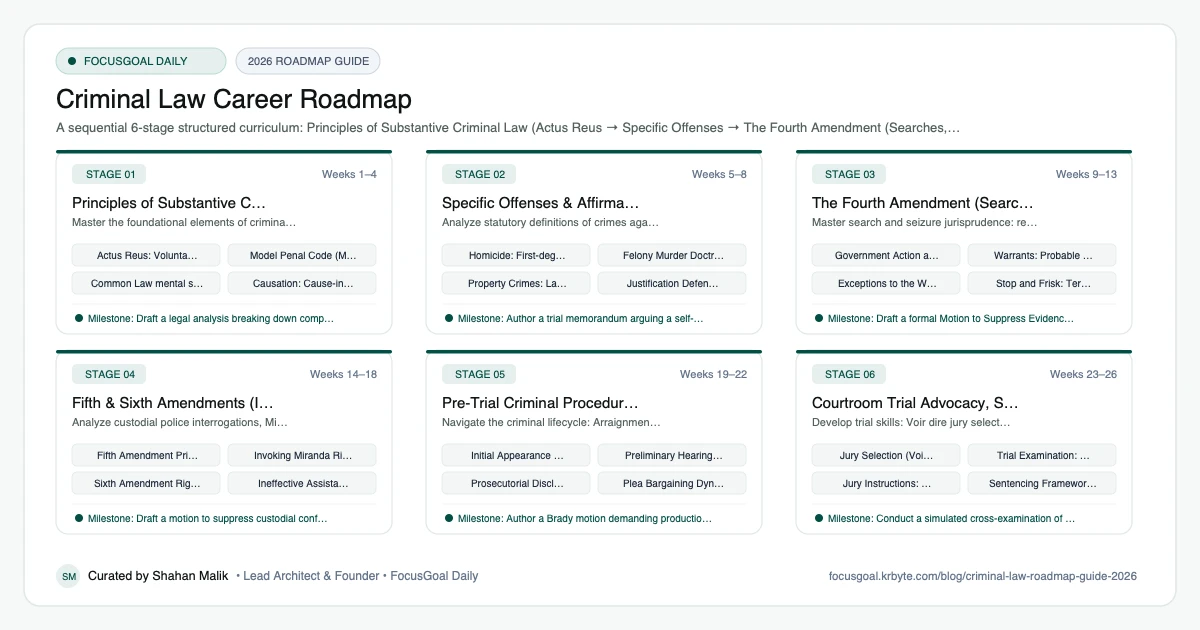
The 6 Production Stages
Follow these structured, sequential stages to systematically build production competence:
Principles of Substantive Criminal Law (Actus Reus & Mens Rea)
Master the foundational elements of criminal culpability: voluntary physical acts, mental states (MPC), and causation.
Specific Offenses & Affirmative Defenses
Analyze statutory definitions of crimes against persons, property, and the state, along with justification/excuse defenses.
The Fourth Amendment (Searches, Seizures & Warrants)
Master search and seizure jurisprudence: reasonable expectations of privacy (Katz), warrant requirements, and warrant exceptions.
Fifth & Sixth Amendments (Interrogation, Counsel & Confrontation)
Analyze custodial police interrogations, Miranda rights, right to counsel, and witness confrontation rights.
Pre-Trial Criminal Procedure (Bail, Discovery & Plea Deals)
Navigate the criminal lifecycle: Arraignments, bail bond hearings, grand jury indictments, Brady disclosures, and plea negotiations.
Courtroom Trial Advocacy, Sentencing & Appeals
Develop trial skills: Voir dire jury selection, opening statements, cross-examination, jury instructions, sentencing, and appeals.
Is a Career in Criminal Law Worth It in 2026?
Criminal law offers direct, high-stakes work with people and the justice system, as a prosecutor, defence lawyer, public defender, or in government and advisory roles. Many lawyers value the early courtroom experience, since junior criminal practitioners often appear in court sooner than in other areas.
The caveats: caseloads can be heavy, the emotional load is real, and funding for public-sector and legal-aid work varies greatly by country. Pay and demand differ by jurisdiction, so research your local market. This article is general educational information, not legal advice. Admission, licensing, and practice rules differ by country and by state or province, so always confirm requirements with your local bar association, law society, or regulator.
- Good fit if you are comfortable with advocacy, fast decisions, and difficult client situations.
- Strong grounding in evidence and constitutional or human-rights protections is essential.
- Resilience and professional boundaries matter as much as legal knowledge.
Criminal Law vs Civil Law vs Family Law: What Is the Difference?
In criminal cases the state prosecutes alleged offences, the standard of proof is higher, and outcomes can include loss of liberty. In civil cases private parties dispute rights or money, and the remedy is usually compensation or an order. Family law covers relationships such as divorce, custody, and support, and combines legal rules with emotionally sensitive negotiation.
The skills overlap in evidence, procedure, and advocacy. Read our Civil Law Roadmap and Family Law Roadmap to compare how each field works day to day.
Skills, Tools & Resources You Will Use in Criminal Practice
Criminal practice builds on statutory interpretation, knowledge of the rules of evidence, cross-examination, and persuasive speaking. Preparation involves reading police and prosecution disclosure, interviewing clients and witnesses, and researching case law on search, interrogation, and sentencing.
You will use legal research databases, court filing systems, case-management software, and often digital evidence such as video or phone records. Strong note-taking and calm communication under pressure are practical skills worth deliberately practising.
- Your jurisdiction's criminal code, rules of evidence, and sentencing guidance.
- Legal research databases for case law and appeals.
- Mock trial and moot court experience for advocacy practice.
- Digital evidence review tools used by courts and practitioners.
Qualifications, Licensing & How to Get Your First Criminal Law Role
As with other branches of law, the usual route is a law degree followed by the professional admission steps your jurisdiction requires. Some countries have specialist training or accreditation for criminal advocacy or duty solicitor schemes, while others do not, so check locally.
Useful early experience includes court observation, legal aid or innocence-project style clinics, internships with prosecutors' or defenders' offices, and mooting. This article is general educational information, not legal advice. Admission, licensing, and practice rules differ by country and by state or province, so always confirm requirements with your local bar association, law society, or regulator.
- Check your regulator for admission rules and any criminal-specific accreditation.
- Volunteer or intern in a clinic, public defender, or prosecution office where possible.
- Attend court hearings to learn procedure and courtroom etiquette.
Beginner Pitfalls vs Production Reality
Self-taught developers commonly waste months making avoidable structural mistakes. Here is how production engineers approach these challenges:
Master Criminal Law with FocusGoal Daily
Criminal law requires memorizing constitutional case law, statutory definitions, and strict procedural rules. FocusGoal Daily turns high-stakes criminal law study into disciplined daily targets.
- Daily micro-tasks for Fourth Amendment warrant exceptions, mens rea levels, and Miranda doctrines.
- Track offline study streaks while in county courthouses, public defender offices, or detention centers.
- Instant AI explanations for Terry stops, Strickland ineffective assistance prongs, and Crawford confrontation limits.
Track this roadmap,
one topic at a time.
Download FocusGoal, pick this roadmap and finish your first daily topic in minutes.
Frequently Asked Questions
What is the difference between a felony and a misdemeanor?
A felony is a serious crime typically punishable by more than one year of incarceration in state or federal prison. A misdemeanor is a less severe offense punishable by fines or up to one year in a local county jail.
What is the burden of proof in criminal trials?
The prosecution must prove every element of the crime beyond a reasonable doubt (the highest legal standard in the justice system). In contrast, civil lawsuits require only a preponderance of the evidence (> 50%).
Can a defendant refuse to testify at their own trial?
Yes. Under the Fifth Amendment, defendants have an absolute right not to testify, and neither the prosecutor nor the judge may instruct the jury to infer guilt from their silence.
What does a criminal lawyer do?
A criminal lawyer represents either the accused or the prosecution in criminal cases. Work includes advising clients, reviewing evidence, negotiating pleas where available, and advocating at hearings and trials.
Is criminal law hard?
It is challenging because it combines strict procedure, evidence rules, and emotionally heavy cases. Many students find the structure of offences and defences logical, and the advocacy skills improve with practice.
How long does it take to become a criminal lawyer?
That depends on your country's education and professional training requirements. Check with your local bar association or law society for the exact route and duration.
Criminal law vs civil law: what is the difference?
Criminal law concerns offences against the state with possible punishment, while civil law resolves private disputes through compensation or orders. They use different standards of proof and different procedures.
Do I need a license to be a criminal defence lawyer?
In most places, yes: you need to be admitted or licensed by the relevant legal regulator. Requirements vary by country and state, so confirm them locally.
Start Your Criminal Law Today
Follow structured daily goals, study 100% offline with local SQLite, and get on-demand AI guidance with FocusGoal Daily on Android.
Get FocusGoal Daily Free on Google Play