Family Law Roadmap (2026): From Premarital Planning to Dissolution & Custody
Learn how domestic relations and marital rights are protected. Master prenuptial drafting, marital asset valuation, child custody 'best interests' standards, guideline child support calculations, and family dispute mediation.

What's in this guide
The Short Answer: Family Law in 2026
Family law governs the most personal and emotionally charged aspects of legal practice: marriage, divorce, parental rights, child custody, and the division of accumulated family wealth. A family law attorney must balance rigorous legal and financial analysis with high emotional intelligence and trauma-informed advocacy.
In 2026, family law practice increasingly centers on complex modern asset valuations (crypto assets, startup equity, private equity carry), multi-jurisdictional custody relocation disputes, and collaborative family law mediation that resolves disputes outside adversarial courtrooms.
In child custody matters, the court's sole guiding star is the 'Best Interests of the Child' standard. Parental grievances, anger, and punitive motives carry zero legal weight and frequently damage a client's standing before the family judge.
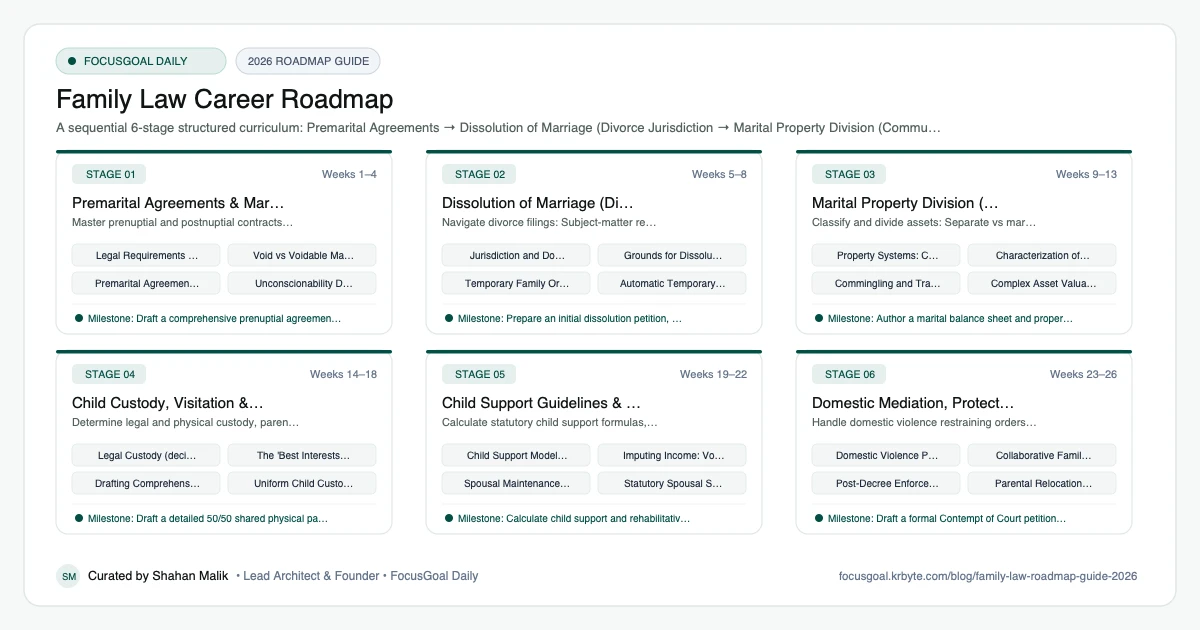
The 6 Production Stages
Follow these structured, sequential stages to systematically build production competence:
Premarital Agreements & Marriage Validity
Master prenuptial and postnuptial contracts under the Uniform Premarital Agreement Act (UPAA), marriage formalization, and annulments.
Dissolution of Marriage (Divorce Jurisdiction & Grounds)
Navigate divorce filings: Subject-matter residency requirements, no-fault vs fault grounds, service of process, and temporary orders.
Marital Property Division (Community Property vs Equitable Distribution)
Classify and divide assets: Separate vs marital property, transmutation, commingling, business valuation, and QDROs.
Child Custody, Visitation & Best Interests Standard
Determine legal and physical custody, parenting time schedules, parental alienation, and interstate UCCJEA jurisdiction.
Child Support Guidelines & Spousal Maintenance (Alimony)
Calculate statutory child support formulas, income imputation, spousal support duration factors, and modifications.
Domestic Mediation, Protective Orders & Post-Decree Enforcement
Handle domestic violence restraining orders, collaborative divorce mediation, contempt of court, and adoption.
Is a Career in Family Law Worth It in 2026?
Family law offers meaningful, people-centred work in areas such as divorce, parenting arrangements, support, and protection from domestic abuse. Practitioners work in private firms, legal aid organisations, mediation practices, and community services, and demand is relatively steady because family issues arise in every community.
The caveats are emotional: clients are often in distress, cases can be long-running, and boundaries matter. Pay and funding vary widely by country and region, with legal aid availability differing significantly. This article is general educational information, not legal advice. Admission, licensing, and practice rules differ by country and by state or province, so always confirm requirements with your local bar association, law society, or regulator.
- Good fit if you have empathy, patience, and strong negotiation skills.
- Many matters are resolved through mediation or negotiation rather than trial.
- Self-care and professional support are important in this field.
Skills, Tools & Resources You Will Use in Family Law
Family practice depends on interviewing, active listening, negotiation, and clear drafting of agreements and court documents. You also need basic financial literacy to understand assets, debts, pensions, and income, as financial disclosure is central to many cases.
Practical resources include your jurisdiction's family legislation and court forms, case-management software, financial disclosure templates, and referral networks such as mediators, counsellors, and financial experts.
- Family court rules, forms, and practice directions in your jurisdiction.
- Mediation and collaborative-practice training where available.
- Financial disclosure and asset-valuation templates.
- Trauma-informed communication training for sensitive client situations.
Qualifications, Licensing & How to Get Your First Family Law Role
Practising family law normally requires a law qualification plus the admission steps of your jurisdiction. Some places also have separate accreditation or panels for child-representation or mediation work, and mediators may need their own training or registration.
To get started, seek experience in legal aid clinics, community legal centres, court-assistance programmes, and mediation services. This article is general educational information, not legal advice. Admission, licensing, and practice rules differ by country and by state or province, so always confirm requirements with your local bar association, law society, or regulator.
- Check your regulator for admission and any family-law specialist accreditation.
- Consider formal mediation training as an additional skill.
- Volunteer at clinics or support services to build client-facing experience.
Beginner Pitfalls vs Production Reality
Self-taught developers commonly waste months making avoidable structural mistakes. Here is how production engineers approach these challenges:
Master Family Law with FocusGoal Daily
Family law requires balancing complex statutory guidelines, property characterization rules, and child custody doctrines. FocusGoal Daily turns extensive domestic relations material into manageable daily milestones.
- Daily micro-tasks for UCCJEA jurisdiction rules, UPAA prenuptial standards, and child support formulas.
- Track study streaks offline while waiting in family courtrooms or attending mediation sessions.
- Instant AI explanations for community property transmutation, QDRO pension distribution, and Best Interests factors.
Track this roadmap,
one topic at a time.
Download FocusGoal, pick this roadmap and finish your first daily topic in minutes.
Frequently Asked Questions
What is the difference between Community Property and Equitable Distribution?
In Community Property states (e.g., California, Texas), all assets acquired during the marriage are generally divided 50/50. In Equitable Distribution states (the majority of US states), judges divide marital property based on what is fair and equitable, which is not always an equal 50/50 split.
Can parents agree to eliminate child support in a prenuptial agreement?
No. Child support belongs to the child, not the parents. Courts will strike down any provision in a prenuptial or separation agreement that waives or unreasonably limits child support.
What is a 'No-Fault' divorce?
A no-fault divorce allows either spouse to dissolve the marriage simply by stating that the marriage is irretrievably broken, without needing to prove wrongdoing such as adultery, cruelty, or desertion.
What does a family lawyer do?
A family lawyer advises on issues such as divorce, child arrangements, financial settlements, and protective orders. They negotiate, draft agreements, and represent clients in court when matters cannot be resolved.
Is family law emotionally difficult?
Yes, it can be, because clients are often dealing with major life changes. Good practitioners set professional boundaries, use supervision or peer support, and focus on practical solutions.
How long does it take to become a family lawyer?
It depends on your country's education and admission process, plus any specialist training you pursue. Check with your local bar association or law society.
Family law vs civil law: what is the difference?
Family law focuses on relationships, children, and household finances, while civil law covers a wider range of private disputes. Family law is usually considered a specialised branch of civil practice.
Do I need a license to practise family law?
In most places you need to be admitted as a lawyer by a regulated body, and mediators may have separate requirements. Confirm the rules with your local regulator.
Start Your Family Law Today
Follow structured daily goals, study 100% offline with local SQLite, and get on-demand AI guidance with FocusGoal Daily on Android.
Get FocusGoal Daily Free on Google Play