Intellectual Property Roadmap (2026): Protecting Inventions, Brands & Creative Works
Learn how intangible ideas and commercial innovations are secured. Master patent claim drafting, trademark brand protection, copyright fair use, trade secret defense, and emerging generative AI IP policy.

What's in this guide
The Short Answer: Intellectual Property in 2026
Intellectual Property (IP) is the primary driver of corporate valuation in the modern global economy. From life-saving pharmaceutical compounds and proprietary silicon architectures to recognizable consumer brand trademarks and digital software code, IP law secures the investments of inventors and creators.
In 2026, intellectual property practice has been revolutionized by Generative AI: debates over copyright fair use in LLM training datasets, patentability of AI-assisted inventions under 35 U.S.C. 101, and heightened scrutiny over trade secret leakage. IP lawyers are indispensable advisors to modern tech enterprises.
The four IP pillars serve completely distinct purposes: Patents protect functional inventions, Trademarks protect source-identifying brand symbols, Copyrights protect original creative expression, and Trade Secrets protect confidential business information. Never conflate their statutory requirements.
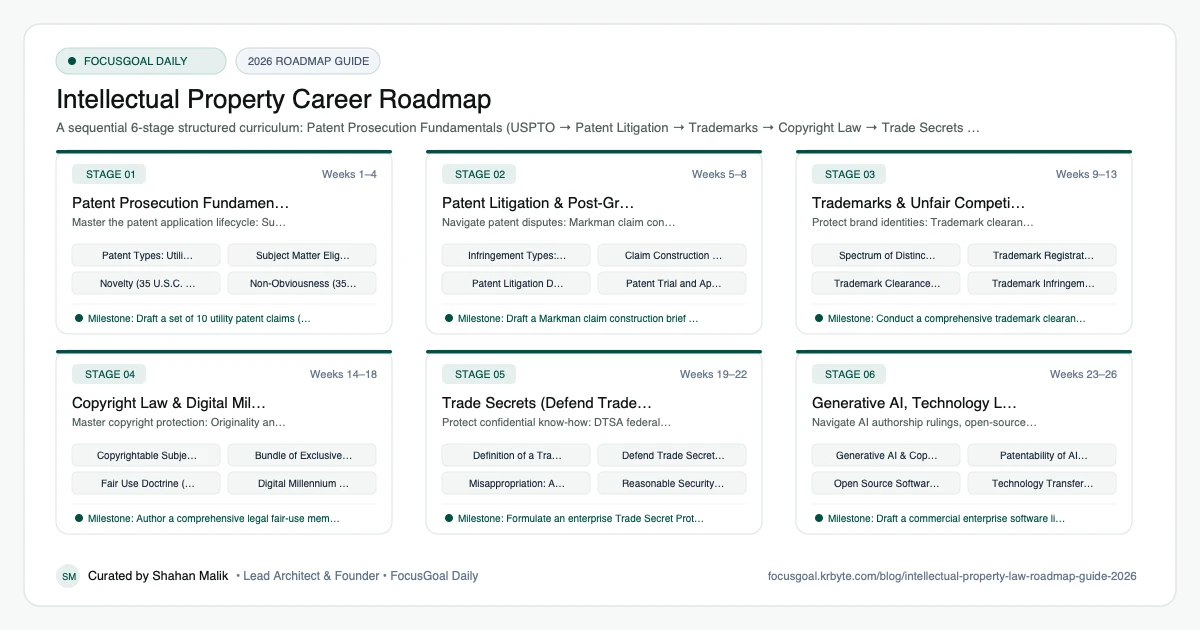
The 6 Production Stages
Follow these structured, sequential stages to systematically build production competence:
Patent Prosecution Fundamentals (USPTO & 35 U.S.C.)
Master the patent application lifecycle: Subject matter eligibility (101 / Alice), novelty (102), non-obviousness (103), and claim drafting.
Patent Litigation & Post-Grant Review (PTAB)
Navigate patent disputes: Markman claim construction hearings, infringement doctrines, invalidity defenses, and IPR proceedings.
Trademarks & Unfair Competition (The Lanham Act)
Protect brand identities: Trademark clearance searches, spectrum of distinctiveness (Abercrombie), USPTO registration, and infringement.
Copyright Law & Digital Millennium Copyright Act (DMCA)
Master copyright protection: Originality and fixation, idea-expression dichotomy, exclusive rights, fair use, and online safe harbors.
Trade Secrets (Defend Trade Secrets Act & Non-Competes)
Protect confidential know-how: DTSA federal jurisdiction, Uniform Trade Secrets Act (UTSA), reasonable security measures, and NDA enforcement.
Generative AI, Technology Licensing & IP Portfolio Strategy
Navigate AI authorship rulings, open-source software licenses, technology transfer, and commercial IP licensing agreements.
Is a Career in Intellectual Property Law Worth It in 2026?
Intellectual property (IP) law protects creations such as inventions, brands, software, designs, and creative works. Demand comes from technology companies, creative industries, universities, and any business that relies on brand or innovation, and from the growing question of how existing IP rules apply to new technologies such as AI.
The caveats: the field is technical, and some areas, such as patent prosecution, may require scientific or technical credentials. Work is also cyclical with industry activity, and pay and demand differ by country. This article is general educational information, not legal advice. Admission, licensing, and practice rules differ by country and by state or province, so always confirm requirements with your local bar association, law society, or regulator.
- Good fit if you enjoy detail, technology, and creative industries.
- Different branches (patents, trademarks, copyright, trade secrets) suit different backgrounds.
- Both advisory and litigation paths are available.
Skills, Tools & Resources You Will Use in IP Practice
IP practice combines legal analysis with technical or creative understanding. You will draft and review licences, assignments, and registrations, search existing rights to assess risk, and advise on enforcement. Attention to detail matters because deadlines and formal requirements can decide whether rights are secured.
Common resources include national and regional IP office databases for patents, trademarks, and designs, the international treaties and systems your jurisdiction participates in, and docketing software to track deadlines.
- Public patent and trademark office search databases.
- IP docketing and deadline-management software.
- Licensing and assignment agreement templates.
- Basic technical or industry knowledge in your chosen sector.
Qualifications, Licensing & How to Get Your First IP Law Role
Routes into IP law vary. General lawyers can advise on trademarks, copyright, and licensing after standard admission to practise. Some jurisdictions have a separate professional qualification for patent or trademark attorneys or agents, and some require a technical degree for patent work, so check the requirements of your local patent or trademark office and professional body.
To build experience, look for internships at IP firms, technology transfer offices, in-house legal teams, and university clinics. This article is general educational information, not legal advice. Admission, licensing, and practice rules differ by country and by state or province, so always confirm requirements with your local bar association, law society, or regulator.
- Check your national IP office and professional body for patent or trademark practitioner rules.
- Consider a technical or science degree if you want to pursue patent work.
- Seek IP clinics, tech-transfer internships, and moot competitions.
Beginner Pitfalls vs Production Reality
Self-taught developers commonly waste months making avoidable structural mistakes. Here is how production engineers approach these challenges:
Master Intellectual Property Law with FocusGoal Daily
Intellectual Property law requires memorizing distinct statutory criteria across patents, trademarks, copyrights, and trade secrets. FocusGoal Daily turns this wide technical curriculum into disciplined daily study goals.
- Daily micro-tasks for patent claim rules, Lanham Act likelihood of confusion factors, and DMCA safe harbors.
- Track study streaks offline while working at patent firms, tech incubators, or corporate innovation centers.
- Instant AI explanations for Alice 101 tests, copyright fair use factors, and DTSA trade secret definitions.
Track this roadmap,
one topic at a time.
Download FocusGoal, pick this roadmap and finish your first daily topic in minutes.
Frequently Asked Questions
Do I need a science or engineering degree to practice Intellectual Property law?
To sit for the USPTO Patent Bar and prosecute patent applications as a Patent Attorney, a recognized degree in engineering, computer science, physics, or physical sciences is mandatory. However, trademark, copyright, trade secret, and IP litigation attorneys do not need a STEM degree.
Can AI-generated works be copyrighted?
Under current US Copyright Office policy, works generated entirely by artificial intelligence without human creative authorship cannot be copyrighted. Human creative arrangement or selection of AI outputs may be protectable, but the raw AI generation is public domain.
What is the difference between a Provisional and Non-Provisional Patent Application?
A Provisional Patent Application is an informal placeholder filing that establishes an early priority date for 12 months with lower filing fees and no formal claims. Within that 12-month period, the inventor must file a formal Non-Provisional Application to secure a granted patent.
What does an intellectual property lawyer do?
An IP lawyer helps clients protect, license, and enforce rights in inventions, brands, creative works, and trade secrets. Typical tasks include registrations, licensing agreements, clearance searches, and handling infringement disputes.
Do I need a science degree to become an IP lawyer?
Not for all areas. Trademark and copyright work generally do not require one, but patent work in many places requires a technical background, so check your local rules.
Patent vs trademark vs copyright: what is the difference?
Patents protect inventions, trademarks protect brand identifiers such as names and logos, and copyright protects original creative works. Each has its own rules, duration, and registration process that vary by country.
How long does it take to become an IP lawyer?
That depends on your country's legal education and any additional patent or trademark qualifications. Check your local regulator and IP office for the exact path.
Do I need a separate license to practise IP law?
General lawyers can often advise on IP, but some countries require separate registration to act before the patent or trademark office. Confirm the requirements with your local professional body.
Start Your Intellectual Property Today
Follow structured daily goals, study 100% offline with local SQLite, and get on-demand AI guidance with FocusGoal Daily on Android.
Get FocusGoal Daily Free on Google Play