Biotechnology Roadmap (2026): From Gene Editing to Industrial Biomanufacturing
Learn how modern life sciences engineer biology to cure disease and manufacture sustainable materials. Master recombinant DNA, CRISPR gene editing, microbial fermentation, computational genomics, and FDA cGMP standards.

What's in this guide
The Short Answer: Biotechnology in 2026
Biotechnology harnesses cellular and biomolecular processes to develop therapies, synthetic proteins, drought-resistant crops, and biofuels. In 2026, the biotechnology landscape is driven by mRNA therapeutics, precision CRISPR gene therapies, AI-assisted protein design (AlphaFold 3), and scaled cellular agriculture.
Succeeding in biotechnology requires mastering both wet-lab molecular techniques (pipetting, PCR, sterile cell culture, chromatography) and computational bioinformatics pipelines in Python and R.
Biological systems are inherently variable. Recombinant cell yields depend critically on aseptic technique, strict dissolved oxygen/pH control in bioreactors, and validation of sterile filtration barriers.
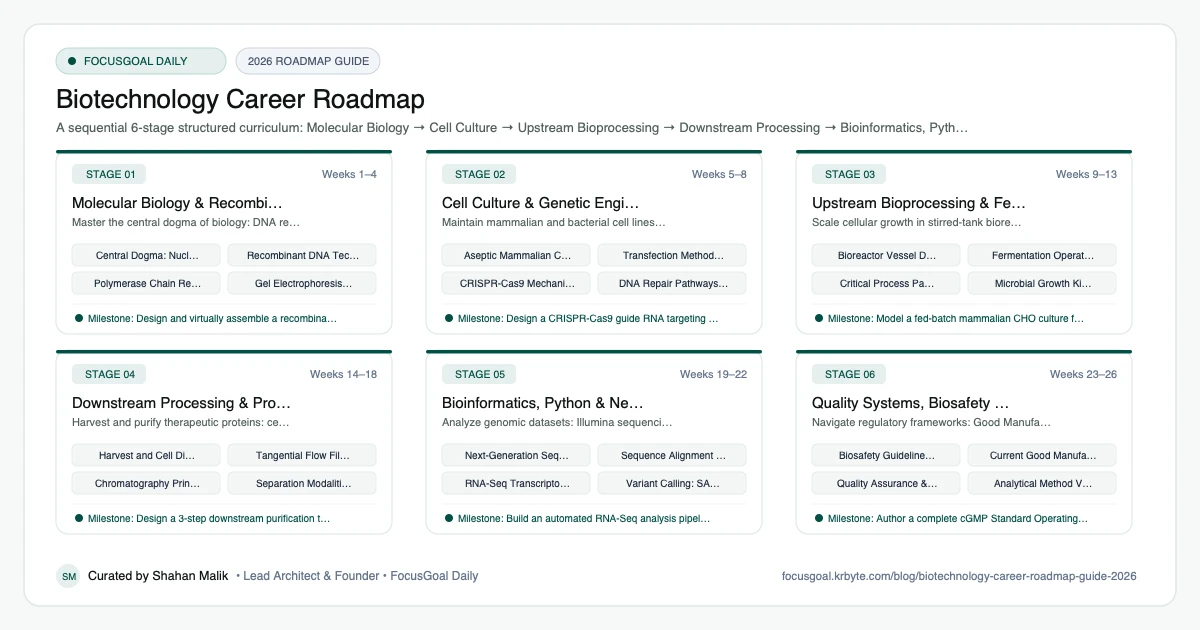
The 6 Production Stages
Follow these structured, sequential stages to systematically build production competence:
Molecular Biology & Recombinant DNA Fundamentals
Master the central dogma of biology: DNA replication, transcription, translation, restriction cloning, and PCR amplification.
Cell Culture & Genetic Engineering (CRISPR-Cas9)
Maintain mammalian and bacterial cell lines, perform lentiviral transfections, and design targeted CRISPR knockouts.
Upstream Bioprocessing & Fermentation Technology
Scale cellular growth in stirred-tank bioreactors: dissolved oxygen (DO), sparging, feed strategies, and microbial kinetics.
Downstream Processing & Protein Purification (FPLC)
Harvest and purify therapeutic proteins: centrifugation, Tangential Flow Filtration (TFF), and multi-column chromatography.
Bioinformatics, Python & Next-Generation Sequencing (NGS)
Analyze genomic datasets: Illumina sequencing libraries, variant calling, RNA-Seq transcriptomics, and Biopython.
Quality Systems, Biosafety & FDA cGMP Regulation
Navigate regulatory frameworks: Good Manufacturing Practice (cGMP), Biosafety Levels (BSL-1 to 4), and FDA IND filings.
Is a Career in Biotechnology Worth It in 2026?
Biotechnology applies biology and engineering to medicine, agriculture, food, industrial processes, and the environment. Demand is driven by drug and diagnostic development, gene and cell therapies, vaccine manufacturing, and the growing use of computation in biology, with employers including pharmaceutical firms, start-ups, contract research and manufacturing organisations, universities, and regulators.
The honest caveats: lab work can be repetitive, experiments often fail, many entry roles expect a postgraduate degree for research positions, and funding for start-ups is cyclical. Pay and hiring vary by country and region, so check local listings before planning.
- Good fit if you enjoy lab work, careful documentation, and slow, evidence-led progress.
- Bioinformatics and data skills widen your options considerably.
- Industry roles in quality, manufacturing, and regulatory affairs are routes beyond bench research.
Biotechnology vs Biomedical Engineering vs Biochemistry: What Is the Difference?
Biotechnology uses living systems, such as cells, enzymes, and genes, to make products or processes. Biomedical engineering applies engineering principles to healthcare, which often means devices, imaging, and prosthetics. Biochemistry studies the chemical processes inside living organisms and is more of a foundational science than an applied field.
The fields overlap in areas such as tissue engineering, diagnostics, and biosensors. If you are unsure which suits you, read our Biomedical Engineering Roadmap alongside this one, and consider how much you prefer wet-lab biology versus hardware and design.
Skills, Tools & Resources You Will Use in Biotechnology
Core wet-lab skills include aseptic technique, pipetting accuracy, cell culture, and reading experimental protocols closely. Standard methods you will meet include PCR, gel electrophoresis, chromatography, and sequencing, plus principles such as good laboratory practice (GLP) and good manufacturing practice (GMP) in regulated settings.
Computational skills are increasingly valuable: basic statistics, Python or R, and working with public biological databases and sequence analysis tools. Clear lab notebooks and reproducible methods matter as much as technique.
- Wet-lab methods: PCR, electrophoresis, cell culture, and chromatography.
- Quality frameworks such as GLP and GMP in regulated environments.
- Python or R for data analysis, plus public sequence databases such as those run by NCBI and EMBL-EBI.
- Electronic lab notebooks and laboratory information management systems.
Qualifications, Certification & How to Get Your First Biotechnology Role
Most roles start with a degree in biotechnology, biology, biochemistry, or a related subject. Research-focused positions often expect a master's or doctorate, while quality control, manufacturing, and lab technician roles may be open to bachelor's graduates or those with technical qualifications. Biotechnology is not generally a licensed profession, but regulated work such as clinical or manufacturing roles has its own training and compliance rules.
To get your first role, seek lab placements, undergraduate research projects, industry internships, and co-op programmes, and keep a record of techniques you have performed. Requirements vary by country, so check your local regulator, university careers service, or professional society.
- Gain hands-on lab hours through projects and internships.
- Learn GLP and GMP basics if you aim at industry.
- Add coding or statistics skills to stand out.
Beginner Pitfalls vs Production Reality
Self-taught developers commonly waste months making avoidable structural mistakes. Here is how production engineers approach these challenges:
Master Biotechnology with FocusGoal Daily
Biotechnology spans intricate gene cloning mechanics, bioreactor engineering equations, and cGMP compliance rules. FocusGoal Daily turns high-complexity life sciences into disciplined daily study milestones.
- Daily micro-tasks for plasmid design, growth kinetic formulas, and chromatography parameters.
- Maintain study streaks offline while running long benchtop incubations or bio-reactor shifts.
- Instant AI explanations for CRISPR PAM requirements, FPLC resin mechanisms, and Phred quality scores.
Track this roadmap,
one topic at a time.
Download FocusGoal, pick this roadmap and finish your first daily topic in minutes.
Frequently Asked Questions
What programming languages are most valuable for biotechnologists?
Python is dominant for general automation, machine learning, and sequence manipulation (Biopython). R is the gold standard for statistical genomics, biostatistics, and differential expression plotting (DESeq2, ggplot2).
What is the difference between Upstream and Downstream Bioprocessing?
Upstream bioprocessing focuses on growing the cells and producing the biological target inside bioreactors or fermenters. Downstream bioprocessing focuses on harvesting, purifying, and concentrating that target protein from cell debris using filtration and chromatography.
What is CRISPR-Cas9?
CRISPR-Cas9 is a targeted bacterial defense mechanism adapted into a precision gene-editing tool. A single guide RNA (sgRNA) directs the Cas9 nuclease enzyme to cut a specific matching sequence in genomic DNA, enabling targeted knockouts or gene insertions.
What does a biotechnologist do?
A biotechnologist uses biological systems and techniques to develop products or processes, such as therapies, diagnostics, crops, or enzymes. Work ranges from lab research and process development to quality control and regulatory support.
Is biotechnology hard to study?
It is challenging because it combines biology, chemistry, and increasingly data skills. Students usually find it manageable with consistent lab practice and a solid grounding in the fundamentals.
How long does it take to become a biotechnologist?
A bachelor's degree is the common starting point, and research roles often add a master's or PhD. Timelines vary by country and education system.
Biotechnology vs biomedical engineering: which should I choose?
Choose biotechnology if you prefer working with cells, genes, and biological processes, and biomedical engineering if you prefer designing devices, imaging systems, or prosthetics. Our Biomedical Engineering Roadmap can help you compare.
Do I need a license or certification to work in biotechnology?
Generally there is no single licence for biotechnologists, though regulated roles may need specific training or accreditation. Check your local regulator and employer requirements.
Start Your Biotechnology Today
Follow structured daily goals, study 100% offline with local SQLite, and get on-demand AI guidance with FocusGoal Daily on Android.
Get FocusGoal Daily Free on Google Play