Biomedical Engineering Roadmap (2026): Designing Life-Saving Medical Technology
Learn how to bridge clinical medicine with precision engineering. Master biosignal acquisition, medical imaging physics, biocompatible materials, neural prosthetics, and medical device regulatory standards.

What's in this guide
The Short Answer: Biomedical Engineering in 2026
Biomedical engineering applies physical engineering principles to healthcare—designing diagnostic equipment, prosthetic limbs, pacemakers, surgical robotics, and continuous biometric monitors. In 2026, the field is expanding rapidly with wearable health sensors, AI-assisted radiology, and biocompatible neurotechnology.
Succeeding as a biomedical engineer requires a multidisciplinary mind: understanding human anatomy and cellular physiology alongside electrical signal conditioning, material science, and rigorous medical device quality systems (ISO 13485).
Medical devices carry the highest safety stakes in all of engineering. Electrical isolation (IEC 60601-1) and strict risk management (ISO 14971) are mandatory to protect patients from microampere leakage currents and system errors.
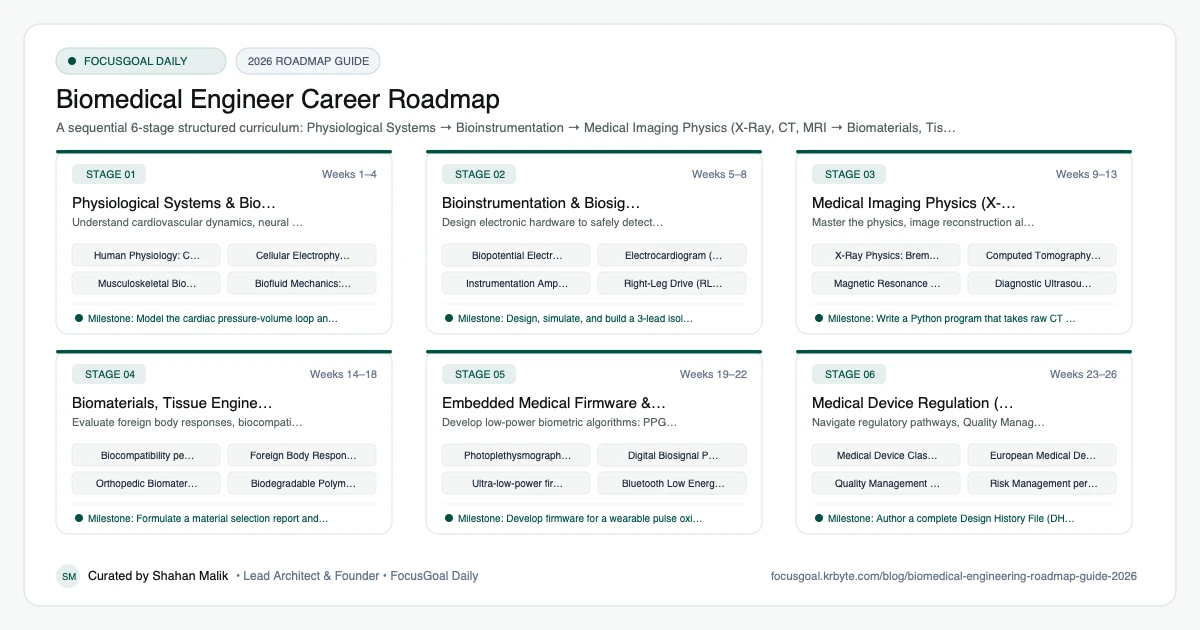
The 6 Production Stages
Follow these structured, sequential stages to systematically build production competence:
Physiological Systems & Biomechanics
Understand cardiovascular dynamics, neural action potentials, musculoskeletal mechanics, and biofluid flow.
Bioinstrumentation & Biosignal Acquisition
Design electronic hardware to safely detect microvolt-level biopotentials: ECG, EMG, and EEG.
Medical Imaging Physics (X-Ray, CT, MRI & Ultrasound)
Master the physics, image reconstruction algorithms, and DICOM processing of primary clinical imaging modalities.
Biomaterials, Tissue Engineering & Implants
Evaluate foreign body responses, biocompatibility, ceramic/polymer/metal implants, and surface modifications.
Embedded Medical Firmware & Wearables
Develop low-power biometric algorithms: PPG pulse oximetry, fall detection, and wireless BLE telemetry.
Medical Device Regulation (FDA 510(k), PMA & ISO 13485)
Navigate regulatory pathways, Quality Management Systems (QMS), and clinical risk management.
Is Biomedical Engineering a Good Career in 2026?
Biomedical engineering applies engineering to healthcare through medical devices, imaging, diagnostics, prosthetics, and health technology. Ageing populations and digital health keep the field relevant, and the work can be personally meaningful.
Honest caveats: it is a competitive field, and some graduates find that a more traditional engineering specialisation or a graduate degree opens more roles. Regulation makes development slow, and entry-level openings vary by region. Check local job listings and official labour statistics.
- Good fit if you want to combine engineering with biology and medicine.
- Many roles are in quality, regulatory, or clinical engineering.
- A master's degree or specialisation can help in some areas.
Software & Standards Biomedical Engineers Use
Biomedical engineers use general engineering tools plus regulatory and quality frameworks specific to healthcare. Learning how regulation shapes design is a real differentiator.
Signal and image processing skills are valuable across diagnostics and imaging roles.
- CAD and simulation: SolidWorks, ANSYS, COMSOL.
- Signal and image analysis: MATLAB, Python, ImageJ.
- Quality and regulation concepts: ISO 13485 for medical device quality systems and ISO 14971 for risk management.
- Regional regulators such as the US FDA and EU MDR frameworks.
- Lab skills: sensors, bioinstrumentation, and biomaterial testing.
Degrees, Licensing & How to Get Your First Biomedical Engineering Job
A bachelor's degree in biomedical or a related engineering field is the usual start, with a master's degree common for research and specialised design roles. PE licensure is uncommon in medical device work, although clinical engineering and some regional systems may have their own credentials. Requirements vary by country, so check your local body.
Internships at device manufacturers, hospitals, or research labs are valuable. Capstone design projects, documented prototypes with design controls, and familiarity with regulatory documents can set you apart.
- Seek internships in device companies, hospitals, or labs.
- Document projects with requirements, risk analysis, and test results.
- Learn basic regulatory vocabulary early.
- Check local clinical engineering credentials if relevant.
Beginner Pitfalls vs Production Reality
Self-taught developers commonly waste months making avoidable structural mistakes. Here is how production engineers approach these challenges:
Master Biomedical Engineering with FocusGoal Daily
Biomedical engineering demands a rigorous balance of clinical physiology, electronic instrumentation, and regulatory protocols. FocusGoal Daily breaks your preparation into disciplined daily targets.
- Daily micro-tasks for bioinstrumentation circuits, imaging formulas, and FDA regulatory standards.
- Maintain offline study streaks while in clinical observation wards or biology cleanrooms.
- AI concept tutor for immediate explanations of Nernst potentials, IEC 60601 isolation rules, and CT Radon transforms.
Track this roadmap,
one topic at a time.
Download FocusGoal, pick this roadmap and finish your first daily topic in minutes.
Frequently Asked Questions
Do biomedical engineers work in hospitals or technology companies?
Both. Clinical engineers work inside hospitals managing medical imaging fleets and patient monitors. Biomedical design engineers work in tech and medtech companies designing pacemakers, robotic surgery consoles, diagnostic sensors, and prosthetics.
What software should biomedical engineers learn?
MATLAB and Python are essential for biosignal and medical image analysis. SolidWorks is standard for orthopedics and mechanical enclosures, and KiCad/Altium is used for bioinstrumentation PCBs.
Is a medical degree required?
No. Biomedical engineers are fully engineers who collaborate closely with physicians, surgeons, and nurses to understand clinical needs and translate them into physical, verifiable devices.
What does a biomedical engineer do?
A biomedical engineer designs and improves technology for healthcare, such as medical devices, imaging systems, prosthetics, and diagnostic tools. Work often involves prototyping, testing, regulatory documentation, and collaboration with clinicians.
Is biomedical engineering hard?
It is demanding because you combine engineering with biology and physiology. Many students find the breadth tough but manageable with consistent study and hands-on lab work.
How long does it take to become a biomedical engineer?
A bachelor's degree typically takes around four years in many countries, and a master's degree adds more time for specialised roles. Timelines vary by country.
Biomedical vs mechanical engineering: which should I choose?
Choose biomedical if you want healthcare-focused coursework, and mechanical if you want broader job options with a possible biomedical specialisation. Both can lead into medical device work.
Do biomedical engineers need a license?
Typically not for medical device design, though rules vary by country and by role. Check your local licensing or professional body for specifics.
Start Your Biomedical Engineer Today
Follow structured daily goals, study 100% offline with local SQLite, and get on-demand AI guidance with FocusGoal Daily on Android.
Get FocusGoal Daily Free on Google Play