Sports Medicine Roadmap (2026): From Sideline Emergency Care to Full Athletic Recovery
Learn how to diagnose, treat, and rehabilitate athletic injuries. Master on-field acute triage, orthopedic diagnostic evaluations, concussion return-to-play protocols, therapeutic modalities, and biomechanical return-to-sport testing.

What's in this guide
The Short Answer: Sports Medicine in 2026
Sports medicine encompasses the clinical prevention, diagnosis, treatment, and rehabilitation of injuries sustained during athletic activity. Whether working as an athletic trainer, sports physical therapist, or team physician, sports medicine clinicians protect athlete health and safely restore functional performance.
In 2026, sports medicine practice is governed by objective criteria-based return-to-sport testing, force plate kinetic profiling, ultrasound-guided musculoskeletal imaging, and strict multimodal concussion evaluation protocols (SCAT6).
Return-to-play decisions must never be based on arbitrary calendar timelines. They must be guided by objective physical criteria: limb symmetry indices (LSI > 90%), validated psychological readiness surveys, and sport-specific reactive agility tests.
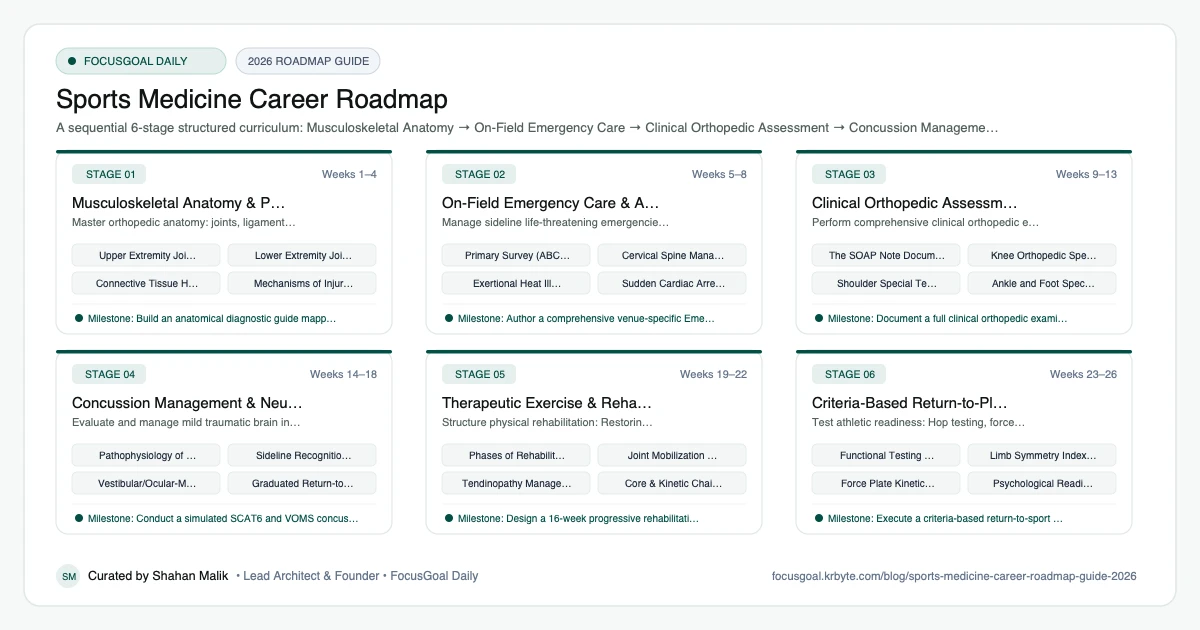
The 6 Production Stages
Follow these structured, sequential stages to systematically build production competence:
Musculoskeletal Anatomy & Pathomechanics
Master orthopedic anatomy: joints, ligaments, tendons, cartilage, and common mechanisms of athletic injury (MOI).
On-Field Emergency Care & Acute Injury Triage
Manage sideline life-threatening emergencies: Cervical spine stabilization, catastrophic bleeding, heat illness, and dislocation reductions.
Clinical Orthopedic Assessment & Special Tests
Perform comprehensive clinical orthopedic examinations: Palpation, Range of Motion (ROM), Manual Muscle Testing (MMT), and special tests.
Concussion Management & Neurocognitive Protocols (SCAT6)
Evaluate and manage mild traumatic brain injuries (TBI): SCAT6 sideline evaluation, VOMS screening, and graduated return-to-learn/play.
Therapeutic Exercise & Rehabilitation Progression
Structure physical rehabilitation: Restoring ROM, neuromuscular re-education, eccentric loading for tendinopathies, and kinetic chain integration.
Criteria-Based Return-to-Play & Re-Injury Prevention
Test athletic readiness: Hop testing, force plate jump asymmetries, reactive agility, and ACL injury prevention programs (FIFA 11+).
Is a Career in Sports Medicine Worth It in 2026?
Sports medicine covers the prevention, diagnosis, treatment, and rehabilitation of injuries and conditions related to exercise and sport. Careers exist for physicians, physiotherapists, athletic trainers, and related clinicians in clinics, hospitals, teams, schools, and military or occupational settings, and the field also serves everyday active people, not just elite athletes.
The honest caveats: training is long and demanding, working with teams can mean irregular hours and travel, and competition for roles with high-profile teams is strong. Pay varies significantly by profession and country. This article is general educational information, not medical advice. Scope of practice, titles, and credentials vary by country, so check your local regulator or professional body for what you are allowed to do and how to qualify.
- Good fit if you enjoy anatomy, problem-solving, and working with active people.
- Different professions within sports medicine have very different training routes.
- Most roles are clinical and based in regular healthcare settings rather than elite sport.
Skills, Tools & Resources You Will Use in Sports Medicine
Core knowledge includes musculoskeletal anatomy, biomechanics, exercise physiology, and the basics of injury mechanisms and healing. Clinical skills include history-taking, physical examination, and clinical reasoning, plus communication with athletes, coaches, and families about return-to-play decisions.
Typical tools and resources include diagnostic imaging such as ultrasound, X-ray, and MRI interpreted by qualified professionals, rehabilitation equipment, and position statements and guidelines from recognised professional bodies. Emergency response and first aid training are essential.
- Anatomy, biomechanics, and exercise physiology.
- Clinical examination and evidence-based rehabilitation protocols.
- Emergency care, first aid, and concussion management training.
- Guidelines from recognised sports medicine and medical bodies.
Qualifications, Licensing & How to Get Your First Sports Medicine Role
Sports medicine is not one single licensed profession. Doctors complete medical school, postgraduate training, and then often a sports medicine specialisation; physiotherapists and athletic trainers follow their own regulated degree and registration routes. Titles such as athletic trainer or physiotherapist are legally protected in many countries.
To build a path, gain clinical placements, volunteer with sports clubs or events under qualified supervision, and pursue relevant postgraduate study. This article is general educational information, not medical advice. Scope of practice, titles, and credentials vary by country, so check your local regulator or professional body for what you are allowed to do and how to qualify.
- Confirm registration and licensing rules with your national or state health regulator.
- Seek supervised placements and volunteer event-medical roles.
- Do not practise beyond your credentials, and refer when needed.
Beginner Pitfalls vs Production Reality
Self-taught developers commonly waste months making avoidable structural mistakes. Here is how production engineers approach these challenges:
Master Sports Medicine with FocusGoal Daily
Sports medicine requires retaining hundreds of orthopedic special tests, acute triage protocols, and progressive rehabilitation guidelines. FocusGoal Daily turns this clinical volume into disciplined daily milestones.
- Daily micro-tasks for orthopedic special tests, SCAT6 concussion protocols, and tissue healing stages.
- Track study streaks offline while working in training rooms, sideline tents, or physical therapy clinics.
- Instant AI explanations for Lachman test mechanics, VOMS vestibular screening, and LSI return-to-sport thresholds.
Track this roadmap,
one topic at a time.
Download FocusGoal, pick this roadmap and finish your first daily topic in minutes.
Frequently Asked Questions
What is the difference between an Athletic Trainer (ATC) and a Physical Therapist (PT)?
Athletic Trainers (ATCs) specialize in immediate on-field emergency triage, acute injury evaluation, and sideline coverage for sports teams. Physical Therapists (PTs) typically work in outpatient clinical settings focusing on comprehensive post-surgical and long-term musculoskeletal rehabilitation.
What is the PEACE & LOVE protocol?
PEACE & LOVE is the modern evidence-based replacement for RICE. Acute phase: Protect, Elevate, Avoid anti-inflammatories, Compress, Educate. Subacute phase: Load, Optimism, Vascularization, Exercise.
What is the Limb Symmetry Index (LSI)?
LSI is the percentage score comparing the injured limb against the uninjured healthy limb in strength or hop tests: (Injured Score / Uninjured Score) × 100. A score of ≥ 90% is commonly required for athletic clearance.
What does a sports medicine professional do?
They help prevent, diagnose, treat, and rehabilitate injuries and conditions related to sport and exercise. The exact role depends on the profession, such as physician, physiotherapist, or athletic trainer.
Is sports medicine hard to get into?
Yes, because the main routes involve regulated healthcare training that is demanding and competitive. Plan your path early and check entry requirements for your chosen profession.
How long does it take to work in sports medicine?
It depends on the profession: becoming a physician takes much longer than some other clinical routes. Check your local regulator and training providers for specific timelines.
Sports medicine vs physiotherapy: what is the difference?
Sports medicine is a broad field that includes physicians and other clinicians, while physiotherapy is a specific profession focused on movement and rehabilitation. They often collaborate on the same patients.
Do I need a license to work in sports medicine?
Yes, clinical roles generally require registration or licensing with a regulator, and protected titles are common. Requirements vary by country, so check locally.
Start Your Sports Medicine Today
Follow structured daily goals, study 100% offline with local SQLite, and get on-demand AI guidance with FocusGoal Daily on Android.
Get FocusGoal Daily Free on Google Play