Go Backend Developer Roadmap (2026): The Complete Systems Guide
Master Golang fundamentals, goroutines, channel synchronization, net/http microservices, gRPC protocol buffers, PostgreSQL, and cloud deployment for high-performance systems.

What's in this guide
The Short Answer: Why Go in 2026?
Go (Golang) has solidified its position as the lingua franca of cloud infrastructure, networking, and high-performance microservices. From Kubernetes and Docker to Terraform and Prometheus, the modern cloud is written in Go.
What makes Go exceptional is simplicity. By deliberately omitting complex inheritance hierarchies and complex macros, Go code is readable, compiles in seconds to a single static binary, and handles hundreds of thousands of concurrent network connections with minimal memory.
Just getting started? Read how to become a backend developer and which language to choose for the beginner-first plan.
Embrace Go's simplicity. Use the standard library, explicit error handling, and lightweight goroutines to build lightning-fast, maintainable cloud backends.
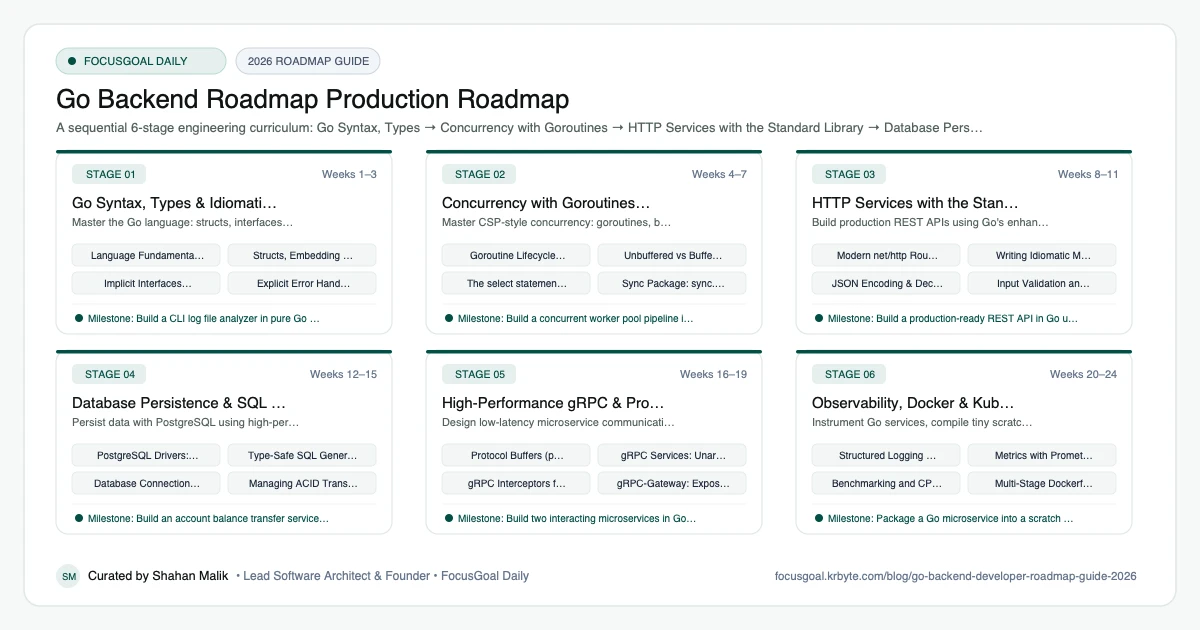
The 6 Production Stages
Follow these structured, sequential stages to systematically build production competence:
Go Syntax, Types & Idiomatic Patterns
Master the Go language: structs, interfaces, pointers, error values, and packages.
Concurrency with Goroutines & Channels
Master CSP-style concurrency: goroutines, buffered/unbuffered channels, select statements, and sync primitives.
HTTP Services with the Standard Library
Build production REST APIs using Go's enhanced net/http routing, middleware patterns, and JSON encoders.
Database Persistence & SQL Drivers (pgx)
Persist data with PostgreSQL using high-performance drivers (jackc/pgx) and type-safe query generators (sqlc).
High-Performance gRPC & Protocol Buffers
Design low-latency microservice communications using Protocol Buffers and gRPC streaming.
Observability, Docker & Kubernetes Deployment
Instrument Go services, compile tiny scratch Docker containers, and deploy to Kubernetes.
Is Go Backend Development Worth It in 2026?
Go is popular for cloud infrastructure, APIs, and command-line tools. Many well-known infrastructure projects are written in it, and its simple syntax, fast compilation, and built-in concurrency make it appealing for backend services.
The caveats: the job market is smaller than for Java or JavaScript, and many Go roles expect prior backend experience rather than hiring complete beginners. The language is intentionally minimal, so you will write more explicit code. Check current job listings in your region.
- Strong fit if you like simplicity and performance.
- Learning curve: the language is small; concurrency patterns take practice.
- Often used alongside Docker and Kubernetes work.
Go vs Node.js vs Java: Which to Learn First
Go is easier to learn than Java and offers stronger concurrency primitives than Node.js, but has a smaller ecosystem of jobs. If you are new, Node.js or Java may offer more entry roles; Go is a great second or focused choice, especially for infrastructure.
See the Node.js Developer Roadmap and Java Backend Developer Roadmap. Go skills also pair well with the DevOps Engineer Roadmap.
Go Backend Setup: Tools You Need
Install Go from the official site; the toolchain includes a formatter, test runner, and module system. Use VS Code with the Go extension or GoLand, plus Git, Docker, and a local PostgreSQL database.
Learn go test, go vet, and the race detector early. Check the official Go documentation for current versions.
- Go toolchain (gofmt, go test, go mod).
- VS Code with Go extension, or GoLand.
- PostgreSQL and Docker.
- An HTTP client for testing APIs.
Go Backend Portfolio Projects & How to Get a Job
Build services that show Go's strengths: a REST or gRPC API with PostgreSQL, a concurrent worker pool, and a CLI tool. Add tests, structured logging, and graceful shutdown to show production habits.
On your resume, highlight how you used goroutines and channels safely. Interviews often cover concurrency, interfaces, error handling, and API design, so practice explaining them.
- Project idea: a rate-limited API gateway.
- Project idea: a web crawler with a worker pool.
- Project idea: a CLI that talks to a cloud API.
- Containerize and document how to deploy.
Beginner Pitfalls vs Production Reality
Self-taught developers commonly waste months making avoidable structural mistakes. Here is how production engineers approach these challenges:
Master Go Cloud Engineering with FocusGoal Daily
Go's systems-level architecture requires disciplined habit building. FocusGoal Daily structures the entire Golang roadmap into achievable daily micro-actions.
- Curated curriculum from Go syntax and goroutines to sqlc and gRPC microservices.
- 100% offline study support powered by local SQLite database on Android.
- On-demand AI tutor to clarify channel synchronization, pointers, and pprof profiles.
- Daily streak tracking to maintain coding discipline every day.
Track this roadmap,
one topic at a time.
Download FocusGoal, pick this roadmap and finish your first daily topic in minutes.
Frequently Asked Questions
Why is Go so popular for backend and cloud systems?
Go compiles directly to standalone machine code with no external VM or runtime dependency, consumes minimal memory (~10–30MB), and starts in milliseconds.
Should I use a framework like Gin, Fiber, or the standard library?
Start with the standard library (net/http). Since Go 1.22 added routing enhancements, many production systems use only the standard library or lightweight routers like chi.
How long does it take to learn Go for backend development?
Because Go has only 25 keywords, most developers learn the language syntax in 2–3 weeks. Becoming proficient in concurrent patterns, channels, and microservices takes about 3 to 4 months.
How do I become a Go backend developer from scratch?
Learn Go syntax and its standard library, build HTTP APIs with a database, and then study concurrency and testing. Deploy small services to practice. A structured roadmap helps.
Is Go still worth learning in 2026?
Yes for cloud, infrastructure, and backend services, though the job market is smaller than for Java or JavaScript. Check local listings.
Go vs Node.js: which should I learn?
Choose Node.js if you know JavaScript; choose Go for performance and concurrency. See the Node.js Developer Roadmap.
Do I need a degree to become a Go developer?
No degree is strictly required, but many Go roles expect prior backend experience. Open-source or project work helps significantly.
How does FocusGoal Daily help Go developers?
FocusGoal Daily turns the Go cloud engineering syllabus into actionable daily learning checklists with offline streak tracking on Android.
Start Your Go Backend Roadmap Today
Follow structured daily goals, study 100% offline with local SQLite, and get on-demand AI guidance with FocusGoal Daily on Android.
Get FocusGoal Daily Free on Google Play