Cybersecurity Engineer Roadmap (2026): From Fundamentals to Defense & Penetration Testing
Build practical hands-on security skills in networking, Linux system hardening, threat detection (SIEM), penetration testing, and cloud defense without getting trapped in pure theory.

What's in this guide
The Short Answer: Cybersecurity in 2026
Cybersecurity has evolved from isolated firewall management into a core engineering discipline. With cloud-native architectures, automated adversary tooling, and sophisticated supply-chain attacks, security professionals must understand both how systems are built and how they are broken.
A common beginner mistake is purchasing multiple expensive certification vouchers without ever analyzing a raw packet capture in Wireshark or configuring a Linux firewall. True defensive and offensive capability comes from understanding the underlying protocol mechanics: how TCP handshakes operate, how memory is addressed, how authentication tokens are validated, and how lateral movement occurs in enterprise networks.
Just getting started? Read how to become a cybersecurity engineer step by step for the beginner-first plan.
Certifications open doors, but practical lab competence wins jobs. Build virtual labs, analyze real traffic, write automated Bash/Python security tools, and understand attack chains from start to finish.
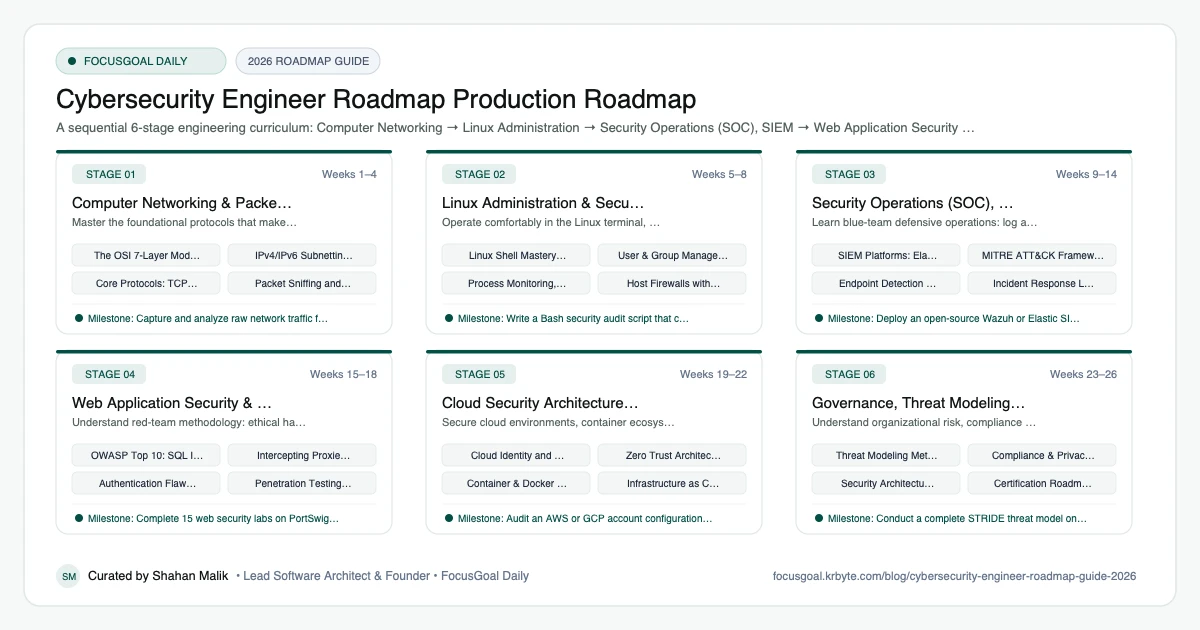
The 6 Production Stages
Follow these structured, sequential stages to systematically build production competence:
Computer Networking & Packet Analysis
Master the foundational protocols that make the internet work: OSI model, packet routing, DNS, and deep packet inspection.
Linux Administration & Security Hardening
Operate comfortably in the Linux terminal, configure access permissions, write security automation scripts, and harden system baselines.
Security Operations (SOC), SIEM & Incident Response
Learn blue-team defensive operations: log aggregation, correlation rules, incident response playbooks, and threat intelligence.
Web Application Security & Penetration Testing
Understand red-team methodology: ethical hacking, vulnerability identification, web exploits, and remediation reporting.
Cloud Security Architecture & Zero Trust
Secure cloud environments, container ecosystems, and modern identity perimeters.
Governance, Threat Modeling & Certifications
Understand organizational risk, compliance regulations, threat modeling, and industry certification paths.
Is Cybersecurity Worth It in 2026?
For people who enjoy investigating problems and thinking like an adversary, yes. Almost every organization that runs software, cloud services, or customer data needs people who can detect and respond to threats, and that need does not disappear when tools get smarter. Security also pairs well with other skills, so you can specialize in cloud, application, or network defense later.
The honest caveat is that true entry-level roles are competitive, and the job is often less like the movies than you expect: much of it is triage, documentation, and patience. Pay and hiring vary a lot by country and specialty, so check current local job listings and official sources instead of relying on one headline figure.
- Strong fit if you like puzzles, logs, and understanding how systems fail.
- Learning curve: networking, Linux, and scripting come first; tools come second.
- Many people enter through IT support, system administration, or software roles and move across.
Cybersecurity vs Networking vs DevOps: Which to Learn First
Security sits on top of other skills, so the right first step depends on your background. Networking fundamentals are the most useful foundation because most attacks and defenses are visible as traffic. If you cannot yet read a packet capture or explain DNS, start with the Network Administrator roadmap and return here.
DevOps and cloud skills matter if you want to secure modern infrastructure, since misconfiguration is a common root cause of incidents. See the DevOps Engineer roadmap when you are ready for pipelines and containers.
- Start with networking if you are new to IT.
- Start with security directly if you already know Linux and basic scripting.
- Add cloud and DevOps later to become useful on cloud-heavy security teams.
Cybersecurity Setup: Tools You Need
You do not need expensive hardware. A laptop with enough memory to run two or three virtual machines is enough for a home lab. Build it on VirtualBox, VMware, or Proxmox, and keep it isolated from your normal network so practice attacks never touch real systems.
Learn the tools in this order: a Linux distribution you are comfortable with, Wireshark for traffic, Nmap for discovery, a log search tool such as the Elastic stack or Splunk free tier, and Burp Suite Community for web testing. Only test systems you own or platforms that explicitly allow it.
- Virtualization software and a hardened lab network.
- Wireshark, Nmap, and a SIEM for logs.
- Python and Bash for automation and log parsing.
- A note-taking system for write-ups and runbooks.
Cybersecurity Portfolio Projects & How to Get a Job
Hiring managers want evidence that you can work methodically. Publish short write-ups of rooms or challenges you completed on legal training platforms, and document a home lab where you deployed a vulnerable service, attacked it, then detected and fixed the issue. Show your reasoning, not just the commands.
On your resume, lead with hands-on projects and any relevant certification, then describe results in plain terms. In interviews expect scenario questions such as how you would investigate a suspicious login, so practice explaining your process out loud.
- Build a SIEM lab that ingests logs and alerts on failed logins.
- Write a Python script that parses auth logs and flags brute-force patterns.
- Threat-model a small web app and publish the findings.
- Document an incident response runbook for a phishing report.
Beginner Pitfalls vs Production Reality
Self-taught developers commonly waste months making avoidable structural mistakes. Here is how production engineers approach these challenges:
Build Cyber Defense Discipline with FocusGoal Daily
Cybersecurity requires mastering diverse technical domains simultaneously. FocusGoal Daily structures this vast landscape into a clear, day-by-day learning habit.
- Step-by-step roadmap from networking basics to SOC analysis and penetration testing.
- 100% offline study support powered by local SQLite database on Android.
- In-app Ask AI tutor to clarify cryptographic ciphers, OSI layers, and attack mechanics.
- Streak tracking to keep your daily security learning consistent and structured.
Track this roadmap,
one topic at a time.
Download FocusGoal, pick this roadmap and finish your first daily topic in minutes.
Frequently Asked Questions
What is the best entry-level certification for cybersecurity?
CompTIA Security+ is the most universally recognized baseline certification for entry-level security analyst and IT security roles, fulfilling DoD 8570 baseline requirements.
Do I need to know how to code to work in cybersecurity?
Basic scripting in Python and Bash is essential for automation, log parsing, and understanding exploits. You do not need to be a full-stack software engineer, but reading code is critical.
Is it better to start in Blue Team (Defense) or Red Team (Offense)?
Starting in Blue Team (SOC Analyst, Security Operations) offers significantly more entry-level job openings. Learning defensive log analysis also makes you a much sharper ethical hacker later.
Is cybersecurity a good career in 2026?
Yes for people who like investigation and continuous learning, because organizations of almost every size need security skills. Entry-level competition is real, so hands-on labs and write-ups matter more than certificates alone.
Can I get into cybersecurity with no experience?
It is possible but usually takes a stepping stone such as IT support, a SOC analyst trainee role, or a junior sysadmin job. Build a home lab and document it so you have evidence to show.
How long does it take to learn cybersecurity?
It depends on your starting point and weekly time, but expect months of consistent study to reach entry-level readiness and years to specialize. Treat it as an ongoing skill rather than a finish line.
Which should I learn first: networking or cybersecurity?
Networking first. Understanding TCP/IP, DNS, and HTTP makes every security tool and concept easier to interpret.
What programming language is best for cybersecurity?
Python is the most practical starting point for automation and log analysis, with Bash for Linux tasks. Learn others such as JavaScript or C when your specialty needs them.
How does FocusGoal Daily help me prepare for cybersecurity careers?
FocusGoal Daily breaks the massive Security+ and practical cybersecurity curriculum into manageable daily learning checklists with offline progress tracking on Android.
Start Your Cybersecurity Engineer Roadmap Today
Follow structured daily goals, study 100% offline with local SQLite, and get on-demand AI guidance with FocusGoal Daily on Android.
Get FocusGoal Daily Free on Google Play