.NET Backend Developer Roadmap (2026): Modern C# & ASP.NET Core Guide
Master cross-platform .NET 9, modern C# 13, high-performance ASP.NET Core Minimal APIs, Entity Framework Core 9, Clean Architecture, and cloud microservices.

What's in this guide
The Short Answer: Modern .NET in 2026
Modern .NET is fully cross-platform, open-source, and one of the fastest web frameworks in the world according to TechEmpower benchmarks. The days of Windows-only .NET Framework are long gone; .NET runs natively on Linux, macOS, and Docker containers.
With C# 13 and ASP.NET Core Minimal APIs, boilerplate has been dramatically reduced. Developers get the speed of compiled C#, memory safety, and enterprise ecosystem maturity without legacy bloat.
Just getting started? Read how to become a backend developer and which language to choose for the beginner-first plan.
Modern .NET combines incredible raw performance with enterprise tooling. Master Minimal APIs, EF Core 9, and Clean Architecture to build enterprise cloud services.
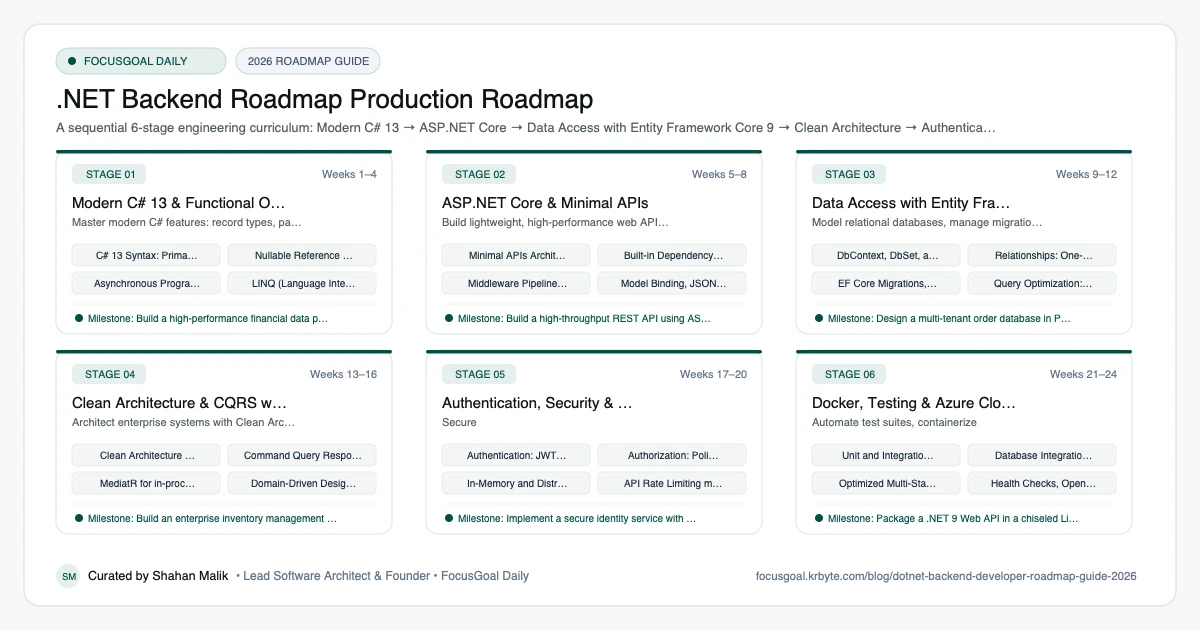
The 6 Production Stages
Follow these structured, sequential stages to systematically build production competence:
Modern C# 13 & Functional OOP
Master modern C# features: record types, pattern matching, nullable reference types, and async/await task mechanics.
ASP.NET Core & Minimal APIs
Build lightweight, high-performance web APIs with ASP.NET Core Minimal APIs and dependency injection.
Data Access with Entity Framework Core 9
Model relational databases, manage migrations, and optimize queries with EF Core 9 and PostgreSQL/SQL Server.
Clean Architecture & CQRS with MediatR
Architect enterprise systems with Clean Architecture: Domain, Application, Infrastructure, and Presentation layers.
Authentication, Security & Distributed Caching
Secure .NET APIs with ASP.NET Core Identity, JWT Bearer tokens, and Redis distributed caching.
Docker, Testing & Azure Cloud Deployment
Automate test suites, containerize .NET applications with Docker, and deploy to Azure App Service or Container Apps.
Is .NET Backend Development Worth It in 2026?
Modern .NET is cross-platform and open source, and ASP.NET Core is a well-regarded framework for web APIs. It is common in enterprises, especially organizations using Microsoft tooling and Azure, and C# is a mature, well-designed language.
The caveats: job concentration varies by region, and some roles expect familiarity with the Microsoft ecosystem, such as Azure and SQL Server. Older .NET Framework codebases also exist, so you may meet legacy code. Check current local job listings.
- Strong fit if you like a polished language and tooling.
- Learning curve: moderate; C# is approachable.
- Works on Windows, macOS, and Linux.
C#/.NET vs Java vs Node.js: Which to Learn First
C#/.NET and Java solve similar problems with similar patterns. Choose by your local market or target employers. Node.js is lighter and quicker for startups and JavaScript developers.
Compare with the Java Backend Developer Roadmap and the Node.js Developer Roadmap. Skills learned in one transfer well to the other.
Modern .NET Setup: Tools You Need
Install the current .NET SDK and an editor: Visual Studio, VS Code with the C# extension, or JetBrains Rider. Add Git, Docker, and a database such as PostgreSQL or SQL Server.
Use the dotnet CLI for creating projects, running tests, and publishing. Check Microsoft's official documentation for current versions.
- The .NET SDK and dotnet CLI.
- Visual Studio, VS Code, or Rider.
- SQL Server or PostgreSQL.
- Docker and Git.
Modern .NET Portfolio Projects & How to Get a Job
Build an ASP.NET Core API using Entity Framework Core, authentication, validation, and automated tests. Examples: an inventory system, a booking API, or a task platform with background services.
Document your architecture, and deploy via containers or a cloud platform. Interviews often cover C# features, async/await, LINQ, dependency injection, and SQL, so practice explaining them.
- Project idea: a multi-tenant API with role-based access.
- Project idea: a background worker processing queue messages.
- Include unit and integration tests.
- Show a CI pipeline.
Beginner Pitfalls vs Production Reality
Self-taught developers commonly waste months making avoidable structural mistakes. Here is how production engineers approach these challenges:
Master Modern .NET with FocusGoal Daily
Modern .NET is a powerhouse for enterprise backend engineering. FocusGoal Daily breaks down this extensive ecosystem into structured daily micro-goals.
- Complete curriculum from C# 13 and Minimal APIs to EF Core 9 and Clean Architecture.
- 100% offline study support powered by local SQLite database on Android.
- In-context Ask AI tutor for immediate explanations of MediatR, LINQ, and EF Core.
- Habit streak tracking to keep your coding habit consistent every single day.
Track this roadmap,
one topic at a time.
Download FocusGoal, pick this roadmap and finish your first daily topic in minutes.
Frequently Asked Questions
Is .NET cross-platform or Windows-only in 2026?
.NET is 100% cross-platform. It runs natively on Linux, macOS, and Docker, and is widely deployed on Linux cloud servers worldwide.
What is the difference between Minimal APIs and Controllers in ASP.NET Core?
Minimal APIs use lightweight lambda expressions and have significantly less startup overhead and ceremony than traditional Controllers, making them ideal for microservices.
Why is C# considered one of the most productive languages?
C# offers type safety, rich functional syntax (records, pattern matching), powerful IDE tooling, and performance that rivals C++ and Go on modern runtimes.
How do I become a .NET backend developer from scratch?
Learn C# fundamentals, then ASP.NET Core and Entity Framework with a database, plus testing. Build and deploy a couple of projects. A structured roadmap keeps your learning ordered.
Is .NET still worth learning in 2026?
Yes. Modern .NET is actively developed and cross-platform, with strong use in enterprises. Check job listings in your region.
C# vs Java: which should I learn?
They are very similar; choose by local employers. See the Java Backend Developer Roadmap to compare.
Do I need a degree or certification to become a .NET developer?
No certification is required, and degree requirements vary. Portfolio projects matter, though Microsoft certifications can help in some Azure-focused roles.
How does FocusGoal Daily help .NET developers?
FocusGoal Daily turns the sprawling .NET and C# documentation into actionable daily learning milestones with offline streak tracking on Android.
Start Your .NET Backend Roadmap Today
Follow structured daily goals, study 100% offline with local SQLite, and get on-demand AI guidance with FocusGoal Daily on Android.
Get FocusGoal Daily Free on Google Play