DevOps & Cloud Engineer Roadmap (2026): The Complete Production Guide
Master Linux internals, Docker containers, Kubernetes orchestration, Terraform Infrastructure as Code, and automated CI/CD pipelines to build scalable, reliable cloud systems.

What's in this guide
The Short Answer: DevOps in 2026
DevOps has transitioned from an experimental buzzword into the operational backbone of modern tech companies. In 2026, software delivery is defined by immutable infrastructure, declarative deployments, automated testing, and zero-downtime release pipelines.
Many aspiring DevOps engineers make the mistake of jumping straight into complex Kubernetes clusters before understanding Linux file systems, process signals, or networking subnets. When an ingress controller fails or a pod crashes with OOMKilled, tools alone won't save you—system understanding will.
Just getting started? Read how to become a DevOps engineer or a cloud engineer for the beginner-first plan.
Master the foundations before the orchestration. A solid foundation in Linux, Bash scripting, and Docker container mechanics makes learning Kubernetes and Terraform 10x faster.
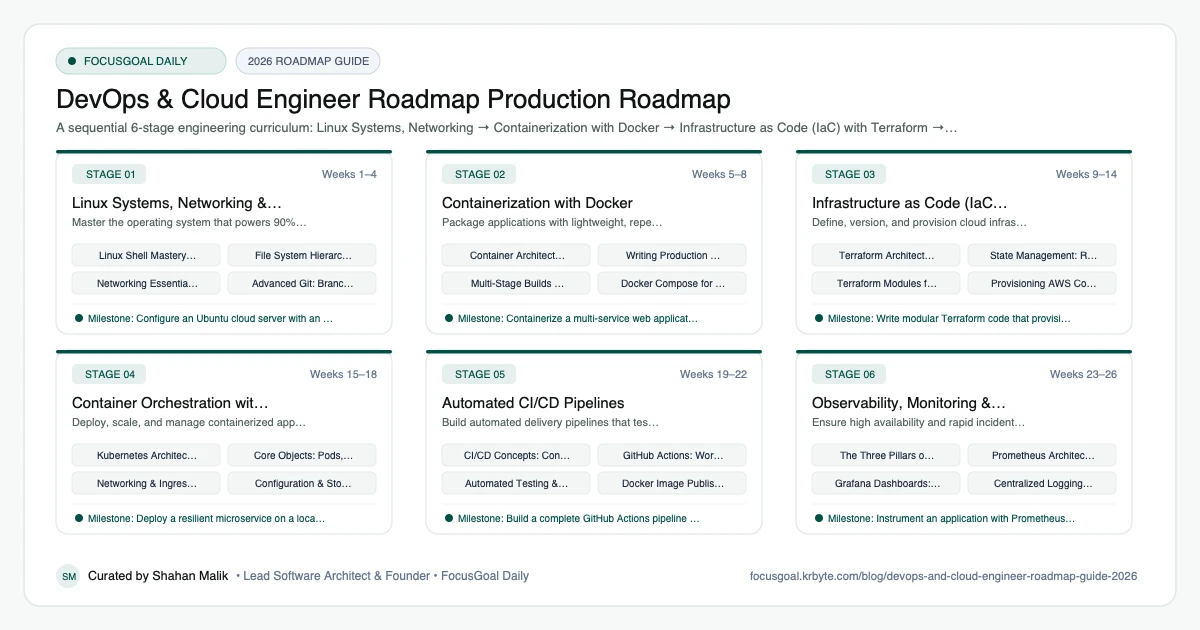
The 6 Production Stages
Follow these structured, sequential stages to systematically build production competence:
Linux Systems, Networking & Git Workflows
Master the operating system that powers 90% of the world's cloud infrastructure and version control workflows.
Containerization with Docker
Package applications with lightweight, repeatable container environments and master multi-stage builds.
Infrastructure as Code (IaC) with Terraform
Define, version, and provision cloud infrastructure programmatically using declarative HashiCorp Configuration Language (HCL).
Container Orchestration with Kubernetes
Deploy, scale, and manage containerized applications in production with industry-standard Kubernetes (K8s).
Automated CI/CD Pipelines
Build automated delivery pipelines that test, build, lint, and deploy software reliably on every Git commit.
Observability, Monitoring & SRE Practices
Ensure high availability and rapid incident resolution through telemetry, metrics, distributed tracing, and structured alerting.
Is a Combined DevOps and Cloud Career Worth It in 2026?
Many job postings ask for both skill sets, which is why this roadmap combines them. Learning them together gives you a practical edge for small and mid-sized teams, where one person often handles pipelines and the infrastructure underneath. It is a reasonable starting point if you want a broad infrastructure career.
The caveat is breadth: you will be learning many tools, and depth comes with experience. Beginners should not expect to master everything at once. Check current local job listings to see how employers in your area describe the role.
- Good fit if you like both building and operating systems.
- Expect to learn gradually; pick one tool per category.
- Titles vary: cloud engineer, DevOps engineer, platform engineer.
DevOps vs Cloud Engineering: How the Roles Differ and Where to Start
Cloud engineering is about the infrastructure itself: networks, compute, storage, identity, and cost on a provider. DevOps is about the process that moves code to that infrastructure safely: version control, automated tests, pipelines, and monitoring. They overlap in infrastructure as code.
If you are a beginner, start with Linux, Git, and one cloud provider's basics, then add a simple CI pipeline. For deeper dives, read the DevOps Engineer roadmap for CI/CD, containers, and Kubernetes, and the Cloud Computing roadmap for architecture and certification paths.
- Cloud: where things run and how they are secured and priced.
- DevOps: how changes get tested, released, and observed.
- Shared ground: Linux, Git, networking, and Terraform-style tooling.
Beginner Setup: Tools You Need
Begin with a laptop, a Linux shell, Git, and a code editor. Create a free account with one cloud provider, set a billing alert immediately, and install its command-line tool. Add Docker once you are comfortable with the shell.
Resist the urge to install everything. A minimal path is Linux, Git, one cloud provider, Docker, a CI service, and Terraform. Add Kubernetes and monitoring after you can deploy a simple application end to end.
- Linux shell and Git.
- One cloud account with budget alerts.
- Docker, then a hosted CI service.
- Terraform once you can create resources manually.
Portfolio Projects & How to Get a DevOps or Cloud Job
A strong beginner project ties both halves together: a small web app, containerized, tested by a pipeline, and deployed to cloud infrastructure defined as code. Add basic monitoring and write down how to tear it down.
Keep your repository clean, with a README that explains the architecture and decisions. In interviews, be ready to explain a deployment failure you hit and how you fixed it; honest troubleshooting stories are persuasive for entry-level roles.
- Deploy a containerized app to a managed cloud service.
- Automate infrastructure and deploys with Terraform and CI.
- Add logs, metrics, and an alert you can demonstrate.
- Document costs and cleanup steps.
Beginner Pitfalls vs Production Reality
Self-taught developers commonly waste months making avoidable structural mistakes. Here is how production engineers approach these challenges:
Master Cloud & DevOps Discipline with FocusGoal Daily
DevOps spans hundreds of tools and practices. FocusGoal Daily keeps you focused by structuring the entire cloud engineering roadmap into actionable daily milestones.
- Structured learning path from Linux and Docker to Kubernetes, Terraform, and CI/CD.
- 100% offline study tracking powered by local SQLite database on Android.
- On-demand Ask AI tutor to clarify Kubernetes manifests, Terraform HCL syntax, and Bash commands.
- Habit streak tracking to ensure daily progress without overwhelming cognitive load.
Track this roadmap,
one topic at a time.
Download FocusGoal, pick this roadmap and finish your first daily topic in minutes.
Frequently Asked Questions
Which cloud provider should I learn first: AWS, Azure, or GCP?
AWS is recommended for most beginners due to its dominant market share (~32%) and extensive ecosystem of jobs, tutorials, and community tooling.
Do I need to be a software developer to become a DevOps engineer?
While you don't need to write complex frontend or mobile applications, you do need intermediate scripting ability in Python or Go, alongside strong Bash skills.
What is the difference between Docker and Kubernetes?
Docker is a tool to create, package, and run individual containers on a single host. Kubernetes is an orchestrator that manages, scales, and coordinates thousands of Docker containers across multiple servers.
What is the difference between DevOps and cloud engineering?
Cloud engineering focuses on designing and running infrastructure on a provider, while DevOps focuses on the automated process that builds, tests, and ships software. Many roles blend both.
Should I learn DevOps or cloud first?
Start with Linux, Git, and one cloud provider's basics, then add CI/CD. You need somewhere to deploy before pipelines make sense.
Can a beginner become a DevOps and cloud engineer?
Yes, though it commonly takes a stepping-stone role and a few demonstrable projects. Build a full pipeline-to-cloud project to show your skills.
Do I need certifications for DevOps and cloud jobs?
They are not always required, but a fundamentals or associate certification can help structure learning and get interviews. Projects and troubleshooting ability still carry heavy weight.
How do I choose between AWS, Azure, and GCP as a beginner?
Choose the provider that appears most in job listings where you want to work. The concepts carry over to the others.
How does FocusGoal Daily help me learn DevOps?
FocusGoal Daily turns the sprawling DevOps ecosystem into a structured daily curriculum, helping you track your study progress and test your knowledge offline on Android.
Start Your DevOps & Cloud Engineer Roadmap Today
Follow structured daily goals, study 100% offline with local SQLite, and get on-demand AI guidance with FocusGoal Daily on Android.
Get FocusGoal Daily Free on Google Play